
Sign In to Your Account
Subscribers have complete access to the archive.
Sign In Not a Subscriber?Join NowContract, and the Culbertson system
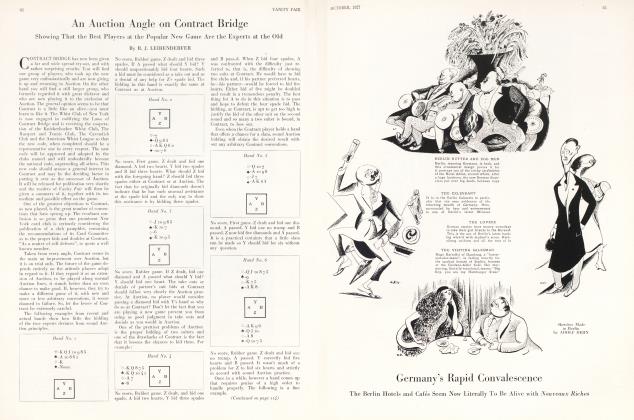
R. J. LEIBENDERFER
The third of a series of articles on this system written with the collaboration of Ely Culbertson
■ As we explained in the last article, Scientific Contract is virtually impossible without the Approach principle and its corollary, the Forcing bids—particularly after any one of a series of Opening bids of one.
It must be borne in mind that the most radical and original features of the Forcing Take-out is that the Jump does not necessarily show great length or strength in the bid suit, but merSly game (or Slam) strength in the hand. Partner therefore must assume a minimum trump suit and support or deny accordingly.
Partner's (Opening bidder's) precise choices of a response will depend on the nature of his hand.
First choice: If able, show another biddable suit.
Second choice: Rebid, over trump suit, if it is a strong five-card or a fair six-card suit.
Third choice: Support partner's Jump suit only if holding at least Q 3 2 or four small trumps. If holding more than the value of one Raise (after deducting the Opening bid values) jump the full amount of Raises.
Fourth choice: Jump the no trump response, if holding at least 3½ honor tricks.
Fifth choice: Lacking any trick values other than those already shown in the Opening bid, respond with the required number of no trumps. This constitutes a minimum response, denying additional support and merely repeating the Opening bid.
Mr. Culbertson is emphatically opposed to the largely prevailing practice of advocating two systems of Contract—one for the expert and the other for the average player. He claims that all hope of improvement must be abandoned when a player is taught a specially prepared set of superficial and incomplete "rules" on the grounds that the proper methods—and the winning ones—are too difficult to grasp and must be reserved for advanced players.
He is of the opinion that these methods, as commonly used by master players, far from being complicated, are essentially simple because they must obey the logic of bidding and playing situations. It is for this reason that the Forcing System is based on natural inferences and avoids far-fetched conventions, or unnecessary complications. It can be successfully employed not only by experts but by average players as well, regardless of the systems used, either by one's partner or by the opponents.
11 And now, for the rest of this article, I
must confine myself to the question of bridge psychology. According to Mr. Culbertson, psychology can be reduced, in contract, to more or less practical methods so that even "psychic" or surprise bids can be judged by certain set standards. This should be a matter of satisfaction to the bridge fans of the country for, to most of them, the so-called psychic bid is still a mystery and, like most mysteries, is as much feared as it is misunderstood. Bridge psychology is the invisible Rule X— more important than all the other rules of Contract put together—for it more or less influences partner's and opponents' mental reactions as to all bidding and playing situations. It operates first, with respect to partnership psychology.
In estimating the real meaning of any bid or play made by partner three psychological factors must be kept in mind:
1. Partner's degree of technical knowledge.
2. Partner's level of natural intelligence.
3. Partner's temperament and morale.
All bids and plays will be largely influenced by these three factors and each factor in turn plays a greater or lesser role according to the individual. Therefore,, in preparing to make a bid or a play one must keep partner's possible mental reactions in mind and, in trying to determine the precise meaning of partner's own bids or plays, one must again readjust the scale of bids on the basis of his mental reactions.
In other words it is not so much what partner should do as what partner can and will do. The reason is that temperaments, skill and intelligence vary. A bridge partner can be catalogued and his reactions foreseen.
It is often said that the true measure of a good player is his ability to play bad hands. It requires a far greater skill and knowledge to play with bad partners than to play with bad hands.
Adaptability is a basic law of the survival of the fittest in Bridge and no player, however perfect technically, can claim to be an expert or indeed be a winning player, unless he learns how to play with bad partners as well as he can with bad cards. Players who bemoan bad partners are certainly less justified than those who bemoan bad cards. Partners (and opponents) can be largely controlled and guided by superior skill.
A partner's morale or emotional state is as important for allies at the Bridge table as for an army in battle. This question of morale is automatically solved for those who realize that partnership is simply a sporting proposition ; we are drawn together for better or worse and should stand together cheerfully.
The so-called psychic bids are here to stay and the players of the country might just as well realize the fact and adapt their game accordingly.
As in war, surprise is the essential factor in psychological tactics against opponents. The bid (or sometimes the absence of a bid) which misinforms the enemy and leads him to make a wrong assumption is a surprise bid. Under this general heading there are grouped many different kinds of surprise bids, variously known as bluff, camouflage, or psychic bids. Surprise tactics are perfectly ethical and are sanctioned among the best players provided no private understanding of any kind exists between partners. Mr. Culbertson has always Cbjected to the so-called fake bids which consist of bidding a suit of which the bidder is void, or holds but a singleton, in the hope of confusing the opponents. This objection is voiced not on the grounds of ethics but on the grounds of stupidity. For instance, a fake bid of one spade with a hand such as
is perfectly ethical but also a little moronic.
■ The art of the unexpected in Contract turns around this point: Make the enemy accept a wrong set of facts instead of the right set of facts. Furnish him with wrong premises and then allow him to draw perfectly logical conclusions. The result, if successful, will be surprise, confusion, consternation. This baiting of wrong premises is possible because the opponents are naturally "listening in" on the line of communications between partners. According to Mr. Culbertson, the tactical structure of surprise bids rests upon three essential requirements:
1. The possibility that partner—who is also misled—might interfere, must always be carefully weighed. The advantage of surprising the opponents must outweigh the disadvantage of misleading the partner. Only such bidding situations should be chosen for psychic bids where partner's possible interference can do no harm or where subsequent bidding would give a clearer cue. 2. The player must, as a rule, have in reserve an escape bid of sufficient strength to carry the bidding higher without risking a severe penalty. This escape bid, which usually consists of a long and fairly powerful suit, offers a safe retreat not only against opponents but against partner's possible interference. Without elements of such real strength in the hand any surprise bid is a bomb charged with sawdust.
(Continued on page 74)
(Continued from page 59)
3. In passing for a "swing," or in making an aggressive bid in one suit in order to conceal strength elsewhere the player must be reasonably certain that the bidding will be kept open either by opponents or partner.
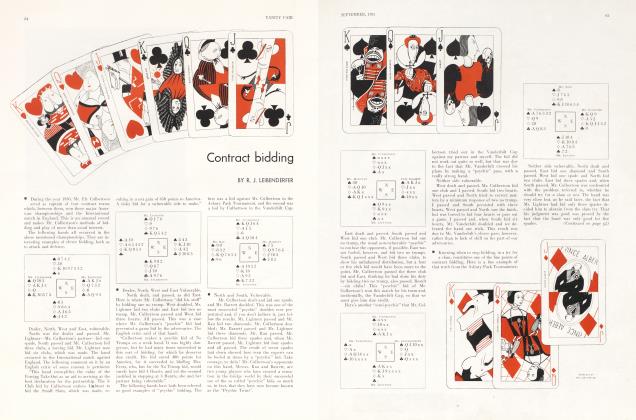
The following illustrations are interesting:
Your partner (not vulnerable) deals and passes, second hand bids one spade. How would you bid the foregoing hand on the basis of a surprise attack? This hand offers the ideal situation for a bluff no trump bid. It is reasonable to assume that the bidding will continue but should all pass, the hand is played at one no trump undoubled, not vulnerable, and no serious harm can result. If, as expected, partner of the spade bidder raises the bid and perchance partner of the bluff no-trump bidder also bids, the powerful diamond suit offers a safe escape or way out.
It cannot be repeated too often that, unless a player has a safe escape, attempts to surprise the opponents by camouflage bidding will, as a rule, end in disaster.
Here is another example:
Your partner deals and passes (not vulnerable) ; second hand bids one heart. There are two choices now available for the surprise bidder of the foregoing hand, either the one spade or one no trump. The actual bidding was a subtle combination of both. One spade wae bid and doubled. Two passes and our hero bid one no trump, which was also doubled. He now bid two spades, a really subtle variation of the usual type of psychics. When this was doubled, he switched to three clubs and this, of course, was also doubled. The disguised escape suit was thus brought into play at a point when the opponents couldn't recognize it as such. All passed and four odd in clubs was made. The opponents could just as easily have made four odd in either hearts or spades, but our surprise bidder had confused the issue just enough to keep them from arriving at their best bid.
The defenses to these psychic bids are more or less hard to define, but there are a few bidding situations where the risk of a psychic bid by the opponents might be justified, and bids made under such conditions should be carefully scrutinized with that possibility in mind. The following situations all offer such a possibility:
1. When the opponents are not vulnerable and one of them passes. This situation is most commonly used for psychic bids, or doubles, for the reason that it offers the maximum of safety. Justifiable surprise bids by the player who is vulnerable are rare. If partner has not passed, the danger of deceiving him is too great to warrant the risk of a surprise bid.
2. When an opponent overcalls partner's bid suit with one no-trump and subsequently bids a suit. Here his failure to double is significant.
3. When an opponent strongly bids up his suit after a previous one.
In conclusion, the situations which logically justify the making of a psy-' chic bid are relatively few and can be clearly marked. The psychic or camouflage bids which can pass through the meshes of fine partnership bidding are fewer still. Perhaps the main value of surprise tactics lies in creating a feeling of uncertainty in the minds of opponents and in hampering the natural development of their bidding.
Subscribers have complete access to the archive.
Sign In Not a Subscriber?Join Now
