




Sign In to Your Account
Subscribers have complete access to the archive.
Sign In Not a Subscriber?Join NowWinter sporting
JOHN R. TUNIS
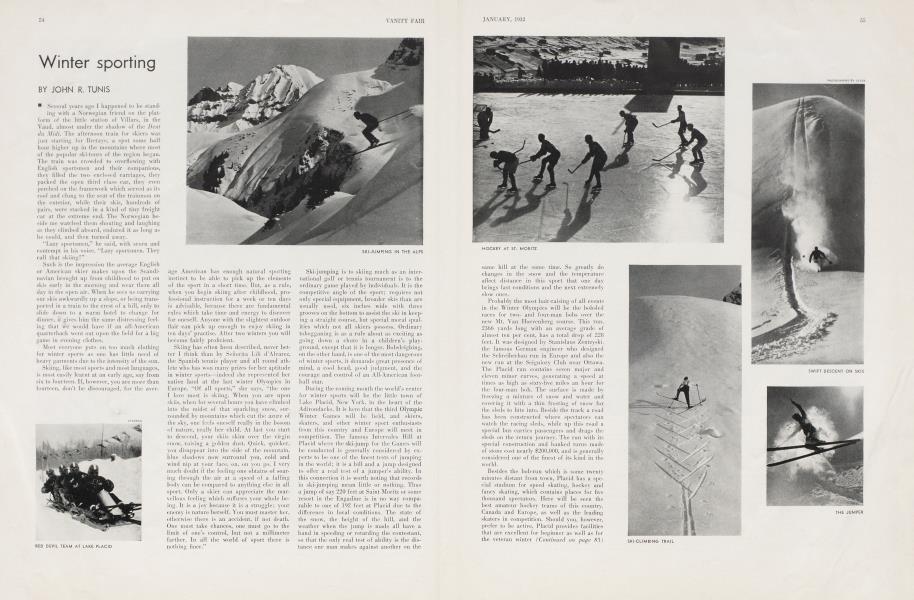
Several years ago I happened to be standing with a Norwegian friend on the platform of the little station of Villars, in the Vaud, almost under the shadow of the Dent du Midi. The afternoon train for skiers was just starting for Bretaye, a spot some half hour higher up in the mountains where most of the popular ski-tours of the region began. The train was crowded to overflowing with English sportsmen and their companions, they filled the two enclosed carriages, they packed the open third class car, they even perched on the framework which served as its roof and clung to the seat of the trainman on the exterior, while their skis, hundreds of pairs, were stacked in a kind of tiny freight car at the extreme end. The Norwegian beside me watched them shouting and laughing as they climbed aboard, endured it as long as he could, and then turned away.
"Lazy sportsmen," he said, with scorn and contempt in his voice. "Lazy sportsmen. They call that skiing!"
Such is the impression the average English or American skier makes upon the Scandinavian brought up from childhood to put on skis early in the morning and wear them all day in the open air. When he sees us carrying our skis awkwardly up a slope, or being transported in a train to the crest of a hill, only to slide down to a warm hotel to change for dinner, it gives him the same distressing feeling that we would have if an all-American quarterback went out upon the field for a big game in evening clothes.
Most everyone puts on too much clothing for winter sports as one has little need of heavy garments due to the intensity of the sun.
Skiing, like most sports and most languages, is most easily learnt at an early age, say from six to fourteen. If, however, you are more than fourteen, don't be discouraged, for the average American has enough natural sporting instinct to be able to pick up the elements of the sport in a short time. But, as a rule, when you begin skiing after childhood, professional instruction for a week or ten days is advisable, because there are fundamental rules which take time and energy to discover for oneself. Anyone with the slightest outdoor flair can pick up enough to enjoy skiing in ten days' practise. After two winters you will become fairly proficient.
Skiing has often been described, never better I think than by Señorita Lili d'Alvarez, the Spanish tennis player and all round athlete who has won many prizes for her aptitude in winter sports—indeed she represented her native land at the last winter Olympics in Europe. "Of all sports," she says, "the one I love most is skiing. When you are upon skiis, when for several hours you have climbed into the midst of that sparkling snow, surrounded by mountains which cut the azure of the sky, one feels oneself really in the bosom of nature, really her child. At last you start to descend, your skiis skim over the virgin snow, raising a golden dust. Quick, quicker, you disappear into the side of the mountain, blue shadows now surround you, cold and wind nip at your face, on, on you go. I very much doubt if the feeling one obtains of soaring through the air at a speed of a falling body can be compared to anything else in all sport. Only a skier can appreciate the marvellous feeling which suffuses your whole being. It is a joy because it is a struggle; your enemy is nature herself. You must master her, otherwise there is an accident, if not death. One must take chances, one must go to the limit of one's control, but not a millimeter farther. In all the world of sport there is nothing finer."
Ski-jumping is to skiing much as an international golf or tennis tournament is to the ordinary game played by individuals. It is the competitive angle of the sport; requires not only special equipment, broader skis than are usually used, six inches wide with three grooves on the bottom to assist the ski in keeping a straight course, but special moral qualities which not all skiers possess. Ordinary tobogganing is as a rule about as exciting as going down a chute in a children's playground, except that it is longer. Bobsleighing, on the other hand, is one of the most dangerous of winter sports, it demands great presence of mind, a cool head, good judgment, and the courage and control of an All-American football star.
During the coming month the world's center for winter sports will be the little town of Lake Placid, New York, in the heart of the Adirondacks. It is here that the third Olympic Winter Games will be held, and skiers, skaters, and other winter sport enthusiasts from this country and Europe will meet in competition. The famous Intervales Hill at Placid where the ski-jump for the Games will be conducted is generally considered by experts to be one of the finest tests of jumping in the world; it is a hill and a jump designed to offer a real test of a jumper's ability. In this connection it is worth noting that records in ski-jumping mean little or nothing. Thus a jump of say 220 feet at Saint Moritz or some resort in the Engadine is in no way comparable to one of 192 feet at Placid due to the difference in local conditions. The state of the snow, the height of the hill, and the weather when the jump is made all have a hand in speeding or retarding the contestant, so that the only real test of ability is the distance one man makes against another on the same hill at the same time. So greatly do changes in the snow and the temperature affect distance in this sport that one day brings fast conditions and the next extremely slow ones.
Probably the most hair-raising of all events in the Winter Olympics will be the bobsled races for twoand four-man bobs over the new Mt. Van Hoevenberg course. This run, 2366 yards long with an average grade of almost ten per cent, has a total drop of 228 feet. It was designed by Stanislaus Zentzyski, the famous German engineer who designed the Schreiberhau run in Europe and also the new run at the Seigniory Club near Ottawa. The Placid run contains seven major and eleven minor curves, generating a speed at times as high as sixty-five miles an hour for the four-man bob. The surface is made by freezing a mixture of snow and water and covering it with a thin frosting of snow for the sleds to bite into. Beside the track a road has been constructed where spectators can watch the racing sleds, while up this road a special bus carries passengers and drags the sleds on the return journey. The run with its special construction and banked turns made of stone cost nearly $200,000, and is generally considered one of the finest of its kind in the world.
Besides the bob-run which is some twenty minutes distant from town, Placid has a special stadium for speed skating, hockey and fancy skating, which contains places for five thousand spectators. Here will be seen the best amateur hockey teams of this country, Canada and Europe, as well as the leading skaters in competition. Should you, however, prefer to he active, Placid provides facilities that are excellent for beginner as well as for the veteran winter sport enthusiast. The terrain is good, the snow conditions of the best, and jumping hills are suitable for all kinds of skiers, while there is really good instruction obtainable for those at every stage of proficiency.
(Continued on page 83)
(Continued from page 55)
Incidentally Americans seem to be taking to winter sports with extraordinary rapidity, and among the expert jumpers and skiers one finds many young college boys who, aided only by natural athletic ability, courage and determination, have finally reached the top. With the result that today the list of prize winners at Lake Placid and elsewhere is coming to contain more and more American names. Six or seven years ago only Norwegians and Swedes were reaching the top rank; names like Sorensen, Olsen, and Johannsen dominated the field, but nowadays Americans and Canadians are taking their share of first places in the winter sport competitions. In some events, they carry off the majority of the trophies in all local competitions.
Lake Placid is of course only one of many resorts in the northern part of this hemisphere where from December to March the snow offers opportunity for winter sports under perfect conditions. More cosmopolitan resorts are to be found in Canada, at Quebec and Montreal, and at smaller centers such as Lucerne-in-Quebec, on the Ottawa River, 45 miles from the capital. At the Chateau Frontenac in Quebec one finds the best of winter sports in the heart of an intensely interesting old world town, and the management of the Chateau has made arrangements whereby hotel guests are accorded members' privileges in the famous "Quebec Winter Club," whose buildings are on Laurier Avenue, not far from the Château. Here besides the usual diversions one has an indoor skating rink, as well as facilities for squash, badminton and a swimming pool.
At the Chateau Frontenac you will find an outdoor winter sport that exists in no other snow bound spot on earth; badminton on skates. And a most amusing and entertaining game it is, too. Tobogganing on the triplechute slide which extends along the entire length of the famous Dufferin Terrace is also a popular sport in this old town which may justly be called the pioneer of winter sports resorts on the North American continent. Today they extend in a line all along the northern border between the two countries, as far west as the Ahwahnee in the Yosemite, and the Tahoe Tavern in California. In future days they will probably speak of Caux as the Quebec of Switzerland, and Davos as the Lake Placid of Europe.
Subscribers have complete access to the archive.
Sign In Not a Subscriber?Join Now

