Sign In to Your Account
Subscribers have complete access to the archive.
Sign In Not a Subscriber?Join NowTHE EDTOR'S UNEASY CHAIR
Vast encyclopaedia
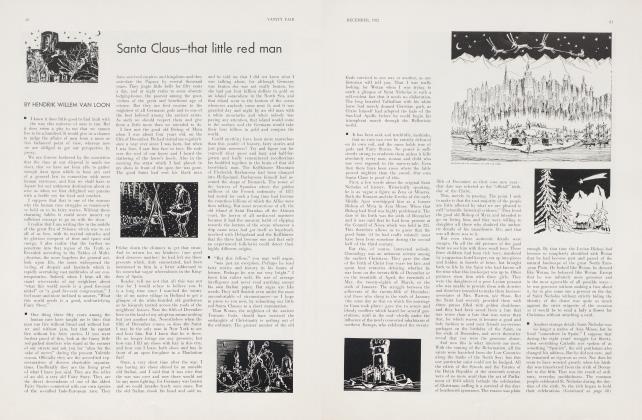
Hendrik Willem van Loon author of That Little Red Man on page 30—celebrated his fiftieth birthday by bringing out ids fifteenth book and his twenty-seventh and twenty-eighth translations, these being a Norwegian edition of his Rembrandt and a version in Urdu of his Story of Mankind.
From his ninth year on, when he began a Universal Encyclopaedia of all Historic Knowledge (a work soon discontinued on account of the high expense of paper to some one haring a weekly stipend of the equivalent of two American cents), until October of this year when to his great surprise lie suddenly made the American public "geography conscious", lie lias devoted most of ills waking hours and many of those during which he should have been asleep to tile study and popularization of history. The "humanization" of history would express it better than the "popularization", for his books have never consciously tried to be "popular" in the usual sense of the word. If they have become so in almost every part of the globe (Russia included, where however Karl Marx was substituted for Jesus Christ) it has been in spite of himself.
He is one of the very few liberals left over from the ravages of the Great Suicide of the Human Race (vulgo, the war of 1914-1918) and equally far removed from the Utopias of Hoover and Stalin. He does not go quite as far as Spongier, who sees western civilization completely and absolutely doomed. He agrees with Spongier that the older generation, with its hopeless blunders, is bound to rush our whole cultural fabric to merry annihilation. Rut lie knows that the old men responsible for the present muddle are rapidly going to their just reward, and he lias a vague hope that just perhaps and maybe he will be able to do something with those who are now from one to twenty-one years of age. Meanwhile lie will take $3.97 in actual cash for that pious hope. But are there any bidders?
Delete: Doug Fairbanks, Jr.
Dear Sir: When I glance through a copy of one of the many motion picture magazines which my hairdresser provides for my delectation. I expect to find an occasional editorial lapse. Several years' close acquaintance with Vanity Fair has led me to expect a considerably higher editorial standard. I am consequently at a loss to account for your forbearance in the
case of your actor-author, Douglas Fairbanks, Jr. If his publicity value and the interest of his subjects make him an indispensable contributor, wouldn't it be possible for someone on your editorial staff to correct Ills themes? You might be able to instill into him, at least, a proper reverence for the dictionary.
"Nebulous" is classified by all my dictionaries as an adjective, yet Mr. Fairbanks speaks of the "esoteric nebulous of tragedy that seems to fill" Ramon Navarro. "Catholic" is defined as meaning "universal; free from prejudice; including all mankind". None of these definitions seems to justify Mr. Fairbanks' use of the word: "the fundamental emotions so catholic to those of ills race". "Catholic to" sounds strangely wrong to me. also, though I cannot prove that it is. Did lie by any chance mean "common to those of his race", and discard so ordinary an expression (yet one possessed, withal, of a pleasing lucidity !) as beneath his literary dignity? "Peruse" in the sense of "examine" or "survey" is said by Webster to be obsolete, yet Ronald Column is described as "perusing the secrets of the old West"—after going "reverently and delicately" into Arizona. 1 should love to see him going delicately into Arizona !
I believe one dictionary does admit that "permeate" may be used intransitively; but in its usual sense I have observed that it is always transitive to standard writers. Rut net to Mr. Fairbanks! He declares that "there permeates about the house an atmosphere of . . . not too pure respectability".
Certainly the young man is a passionate lover of "language", and can crowd more uncongenial words Into close proximity than any other author I've ever encountered (out of high school). I wish someone would elucidate the statement that Ronald Column is "extremely meticulous in every mode of living, even extending into the domain of laxness". I am filled with a sense of wistful inadequacy in the face of such statements. They are satisfyingly mouth-filling—but what do they mean? Incidentally, one would suppose that a word meaning "unduly or excessively careful of small details" was strong enough without further underlining, but Mr. Fairbanks is nothing if not redundant; so lie makes his subject "extremely meticulous", extremely excessively careful—in every manner of living. There's an awe-inspiring Idea!
Please, Mr. Editor, have someone try to persuade this aspiring youth that one of the finest criteria of good writing is simple comprehensibility—or else persuade him to confine his efforts to the screen, where his pleasantly boyish personality is always a source of enjoyment. There isn't such an esoteric nebulous surrounding him in that domain.
ELIZABETH PENNY.
Birmingham, Mich.
Mr. Fairbanks' self-illustrated series of sketches on Hollywood personalities was published in the belief that, although far too much has been said about cinema people on the part of professional writers, little description lias been made of them by one actually in their ranks. Mr. Fairbanks' sketches therefore were Hollywoodiana of the most genuine sort and a revealing document on the inner workings of a motion-picture mind. We feel that Mr. Fairbanks has evolved a style and employed a vocabulary brilliantly adapted to his subject matter. The series is now CONCLUDED.-THE EDITORS.
Insert: Upton Sinclair
Attention Mr. Jefferson Chase
Dear Sir: AH right. Mr. Jefferson Chase, I'll rise to your bait Why did you fall to mention Mr. Upton Sinclair in your article Reenter the Pamphleteer?
For over a quarter of a century Mr. Sinclair has raised that voice of dis content of which you speak. Not one of bis contemporaries or followers has been as bold as he. Who has fought as lie has to rise above the secret and political censorships which do exist? For all too many years, lie has had to publish hi ; own books and pamphlets because no book firm or magazine would touch them, and I believe you should acknowledge the hard-won struggle that has ended in his independence.
It is my belief that under no possible classification can Sinclair be omitted from the front ranks of our esteemed pamphleteers. I think of him as much more than an American Zola, and 1 should like you to consider his work in relation to that of Mencken, Lewis, Broun and Stuart Chase.
In any case, my log-rolling for Mr. Sinclair has not a great deal to do with the point of your article, which was a very good observation Indeed. You are always an interesting writer, Mr. Chase.
CARLOS HUDSON. Minneapolis, Minnesota
Judge Allen's fame
Dear Sir: It has recently been called to my attention that you have nominated me for your Hall of Fame. 1 desire to express my appreciation of this very real honor. 1 do not myself feel that 1 belong in any "Hall of Fame," but 1 have tried with all that is in me worthily to represent the men and women, almost one million in number, who voted for my re-election to the highest bench of the state.
It is a very taxing thing to hold public office, and because of that, recognition which comes unsought, such as that embodied in your article, is very gratifying indeed.
I hope some time to be able to thank you in person.
FLORENCE E. ALLEN. Supreme Court of Ohio, Columbus.
Young challenger
William Harlan Hale—author of So Many Doomsdays, on page 35has written articles for various American magazines. Recently he became one of the
editors of Vanity Fair.
"I was one of the last, of the pre-war babies", he says. "Living in London, at the tender age of four. 1 watched the first guard regiments march off for the Belgian front : living in Berlin, two years later. I watched the pale schoolboys crowd the stations on their way to the Somme: living in New York, two more years later. I watched the divisions file down to the piers. Few excitements of later years have equalled the impressions of that vast era during a wandering childhood.
"The writing bug got me at sixteen, and I forthwith bought a smart art-colony weekly and tried every Saturday to tell eminent artists how to paint, and even more presumptuously bow to behave. 1 discover now that my influence on the development of American art was negligible.
"At Vale the atmosphere was so polite ly dead that in Senior year my roommate and I could not help launching the Darkness Hoot, which turned out to be a sustained editorial Fourth of July, with smoke and all.
"Then I seem to have spent a year in Europe, where between Samois-sur-Seine and Burghausen-an-der-Inn I wrote a book. Challenge to Defeat, which-so I thought-settled all the problems of the modern world in two hundred pages. Not everyone seems to have agreed."
Restless fictioneer
Philadelphia: Faithful to the Crown on page 33 is the natural expression of that most incorrigible Pennsylvaninn. Joseph Hergesheimer. He is also Pennsylvania's most irrepressible novelist, having composed well over twenty novels in a literary life that has still a long way to go before it reaches Shavian length. Mr. Hergesheimer was not one of those scintillating practitioners of letters who threw their first epic to paper at the age often: he was. throughout his early years, a painter, lie was not one of those fellows who stage a literary explosion when they have filled up their first quire of typewriter paper; rather, lie wrote and wrote for fourteen years without getting a word published. He was thirty-four when lie reached the bound-volume stage. Today, eighteen years later, he stands as one of the most vivid, charming, and learned of American writers. The literary craft has absorbed most of his waking hours; but he has also become an authority on antiques, on porcelain and glass, and, not the least, on the social history of America. Some years ago he entered the field of travel-writing, and wrote San Cristobal de la Habana; and this year, after a trip through the Germany on which all eyes are focussed, he produced the lively travelogue entitled Berlin.
(Continued on page 15)
Set my people free!
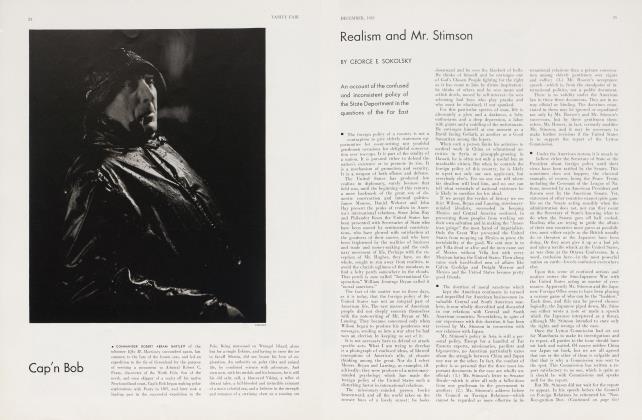
Dear Sir: In the course of the article prepared for Vanity Lair by Mr. George E. Sokolsky lie proposes as a solution of the Philippine problem "the granting of dominion status to the Philippines'', and declares that "such an arrangement ought to satisfy the Filipinos, for it gives them self-government under American protection." He also expresses the view that tills relationship of the Philippines to the United States would have the approval of Americans and the concurrence of "Asiatic states because it averts a disturbance of the international equilibrium." We cannot presume to speak for the people of the United States, or to know the minds of the Asiatic states, lint we are quite certain that the Filipino nation desires and seeks separate, independent nationhood and will be content with no substitute or compromise for it.
Mr. Sokolsky has overlooked or ignored the ethical factor of the Philippine problem. That is America's promise— uttered by Presidents and proclaimed by Congress—that the Filipinos were eventually to receive independence. His formula. it appears, takes no account of this solemn pledge as an obligation which can not be disregarded without making America guilty of a breach of faith. . . .
The granting of Philippine independence "at this time of economic and political disturbance in Asia would play into the hands of the -Asiatic communists", Mr. Sokolsky says, because the "example of the United States would he cited to the people of all the Asiatic states", and excite them to demand that Great Britain, France, Holland and Japan give independent status to their colonials. The answer to that is a question. What would these "peoples of all the Asiatic states" think and do if the United States should proclaim that it had no intention of redeeming its pledge to the Filipinos— also an Asiatic people?
PEDRO SABIDO.
Washington, I). C.
Paint-brush satirist
Guy Pène du Bois, a reproduction of whose portrait of the late Jeanne Eagels appears on page 32 of this issue, was born in Brooklyn in 1884. He studied painting in Paris, and in New York under the great teachers William M. Chase and Robert Henri. Even in early years lie supplemented his work in painting by extensive writings on art for the New York American, Tribune, and Evening Post. This literary talent was inherited from his father, Henri Pène du Bois, who was a critic on the old Journal. Indeed, most of Mr. du Bois' painting itself has a certain literary and critical tlavor. With his interest in the social scene and with ills ability to portray the mental types of modern America, lie belongs in tlie analytical tradition of Daumier and Gavarni. He sees an unvarnished and unlovely world. He tries to look under the surface of appearances; and when he depicts the Boardwalk at Atlantic City or the restaurants of lower New York, lie does so in a vein of satire and frequent bitterness.
Mr. du Bois, living in New York and Paris, lias given much time also to watercolors and drawings, besides some occasional work in teaching. For many years lie was left unnoticed by tlie American public; but now recognition has been wide-spread, and he is represented in many of our leading museums and most prominent collections.
Humiliated Southerner
Dear Sir: Here Is n check for four dollars drawn on a solvent bank. I ant not haggling I know a bargain when 1 see it. If the next 24 months are like the last, anticipation of each succeeding issue may provide a two year Insurance against "flumping" in front of a moving train -nasty business at best.
Tills, in spite of the fact that you sometimes injure my sensibilities by generalities regarding the South—suh, and the West podner, based on specific unfortunate attributes of both. There are Fundamentalists. Drys, Illiterates, Demagogue'.. Cannons, Garners, Kingflsh Longs. Patmans. Bonus Grabbers, "CockleBurr Pills". "Ma" Fergusons, God help us. but like droughts and depressions they are deformities of which your body of readers are most sensitive. Ah, there is the point ! The afore-mentioned denizens confront them with their Infantilism through the medium of the county weekly or Liberty. Broadsides tired at the South and West as a mass only wound your renders, hut bounce off the thick skins of those they are really aimed to reach. . . .
If we of the hinterland referred to New York as "The Coney Island Belt", "La-Guardialand", or "Walkercity", you would lie quick to resent It and rightfully so. It would lie narrow provincial ism on our part, revealing our lack of knowledge of the real and important New York. Follow?
With deepest gratitude for the existence of Vanity Pair.
JULIAN N. BARRETT.
Pampa, Texas.
Treasury report
Dear Sir:
I very rarely write newspapers to correct mis-statements as to myself, but sometimes if one allows them to lie made often enough, they tend to establish a false state of facts. I am, therefore, taking the liberty of writing you with reference to the October number of Vanity Pair, a marked copy of which was sent me. On page 41, it is stated that, as Under secretary of the Treasury, I rejected the general sales tax, and that four months later I was an active apologist for the sales tax, saying that few would really feel it.
The gentleman who wrote the article has evidently simply read some foolish Speeches made on the Floor of the House of Representatives by men who knew little or nothing about taxation, and who confused a special sales tax with a general sales tax.
In the eighteen years during which I have given considerable study to tax problems. I have been consistently op posed to a general sales tax from the first. I have never believed in such a tax ; I have never supported such a tax.
The Ways and Means Committee of the House, in the last session of Congress, reported what is known as a manufacturers' sales tax, based largely along the lines of a tax system which has been In force In Canada for a number of years, which provided definite and effective mechanism for the prevention of pyramiding, and did not reach the necessities of life.
Tills measure bears no resemblance whatsoever to a general sales tax. When tlie question comes up again, as it doubtless will, I shall continue to say just what I said last December about a general sales tax ; and if our revenue requirements make it necessary, I shall again support a manufacturers' excise tax. on the Canadian model; and I shall be wholly consistent in taking these two positions.
OGDEN L. MILLS Department of the Treasury Washington, D. C.
Subscribers have complete access to the archive.
Sign In Not a Subscriber?Join Now
