
Sign In to Your Account
Subscribers have complete access to the archive.
Sign In Not a Subscriber?Join NowThe screen
PARE LORENTZ
A critical estimate of the film version of "Strange Interlude", with a word for other recent movie epics
O'NEILL IN THE ARMS OF GABLE. The film version of Strange Interlude will cause professional and amateur critics alike to flood the public prints with a routine fallacious stream of comment, furiously debating such unimportant considerations as: Is the movie as good as the play? Is Gable an actor? Has Norma Shearer become a great emotional actress? Does the picture mark a new era of Art in Hollywood? and so on.
That it was a courageous thing to dismantle the giant structure of the play and put it together in a picture, that seldom do we have such material assembled on the screen, is of importance only to those who like to point with pride to landmarks of progress as we whiz by them.
However, it did take courage to screen a play which cuts with deep surgical strokes into its characters; a play, certainly, whose characters struggle so much more earnestly and terribly than any ever put on a screen, that there is no other movie with which to compare it. But, while courage is rare enough in movie circles, the producers needed more than that. They were faced with the almost insoluble problem of adapting one medium to another. They were faced with a play which on the stage ran for five hours, a playing time impossible for the screen. (Impossible, that is, if they wanted to make expenses.) And they had a play which demands the best, and more, from the best actors.
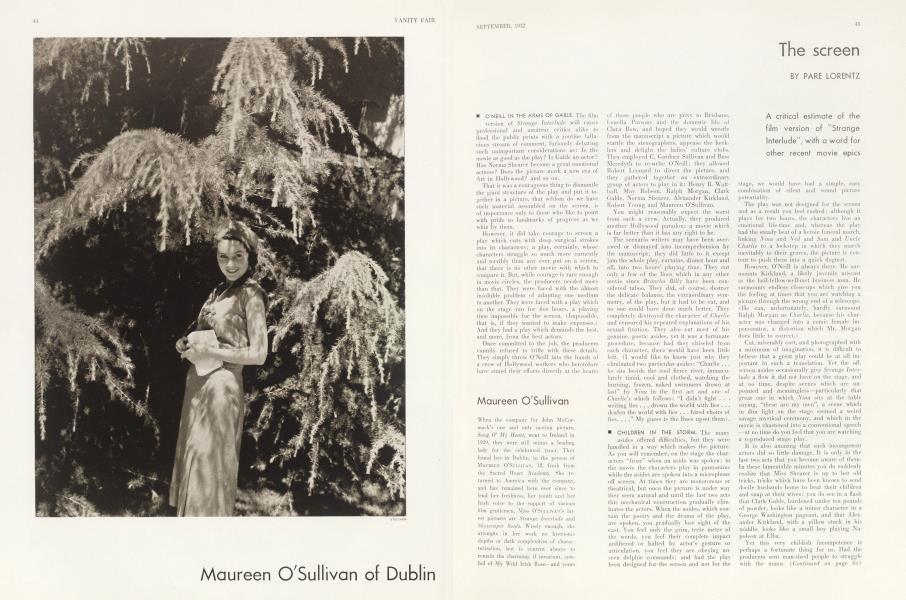
Once committed to the job, the producers cannily refused to trifle with these details. They simply threw O'Neill into the hands of a crew of Hollywood workers who heretofore have aimed their efforts directly at the hearts of those people who are privy to Brisbane, Louella Parsons and the domestic life of Clara Bow, and hoped they would wrestle from the manuscript a picture which would startle the stenographers, appease the hecklers and delight the ladies' culture clubs. They employed C. Gardner Sullivan and Bess Meredyth to re-write O'Neill; they allowed Robert Leonard to direct the picture, and they gathered together an extraordinary group of actors to play in it: Henry B. Walthall, May Robson, Ralph Morgan, Clark Gable, Norma Shearer, Alexander Kirkland, Robert Young and Maureen O'Sullivan.
You might reasonably expect the worst from such a crew. Actually, they produced another Hollywood paradox: a movie which is far better than it has any right to he.
The scenario writers may have been overawed or dismayed into incomprehension by tlie manuscript; they did little to it except jam the whole play, curtains, dinner hour and all, into two hours' playing time. They cut only a few of the lines which in any other movie since Broncho Billy have been considered taboo. They did, of course, destroy the delicate balance, the extraordinary symmetry, of the play, hut it had to he cut, and no one could have done much better. They completely destroyed the character of Charlie and censored his repeated explanations of his sexual fixation. They also cut most of his genuine, poetic asides, yet it was a fortunate procedure, because had they chiseled from each character, there would have been little left. (I would like to know just why they eliminated two particular asides: "Charlie . . . he sits beside the cool fierce river, immaculately timid, cool and clothed, watching the burning, frozen, naked swimmers drown at last" by Nina in the first act and one of Charlie's which follows: "I didn't fight . . . writing lies . . . drown the world with lies . . . deafen the world with lies . . . hired choirs of lies. . . ." My guess is the lines upset them).
CHILDREN IN THE STORM. The many asides offered difficulties, hut they were handled in a way which makes the picture. As you will remember, on the stage the characters "froze" when an aside was spoken; in the movie the characters play in pantomime while the asides are spoken into a microphone off screen. At times they are monotonous or theatrical, hut once the picture is under way they seem natural and until the last two acts this mechanical construction gradually eliminates the actors. When the asides, which contain the poetry and the drama of the play, are spoken, you gradually lose sight of the cast. You feel only the grim, terse metre of the words, you feel their complete impact unfiltered or halted by actor's gesture or articulation, you feel they are obeying unseen delphic commands; and had the play been designed for the screen and not for the stage, we would have had a simple, easy combination of silent and sound picture potentiality.
The play was not designed for the screen and as a result you feel rushed; although it plays for two hours, the characters live an emotional life-time and, whereas the play had the steady heat of a heroic funeral march, linking Nina and Ned and Sum and Uncle Charlie to a lockstep in which they march inevitably to their graves, the picture is content to push them into a quick dogtrot.
However, O'Neill is always there. He surmounts Kirkland, a likely juvenile miscast as the hail-fellow-well-met business man. He surmounts endless close-ups which give you the feeling at times that you are watching a picture through the wrong end of a telescope. (He can, unfortunately, hardly surmount Ralph Morgan as Charlie, because his character was changed into a comic female impersonator, a distortion which Mr. Morgan does little to correct.)
Cut, miserably cast, and photographed with a minimum of imagination, it is difficult to believe that a great play could he at all important in such a translation. Yet the offscreen asides occasionally give Strange Interlude a flow it did not have on the stage, and at no time, despite scenes which are unpointed and meaningless—particularly that great one in which Nina sits at the table saying, "these are my men", a scene which in dim light on the stage seemed a weird savage mystical ceremony, and which in the movie is chastened into a conventional speech —at no time do you feel that you are watching a reproduced stage play.
It is also amazing that such incompetent actors did so little damage. It is only in the last two acts that you become aware of them. In these lamentable minutes you do suddenly realize that Miss Shearer is up to her old tricks, tricks which have been known to send docile husbands home to heat their children and snap at their wives; you do see in a flash that Clark Gable, burdened under ten pounds of powder, looks like a minor character in a George Washington pageant, and that Alexander Kirkland, with a pillow stuck in his middle, looks like a small hoy playing Napoleon at Elba.
Yet this very childish incompetence is perhaps a fortunate thing for us. Had the producers sent man-sized people to struggle with the manuscript, we might have been the losers. They might have wrenched Strange Interlude away from O'Neill. As it is, they put up no battle, and he and the audience win easily.
(Continued on page 62)
(Continued from page 45)
The picture will probably be a tremendous success. It marks no epoch, it forwards no specific movie form, it proves, in fact, nothing except that Strange Interlude is one of the finest plays of our time. But it is more exciting than a thousand "action" movies and it does, in my opinion, give you a truer interpretation of the play than the country at large was given by a weary road company of stage actors.
KAUFMAN INTO LAVENDER AND OLD LACE. The Hollywood cycle has come and gone and left us just about where we were before. Hollywood making movies about itself has all the wild abandonment and good nature one finds in those clever satires lampooning Superintendent Schultz which are produced each year by the factory girls when he takes them on their annual picnic.
The only one of the half dozen or so Truth-About-Hollywood epics which had any merit at all was What Price Hollywood? Begun as a satire, it immediately changed focus, and the producer who advised his yes-men to speak "one at a time" turns into a warm-hearted husbandman who wouldn't take dimes from Rockefeller; and the waitress who becomes a star, marries a polo player and by her attention to work and her old friends loses him, happily receives him again into her arms in a happy fade-out in the South of France.
However, it was a simple, unaffected picture. Director Cukor managed to extract some warmth from Constance Bennett and a great deal of the time you knew—superficial, living in a world as permanent as a Southern bank, eating and drinking newsprint— these people to be working, fighting, drinking and loving after a fashion known only in Hollywood. That they are not lovely people does not detract from the fact that they were ingenuously presented to us, and the easy broad comedy in the picture brought it far in the lead of the other productions which were hastily thrown to the public to thwart the oncoming Once in a Lifetime.
THE INFANTILE TRADITION. Although ailing box-office reports stared them in the face, every executive movie producer spent large sums this season importing new cuties and curly-headed boys to replace the ones they have.
Yet, while the producers are preparing costly advertising campaigns with which to impress their cuties and their pole-vaulters on the consciousness of the public, the public, with its usual good sense, is showing little or no interest in the nursery.
With the exception of the club ladies and a few reactionary stenographers, audiences of which I have been a member this year audibly expressed a preference for grown-up actors such as Lionel Barrymore, Marie Dressier, Jimmy Durante, Zasu Pitts, Wallace Beery, Helen Hayes, Roland Young, Sylvia Sidney, and practically all the Russians; but if there is any shouting from the galleries for Helen Twelvetrees, Elissa Landi, Ann Dvorak, Phillips Holmes, Gene Raymond, Joel McCrea, Sydney Fox, or any of the bright-faced young people, it must come from the ushers. Furthermore, that preference has been expressed in hard cash, so, without apparently any attempt to find a reason for their popularity, every company has pushed its old-timers into prominence along with its imported flaming youth.
The children in the movies are not just young in years. It is the shallow, undeveloped, skin-deep emotional capacity of the ordinary movie actor or actress which has turned audiences to demanding mature actors. A great many beautiful morons were banished when sound came along. Some of them took lessons and came back to work, and some brighter but no more mature weeds have replaced the old. But their age has nothing to do with their acting. Laboring under the memory of the good old days, it is next to impossible for any producer to understand this; to understand, for example, that the public appreciates the difference between a Sylvia Sidney and a Clara Bow.
In fact, Miss Sidney offers a good example of public preference and movie incomprehension. I can think of no young actress on screen or stage who possesses any greater talent or genuine authenticity. Her work in An American Tragedy made her instantly popular. But she is young. Therefore she has been asked to work in Confessions of a Co-Ed, Ladies of the Pig House, Merrily We Go to Hell and other silly tales, merely because Clara Bow made the company money by cavorting in identical brash, backstairs epics such as The Fleet's In.
Movie material and movie audiences have aged; especially the audiences. The whole country has turned grey-haired practically overnight. They are a bit testy and they simply don't think the children are cute any more.
LITTLE THEATRE NOTES. Unless you want to go just for the free lemonade and cigarettes, there are only a few pictures playing the little theatre circuit this month worth any of your time. If you missed it the first time around, certainly watch for Clair's A Nous La Liberte. Pabst has a picture, Comrades, which is being treated with English titles, and which may be cut and censored somewhat, but enough of his camera work should remain to make it an entertaining movie. You can expect almost anything from the Germans and practically nothing from the Russians. Girls In Uniform still is being handed from odd lot dealers to the censors; it may appear this month, however, and I advise you to see it. Froehlich sent over another picture, a routine, cumbersome, musical production called Fire In The Opera which has some agreeable music to compensate for its clumsiness. Then there is the GermanAmerican picture, The Doomed Battalion, which you might, and should, see in any size theatre, if you can.
Subscribers have complete access to the archive.
Sign In Not a Subscriber?Join Now
