Sign In to Your Account
Subscribers have complete access to the archive.
Sign In Not a Subscriber?Join NowThe intimate recital
PAUL HORGAN
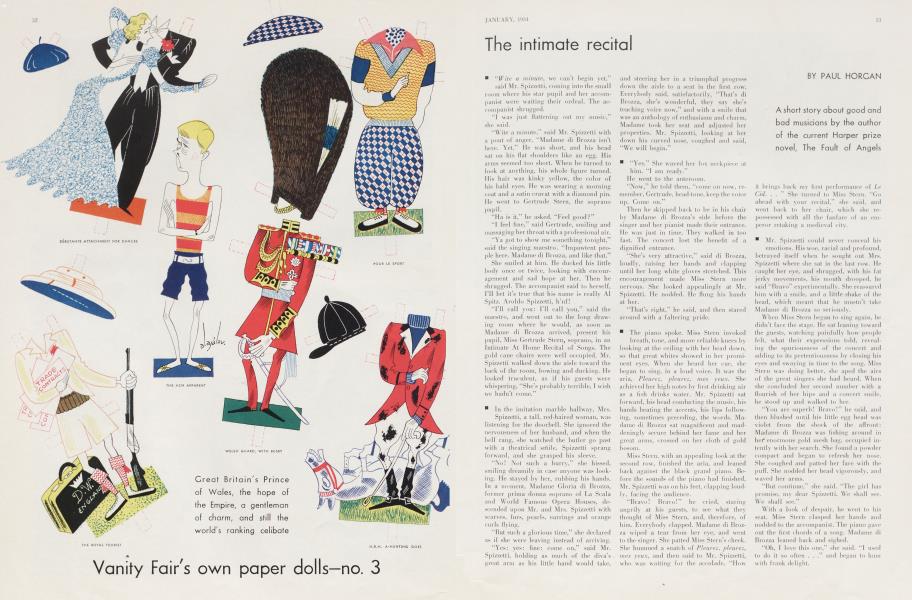
A short story about good and bad musicians by the author of the current Harper prize novel, The Fault of Angels
"Wite a minute, we can't begin yet," said Mr. Spizzetti, coming into the small room where his star pupil and her accompanist were waiting their ordeal. The accompanist shrugged.
"I was just flattening out my music," she said.
"Wite a minute," said Mr. Spizzetti with a pout of anger. "Madame di Brozza isn't here. Yet." He was short, and his head sat on his flat shoulders like an egg. His arms seemed too short. When he turned to look at anything, his whole figure turned. His hair was kinky yellow, the color of his bald eyes. He was wearing a morning coat and a satin cravat with a diamond pin. He went to Gertrude Stern, the soprano pupil.
"Ha is it," he asked. "Feel good?"
"I feel fine," said Gertrude, smiling and massaging her throat with a professional air.
"Ya got to show me something tonight," said the singing maestro. "Impawtent people here. Madame di Brozza, and like that."
She smiled at him. He ducked his little body once or twice, looking with encouragement and sad hope at her. Then he shrugged. The accompanist said to herself, I'll bet it's true that his name is really Al Spitz. Aroldo Spizzetti, h'nf!
"I'll call you: I'll call you," said the maestro, and went out to the long drawing room where he would, as soon as Madame di Brozza arrived, present his pupil, Miss Gertrude Stern, soprano, in an Intimate At Home Recital of Songs. The gold cane chairs were well occupied. Mr. Spizzetti walked down the aisle toward the hack of the room, bowing and ducking. He looked truculent, as if his guests were whispering, "She's probably terrible, I wish we hadn't come."
In the imitation marble hallway, Mrs. Spizzetti, a tall, red-haired woman, was listening for the doorbell. She ignored the nervousness of her husband, and when the bell rang, she watched the butler go past with a theatrical smile. Spizzetti sprang forward, and she grasped his sleeve.
"No! Not such a hurry," she hissed, smiling dreamily in case anyone was looking. He stayed by her, rubbing his hands. In a moment, Madame Gloria di Brozza, former prima donna soprano of La Scala and World Famous Opera Houses, descended upon Mr. and Mrs. Spizzetti with scarves, furs, pearls, earrings and orange curls flying.
"But such a glorious time," she declared as if she were leaving instead of arriving.
"Yes: yes: fine: come on," said Mr. Spizzetti, holding as much of the diva's great arm as his little hand would take, and steering her in a triumphal progress down the aisle to a seat in the first row. Everybody said, satisfactorily, "That's di Brozza, she's wonderful, they say she's teaching voice now," and with a smile that was an anthology of enthusiasm and charm, Madame took her seat and adjusted her properties. Mr. Spizzetti, looking at her down his curved nose, coughed and said, "We will begin."
"Yes." She waved her fox neckpiece al him. "I am ready."
He went to the anteroom.
"Now. he told them, "come on now, remember, Gertrude, bead-tone, keep the voice up. Come on."
Then he skipped back to be in bis chair by Madame di Brozza's side before the singer and her pianist made their entrance. He was just in time. They walked in too fast. The concert lost the benefit of a dignified entrance.
"She's very attractive," said di Brozza, loudly, raising her hands and clapping until her long white gloves stretched. This encouragement made Miss Stern more nervous. She looked appealingly al Mr. Spizzetti. He nodded. He flung his hands at her.
"That's right," he said, and then stared around with a faltering pride.
The piano spoke. Miss Stern invoked breath, tone, and more reliable knees by looking at the ceiling with her head down, so that great whites showed in her prominent eyes. When she heard her cue, she began to sing, in a loud voice. It was the aria, Pleurez, pleurez, mes yeux. She achieved her high notes by first drinking air as a fish drinks water. Mr. Spizzetti sal forward, his head conducting the music, his hands beating the accents, his lips following, sometimes preceding, the words. Madame di Brozza sat magnificent and maddeningly secure behind her fame and her great arms, crossed on her cloth of gold bosom.
Miss Stern, with an appealing look al the second row, finished the aria, and leaned back against the black grand piano. Before the sounds of the piano had finished, Mr. Spizzetti was on his feet, clapping loudly, facing the audience.
"Bravo! Bravo!" he cried, staring angrily at his guests, to see what they thought of Miss Stern, and, therefore, of him. Everybody clapped. Madame di Brozza wiped a tear from her eye, and went to the singer. She patted Miss Stern's cheek. She hummed a snatch of Pleurez. pleurez, mes yeux, and then said to Mr. Spizzetti, who was waiting for the accolade, "How it brings back my first performance of Le Cid. . . She turned to Miss Stern. "Go ahead with your recital," she said, and went back to her chair, which she repossessed with all the fanfare of an emperor retaking a medieval city.
Mr. Spizzetti could never conceal his emotions. His woe, racial and profound, betrayed itself when he sought out Mrs. Spizzetti where she sat in the last row. He caught her eye, and shrugged, with his fat jerky movements, his mouth drooped, he said "Bravo" experimentally. She reassured him with a smile, and a little shake of the head, which meant that he mustn't take Madame di Brozza so seriously.
When Miss Stern began to sing again, he didn't face the stage. He sat leaning toward the guests, watching painfully how people fell, what their expressions told, revealing the spuriousness of the concert and adding to its pretentiousness by closing bis eyes and swaying in time to the song. Miss Stern was doing better, she aped the airs of the great singers she had heard. When she concluded her second number with a flourish of her hips and a concert smile, he stood up and walked to her.
"You are superb! Bravo!" he said, and then blushed until his little egg head was violet from the shock of the affront: Madame di Brozza was fishing around in her enormous gold mesh bag, occupied intently with her search. She found a powder compact and began to refresh her nose. She coughed and patted her face with the puff. She nodded her head vigorously, and waved her arms.
"But continue," she said. "The girl has promise, my dear Spizzetti. We shall see. We shall see."
With a look of despair, he went to his seal. Miss Stern clasped her hands and nodded to the accompanist. The piano gave out the first chords of a song. Madame di Brozza leaned back and sighed.
"Oh, I love this one," she said. "I used to do it so often . . ." and began to bum with frank delight.
Subscribers have complete access to the archive.
Sign In Not a Subscriber?Join Now