

Sign In to Your Account
Subscribers have complete access to the archive.
Sign In Not a Subscriber?Join NowPraise and prejudice
In which the newest books are passed in review
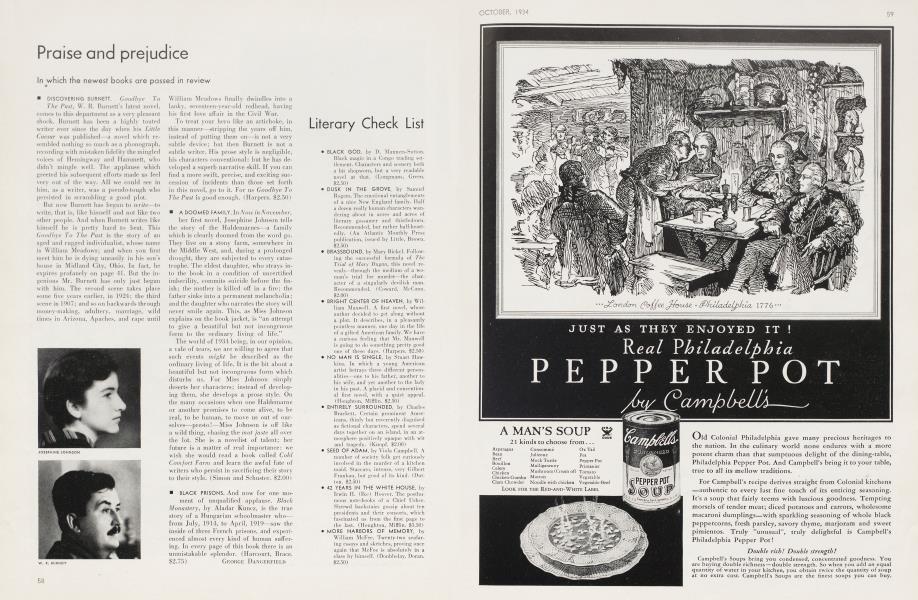
DISCOVERING BURNETT. Goodbye To The Past, W. R. Burnett's latest novel, comes to this department as a very pleasant shock. Burnett has been a highly touted writer ever since the day when his Little Caesar was published—a novel which resembled nothing so much as a phonograph, recording with mistaken fidelity the mingled voices of Hemingway and Hammett, who didn't mingle well. The applause which greeted his subsequent efforts made us feel very out of the way. All we could see in him, as a writer, was a pseudo-tough who persisted in scrambling a good plot.
But now Burnett has begun to write—to write, that is, like himself and not like two other people. And when Burnett writes like himself he is pretty hard to beat. This Goodbye To Ike Past is the story of an aged and rugged individualist, whose name is William Meadows; and when you first meet him he is dying uneasily in his son's house in Midland City, Ohio. In fact, he expires profanely on page 41. But the ingenious Mr. Burnett has only just begun with him. The second scene takes place some five years earlier, in 1924; the third scene in 1907; and so on backwards through money-making, adultery, marriage, wild times in Arizona, Apaches, and rape until William Meadows finally dwindles into a lanky, seventeen-year-old redhead, having his first love affair in the Civil War.
To treat your hero like an artichoke, in this manner—stripping the years off him, instead of putting them on—is not a very subtle device; but then Burnett is not a subtle writer. His prose style is negligible, his characters conventional: but he has developed a superb narrative skill. If you can find a more swift, precise, and exciting succession of incidents than those set forth in this novel, go to it. For us Goodbye To The Past is good enough. (Harpers. $2.50)
■ A DOOMED FAMILY. In Now in November, her first novel, Josephine Johnson tells the story of the Haldemarnes—a family which is clearly doomed from the word go. They live on a stony farm, somewhere in the Middle West, and, during a prolonged drought, they are subjected to every catastrophe. The eldest daughter, who strays into the book in a condition of uncertified imbecility, commits suicide before the finish; the mother is killed off in a fire; the father sinks into a permanent melancholia; and the daughter who narrates the story will never smile again. This, as Miss Johnson explains on the book jacket, is "an attempt to give a beautiful but not incongruous form to the ordinary living of life."
The world of 1934 being, in our opinion, a vale of tears, we are willing to agree that such events might be described as the ordinary living of life. It is the bit about a beautiful but not incongruous form which disturbs us. For Miss Johnson simply deserts her characters; instead of developing them, she develops a prose style. On the many occasions when one Haldemarne or another promises to come alive, to be real, to be human, to move us out of ourselves—presto!—Miss Johnson is off like a wild thing, chasing the mot juste all over the lot. She is a novelist of talent; her future is a matter of real importance: we wish she would read a book called Cold Comfort Farm and learn the awful fate of writers who persist in sacrificing their story to their style. (Simon and Schuster. $2.00)
■ BLACK PRISONS. And now for one moment of unqualified applause. BlackMonastery, by Aladar Kuncz, is the true story of a Hungarian schoolmaster who— from July, 1914, to April, 1919—saw the inside of three French prisons, and experienced almost every kind of human suffering. In every page of this book there is an unmistakable splendor. (Harcourt, Brace. $2.75) GEORGE DANGERFIELD
GEORGE DANGERFIELD
Subscribers have complete access to the archive.
Sign In Not a Subscriber?Join Now