Sign In to Your Account
Subscribers have complete access to the archive.
Sign In Not a Subscriber?Join NowPraise and prejudice
GEORGE DANGERFIELD
The Pulitzer novel and the jitters — Tess Slesinger and Erskine Caldwell — a great war novel — some suggestions
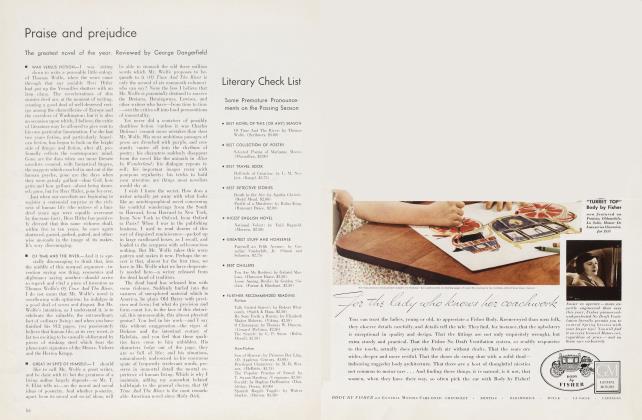
THE PULITZER PRIZE NOVEL—It is a superstition among young writers that tragedy is simply a matter of piling on the agony. Not long ago Miss Josephine Johnson, in Now In November, endowed this superstition with the attractive resonance of a semi-poetical prose; and she won the Pulitzer novel prize. Well, Miss Johnson is young; she is promising; she is bound to improve: and when you think of the literary efforts the prize might have gone to, there is probably much to be thankful for because it went where it did.
After all, there was only one real candidate. That was Robert Cantwell's Land of Plenty, which ought to have won the prize, but was presumably too impolite in its subject matter, and too oblique in its method, for the delicate susceptibilities of the awarding witenagemot, the wise men.
LAURELS FOR THE JITTERS.—So Miss Johnson won the laurels, and, with a gratifying unanimity, the critics played upon the flute, harp, sackbut and psaltery of delighted praise. Much as I hate to strike a discordant note, I have to contend that, if you remove from the book Miss Johnson's animadversions upon nature, little remains except the tale of a family which—in a more workmanlike world—would mercifully have been committed to the nearest taxpaid lethal chamber. For Miss Johnson was unconsciously investigating—with all the poetics of sensitive immaturity—an over-ripe case of common jitters.
By the jitters I mean those daily perturbations of the human soul, which, though they often contain the cruel seeds of farce, are altogether too undignified to blossom into high tragedy. And the most distinguished, the most conscious exponent of contemporary jitters is Tess Slesinger, who dissects them with an alarming shrewdness in a collection of short stories Time: the Present (Simon & Schuster. $2.50).
TIME: THE PRESENT.—In the cloacine last chapter of Ulysses, James Joyce presented us with a valuable idea—that if one listens one can hear life talking to itself. Many and lamentable were his imitators; young men and women who listened feverishly, and spilled the results into that sluttish non-style which came to be known as "stream of consciousness". I suppose that a trickle of the "stream of consciousness" rather stains Miss Slesinger's pages, too. In her first story, the embarrassing monologue of a cheated wife, she seems to be getting the lowdown on the human soul in the manner of a housemaid whose ear is glued to a bedroom key-hole.
But in her other stories, which are at once active and astute, malicious and compassionate, and in which she sets forth the minor follies of mankind, she does more than just listen. Almost you might say that she is on the hunt. She tiptoes through the whispering jungles of society (which whisper loudest in New York) with, as it were, a little shot-gun: and every now and again she pots a roosting suppression, or knocks down a nice case of hysteria as it rockets by on the wing.
This is perhaps not the highest form of art. Casually accurate, deliberately informal, Miss Slesinger would be just another gifted writer, if it were not for her last story, "The Answer of the Magnolia Tree", a detailed glimpse of a girls' finishing school. With its remarkable atmospherics, its subtle distillation of an odor di femina, its mingled detachment and tenderness, this tale is by way of being a masterpiece. It proves that Miss Slesinger —as, somehow or other, most of us suspected she would—has glided adroitly to the front rank.
THE BURNISHED NIGHTMARE OF MR. CALDWELL.— And, by some irony of fate, what should Mr. Erskine Caldwell do but appear with his collection of short stories? (Kneel to the Rising Sun. Viking. $2.50.)
Mr. Caldwell's methods are the exact opposite of Miss Slesinger's. He, too, is sensitive to the jitters; but he does not listen to them, he sees them. Life for him is a kind of ambulant nightmare, mute and commonplace, a nightmare which he tries to make aere perennius, more lasting than bronze. He polishes it, he reduces it to a careful succession of lucid gestures; it is like a shining spittoon into which his characters occasionally expectorate the ineffective monosyllables of their conversation.
But it is human? Every now and again, through the ordered scene of his stories, there drifts a disturbing shadow, like the shadow of a fish in a miniature aquarium. Ponderous but intangible, it passes from paragraph to paragraph, and disappears. You watch it with alarm. What can it be? Is it?—good heavens, it can't be; but it is: it's a thought. One of Mr. Caldwell's characters has been thinking out loud. . . .
I realize that in this sort of objective writing, Mr. Caldwell is way ahead of his field; that he is a sensitive observer, a remarkable stylist. But I don't believe that you can drill the jitters like a regiment, make them polish their buttons, present arms, and march in step: and what is Mr. Caldwell doing, if not that?
A GREAT WAR NOVEL.—And when you come to a real nightmare, such as Humphrey Cobb's Paths of Glory (Viking. $2.50)—which everyone is hereby implored to read—you are astonished to discover that its very essence lies in the humble acceptance of an overwhelming fact. I believe that it is the greatest war novel since All Quiet; I believe, too, that few more frightful tales have ever been told. But chapter succeeds chapter with quiet authority; terror communicates itself sotto voce; there are no hysterics, no inviting heaven and earth, in impassioned paragraphs, to witness the wrongs of common men. Yet every beastly detail, every petty motive, every noble action, stands out in excruciating relief; a final revelation of the peculiar hell of war.
SOME SUGGESTIONS.— Tortilla Flat, by John Steinbeck (Covici-Friede $2.50). The amoral adventures of a bevy of Monterey paisanos. Tender, humorous, rather too other-worldly perhaps: but deserves to have considerable success. Landtakers, by Brian Penton (Farrar & Rinehart. $2.50). A grim novel of the early Australian bush. Grips you like a cramp. Swell, if you can stand it. A London Story, by George Buchanan (Dutton. $2.50). A study in success and failure, written with a Gallic economy, and definitely one of the best English novels of the year; possible the best. Out of that Dream, by Katherine Newborg (Doubleday, Doran. $2.50). A first novel, with a stale on-board-ship setting, but some remarkably effective scenes. Miss Newborg should go a long way, particularly if she happens to discover that love is not really de luxe. Man of Aran, by Pat Mullen (Putnam. $3.00). A naive, absorbing account of the making of Mr. Flaherty's film, by one of its actors. God's Soldier, by St. John Ervine (Macmillan. $7.50). To those with the special inclination, this exact; laborious, and incongruously fascinating study of the Salvation Army will not come amiss.
Subscribers have complete access to the archive.
Sign In Not a Subscriber?Join Now