
Sign In to Your Account
Subscribers have complete access to the archive.
Sign In Not a Subscriber?Join NowPraise and prejudice
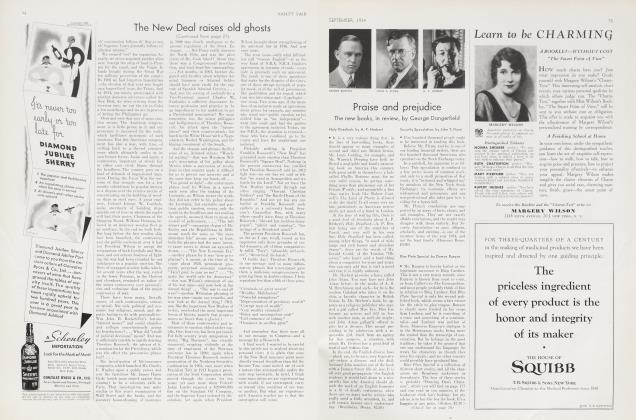
GEORGE DANGERFIELD
Messrs. James Gould Cozzens, Johan Fabricius, Klaus Mann, T. S. Stribling, and Carl Fallas flee from life into fiction
"Escapist" fiction, roughly, implies something with a touch of the hobgoblin in it, a witch, a ghost, a goat-foot on the lawn, and other more subtle appurtenances of the world of fantasy. It may also mean any fiction which turns its back on reality; and this, when one is in a gloomy mood, may mean almost any fiction. Here, for instance, are five novels which have nothing in common except an alarming tendency to turn the back on this or on that.
A novelist's obligation, presumably, is to tell the truth as he sees it and not as he doesn't see it. And it is because he is rather uncertain as to what he sees and what he doesn't see that I offer, as my first escapist, Mr. James Gould Cozzens.
In his latest novel, Men and Brethren, Mr. Cozzens is obliged to wriggle from one horn to the other of a painful dilemma, a position upon which, since he put himself there, one cannot expend too much pity. He attempts to create the character of a virtuous man. Endeavoring to escape from the painful necessity of defining virtue— whether it should be religious or utilitarian —he ends by not defining it at all.
His chief character is the Reverend Ernest Cudlipp, an Episcopalian Vicar; and in the course of two summer days, Mr. Cudlipp is given what one might legitimately describe as the literary one-two. He rescues one lady from suicide, and is only just too late to perform the same service for another; there is a natural death; there are exacting scenes with an over-politic rector, an exasperating curate, an AngloCatholic monk who has left his monastery under revolting circumstances, a nice lady who would like both a divorce and Mr. Cudlipp, curious voices on the telephone, scandal, heat, and the nausea which comes from chain-smoking under strain. Whether all this is not over-taxing both the credulity of the reader and the capabilities of the Cloth is not (Mr. Cozzens being a skillful writer) ever very seriously in question. What is in question is the character of Mr. Cudlipp. Mr. Cozzens has invested this youngish ecclesiastic with an extraordinary infallibility. It is useless for Mr. Cudlipp to protest, as he does occasionally, that he is not infallible; because he is. Even his mistakes have an air of rightness. He is by no means a prig; he is far from unlikeable: but he is less a character than a confusion, a personified and improbable compromise between God and Mammon. Even his most uncanonical moments are conducted with reference to eternity and vice versa; from which one can only deduce that Mr. Cozzens is himself in some doubt as to whether the truth will be found in a Creed or in common sense; that he sees life with a terrific squint. (Harcourt, Brace. $2.50.)
Another kind of literary escape gradually unrolls itself through the pages of Johan Fabricius' The Son of Marietta (Little, Brown. $3.00), a book which lingers in an indecisive region between Gil Bias and La Chartreuse de Parme. In this instance, it is an escape from the necessity of having to define a character at all. This form of retreat can have a powerful and persuasive appearance, as in the case of Anthony Adverse; but very few readers of that endless book were able to say, on emerging from it here or there, just what sort of a person Anthony was. And it is very difficult to imagine that the author himself was altogether sure. The same indecision seems to reveal itself in The Son of Marietta. Like Anthony Adverse, its first two hundred or so pages have all the authority of vital fiction, and it afterwards astonished you with splendid scenes and flashes of notable characterization; and, like Anthony Adverse, its intervening sections are literate, suggestive, and opaque.
Are Mr. Fabricius' energies absorbed in a re-creation of the social life of eighteenth century Italy? or are they devoted to plumbing the mysterious depths of the soul of Benedetto Buzzi? The conflict is immense (813 pages) and inconclusive. You know of Benedetto that he was the illegitimate son of a bishop and a carpenter's wife, and that he was driven by an intolerable inner loneliness from his provincial Todi to Venice, and crime, and death. But what sort of a person was he? Was he a Casanova, an eternal adolescent, incapable of an adult relationship with any woman? was he a simple victim of circumstance? or was there some profound and tragic conflict of good and evil to be discovered in him? Mr. Fabricius does anything to avoid an answer. He piles incident upon incident; he creates other characters, about whose reality there is no doubt; he surrounds his elusive Benedetto with the magnificent profusion of his researches into eighteenth century Italy. And in the end, being unable to bring the young man completely alive, he kills him, neatly and suddenly, on the gallows. It's three dollars' worth of entertainment though, any way you look at it.
Mr. T. S. Stribling, in The Sound Wagon, turns to that most deceptive of refuges— self-expression, the antipodes of creation. The desire to write has apparently blinded him to the consideration of whether or not he has anything to write about. There may possibly be men who could do a satirical novel about the political situation in a collective American city called Megapolis; who could pursue with sufficient subtlety and precision the career of a gangster-supported Senator. Such men there may be. But Mr. Stribling, gifted though he is in other directions, is not one of them. (Doubleday, Doran. $2.50.)
Mr. Klaus Mann, on the other hand, has something very real to say against Hitlerism: but he doesn't say it. Like one avoiding his creditors, he dashes into a novel and hides there. His Journey Into Freedom (the tale of a girl, exiled from Germany, who finds her true love in Finland, only to be called back to fight for freedom) is—from the whole method of its handling, its continuous, intrusive mood of sombre premonition—an explicit confusion as to whether the author should write about love or against the Nazis. I do not believe that any story should be written entirely with its last page in mind—and I cannot help feeling that this is what happened in Journey Into Freedom. (Knopf. $2.50.)
Whereas "escapist" fiction, at its purest and most fortunate, will be found in The Wooden Pillow by Carl Fallas. (Viking. $2.50.) This tells of a young Englishman's stay in Japan (period, early twentieth century), and of a very delicate liaison which, mingled with a great deal of more or less irrelevant and quite delightful circumstance, he is lucky enough to have. I imagine that, as a description of Japanese manners and customs, The Wooden Pillow is extremely accurate; but the spirit which informs it is no accurate spirit. Indeed, there is an air in this book of such enchanting unreality that it almost seems as if one of those willow plates, with its eternally arrested drama, had stirred and come alive before our eyes.
Subscribers have complete access to the archive.
Sign In Not a Subscriber?Join Now