Sign In to Your Account
Subscribers have complete access to the archive.
Sign In Not a Subscriber?Join NowThe Mesdames Kilbourne
ALLAN SEAGER
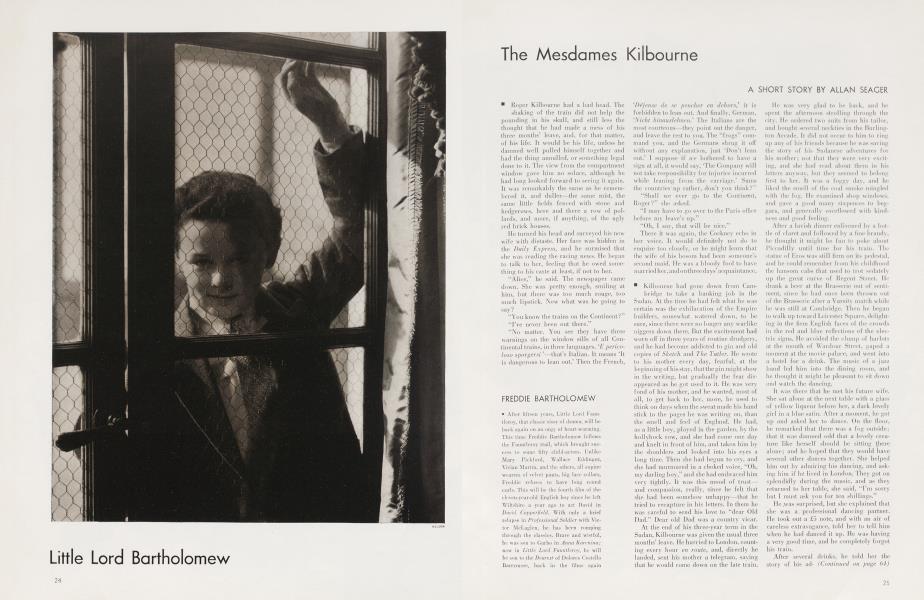
Roger Kilbourne had a bad head. The shaking of the train did not help the pounding in his skull, and still less the thought that he had made a mess of his three months' leave, and, for that matter, of his life. It would be his life, unless he damned well pulled himself together and had the thing annulled, or something legal done to it. The view from the compartment window gave him no solace, although he had long looked forward to seeing it again. It was remarkably the same as he remembered it, and duller—the same mist, the same little fields fenced with stone and hedgerows, here and there a row of pollards, and more, if anything, of the ugly red brick houses.
He turned his head and surveyed his new wife with distaste. Her face was hidden in the Daily Express, and he surmised that she was reading the racing news. He began to talk to her, feeling that he owed something to his caste at least, if not to her.
"Alice," he said. The newspaper came down. She was pretty enough, smiling at him, but there was too much rouge, too much lipstick. Now what was he going to say?
"You know the trains on the Continent?"
"I've never been out there."
"No matter. You see they have three warnings on the window sills of all Continental trains, in three languages. 'E pericoloso sporgersi '—that's Italian. It means 'It is dangerous to lean out.' Then the French, 'Defense de se pencher en dehors* it is forbidden to lean out. And finally, German, 'Nicht hinauslehnen' The Italians are the most courteous—they point out the danger, and leave the rest to you. The "frogs" command you, and the Germans shrug it off without any explanation, just 'Don't lean out.' I suppose if we bothered to have a sign at all, it would say, 'The Company will not take responsibility for injuries incurred while leaning from the carriage.' Sums the countries up rather, don't you think?"
"Shall we ever go to the Continent, Roger?" she asked.
"I may have to go over to the Paris office before my leave's up."
"Oh, I say, that will be nice."
There it was again, the Cockney echo in her voice. It would definitely not do to enquire too closely, or he might learn that the wife of his bosom had been someone's second maid. He was a bloody fool to have married her, and on three days' acquaintance.
Kilbourne had gone down from Cambridge to take a banking job in the Sudan. At the time he had felt what he was certain was the exhilaration of the Empire builders, somewhat watered down, to be sure, since there were no longer any warlike niggers down there. But the excitement had worn off in three years of routine drudgery, and he had become addicted to gin and old copies of Sketch and The Tatler. He wrote to his mother every day, fearful, at the beginning of his stay, that the gin might show in the writing, but gradually the fear disappeared as he got used to it. He was very fond of his mother, and he wanted, most of all, to get back to her, more, he used to think on days when the sweat made his hand stick to the pages he was writing on, than the smell and feel of England. He had, as a little boy, played in the garden, by the hollyhock row, and she had come one day and knelt in front of him, and taken him by the shoulders and looked into his eyes a long time. Then she had begun to cry, and she had murmured in a choked voice, "Oh, my darling boy," and she had embraced him very tightly. It was this mood of trust— and compassion, really, since he felt that she had been somehow unhappy—that he tried to recapture in his letters. In them he was careful to send his love to "dear Old Dad." Dear old Dad was a country vicar.
At the end of his three-year term in the Sudan, Kilbourne was given the usual three months' leave. He hurried to London, counting every hour en route, and, directly he landed, sent his mother a telegram, saying that he would come down on the late train.
He was very glad to be back, and he spent the afternoon strolling through the city. He ordered two suits from his tailor, and bought several neckties in the Burlington Arcade. It did not occur to him to ring up any of his friends because he was saving the story of his Sudanese adventures for his mother; not that they were very exciting, and she had read about them in his letters anyway, but they seemed to belong first to her. It was a foggy day, and he liked the smell of the coal smoke mingled with the fog. He examined shop windows, and gave a good many sixpences to beggars, and generally overflowed with kindness and good feeling.
After a lavish dinner enlivened by a bottle of claret and followed by a fine brandy, he thought it might be fun to poke about Piccadilly until time for his train. The statue of Eros was still firm on its pedestal, and he could remember from his childhood the hansom cabs that used to trot sedately up the great curve of Regent Street. He drank a beer at the Brasserie out of sentiment, since he had once been thrown out of the Brasserie after a Varsity match while he was still at Cambridge. Then he began to walk up toward Leicester Square, delighting in the firm English faces of the crowds in the red and blue reflections of the electric signs. He avoided the clump of harlots at the mouth of Wardour Street, gaped a moment at the movie palace, and went into a hotel for a drink. The music of a jazz band led him into the dining room, and he thought it might be pleasant to sit down and watch the dancing.
It was there that he met his future wife. She sat alone at the next table with a glass of yellow liqueur before her, a dark lovely girl in a blue satin. After a moment, he got up and asked her to dance. On the floor, he remarked that there was a fog outside; that it was damned odd that a lovely creature like herself should be sitting there alone; and he hoped that they would have several other dances together. She helped him out by admiring his dancing, and asking him if he lived in London. They got on splendidly during the music, and as they returned to her table, she said, "I'm sorry but I must ask you for ten shillings."
He .was surprised, but she explained that she was a professional dancing partner. He took out a £5 note, and with an air of careless extravagance, told her to tell him when he had danced it up. He was having a very good time, and he completely forgot his train.
After several drinks, he told her the story of his adventures in the Sudan, embellishing them suitably, and the longer he talked, the more charming, to his notion, she became. At midnight, he asked if he might see her home. It had been damned lonely in Africa.
(Continued on page 64)
(Confinued from page 25)
She had a flat in Maida Vale, and at the door, she said, "Would you like to come in? I have some gin."
With a tingling in his spine, he went in. He knew that he would spend the night with her, and he had never spent the night with a girl before.
He thought she was wonderful, and by the time the darkness weakened in the east, he had told her all about his life. He was only twenty-four, and he was certain he loved Alice.
During the next three days, she made up for all the long hot nights of work, and for all his loneliness. She was gentle; she was kind; and she was beautiful. Roger felt a convulsion which he was certain was love and he married her on the third day. They celebrated in several night clubs.
And now he was taking his wife, a former professional dancing partner, to meet his parents, the Rev. and Mrs. Henry Kilbourne, the Vicarage, Dry Sandford, Berks.
As the train passed landmarks which were more and more familiar, the ties he had broken in London began to knit themselves together again, and he felt increasingly unhappy that he had forsaken his mother.
When they approached the Vicarage, his mother saw them coming. She was a tall, heavy woman. Her face was a healthy red, and her plump cheeks were curtailed by fringes of grey bobbed hair. She wore a camel's-hair sweater, a shapeless green dress, and on her feet were flat-heeled shoes with a single strap across the instep. Behind the window curtains, she stood quivering with a jealous rage she had always known she would feel when her son brought home a wife.
Blushing with shame, Roger opened the door, and accepted his mother's long embrace. After her kiss, she held him and looked deep into his eyes as if she expected to find in them a sign of his defection. Then, stiffening her face, she turned to Alice.
"Mother, this is my wife, Alice."
She said to Alice, "How d'you do?" and shook hands. "Your father is in the study, Roger."
Roger hurried into the stuffy little room, and shook hands morosely with his father. The two men returned to the living room, and Mrs. Kilbourne took Alice by the arm, saying to the Vicar, "Henry, this is Roger's wife." It was all done quietly, and it was very painful for everyone, except, it seemed, the Vicar. He took his glasses out of a case, squinted through them, and said jocosely, "Why, you're very pretty, my dear." He kissed her on the cheek and led her to a couch before the fire, and began to talk with her.
Mrs. Kilbourne, hearing the Cockney taint in Alice's voice, and remarking the rouge, and the cheap clothes, saw immediately that it was not loss she was suffering, but insult. Roger had insulted her. He had married a shop-girl, or worse. Mrs. Kilbourne looked Roger in the eye, and he rose dutifully.
"You will excuse me, if I speak to Roger?" she said to the couch.
They left the room, and presently they were heard climbing the stairs.
Alice looked at her father-in-law in the firelight. He was a meek little man, somewhat dirty, with a bald head and a grey fringe around it. His soiled clerical collar stood out a half-inch too large around his withered neck. Yet he had fine hands and he had been kind to her. She decided to tell him the truth. They all knew it anyway.
"You know, sir, that I'm a professional dancing partner?"
"What fun! We hear the London orchestras every night over the wireless, but I haven't danced, my dear, why, I haven't danced in twenty years."
"But don't you see, sir—"
"Call me Dad, Alice. I am your Dad, you know."
"Well—Dad—I'm not right for Roger really. I know it, and—"
"Why not, pray, you're a lovely girl, and strong enough for his children." Here he patted her hip. "And you love him, don't you?" He looked at her anxiously.
"Yes, I love him all right." It was very Cockney, her pronunciation, but it was sincere.
"Well then, I shouldn't worry. Of course, it is a surprise, and Roger's mother would have him married to a duke's daughter if she could, but the stock needs refreshing, and I like you, my dear. Don't you worry."
Roger joined them silently and the maid brought in the tea. It was a rather special tea with eggs and an almond cake.
"Where's your mother, Roger?" his father asked.
"She'll be down presently she said."
The Vicar busied himself with the tea, slicing cake and pouring. Then they waited for Mrs. Kilbourne.
"Perhaps I'd better fetch her," the Vicar said.
He mounted the stairs slowly to his wife's bedroom. He found her hanging from a scarf to an old lamp hook in the ceiling. A stool lay overturned on the floor. He cut her down swiftly and laid her on the bed to listen for her heartbeat. There was none. Then he rang for the maid. She came, gave a little scream at Mrs. Kilbourne's body, and he sent her for the doctor.
The Vicar came down the stairs.
"Roger," he said, "Your mother has hanged herself. Go to her."
And then to Alice, "My wife, Alice, my wife. Roger's mother. We were married thirty years, and yet—" He started to walk up and down—"—and yet, you know." The old man stopped and stared, through the walls themselves, she thought, and back into the heart of thirty years. "You know, Alice, I've always hated her. God forgive me, I've hated her."
Upstairs, kneeling beside the bed, remembering his mother in the garden with the hollyhocks, Roger spoke to her corpse.
"Mother, mother darling," and with the words, all his childhood rushed back and the tears streamed down his face. "I'll always hate her. Always."
Below, in the crook of the Vicar's arm, Alice wept.
Subscribers have complete access to the archive.
Sign In Not a Subscriber?Join Now
