Sign In to Your Account
Subscribers have complete access to the archive.
Sign In Not a Subscriber?Join NowPraise and prejudice
GEORGE DANGERFIELD
An important new English novel arrives in our midst— A fine story of the South — Mr. Balfour's eastern tour
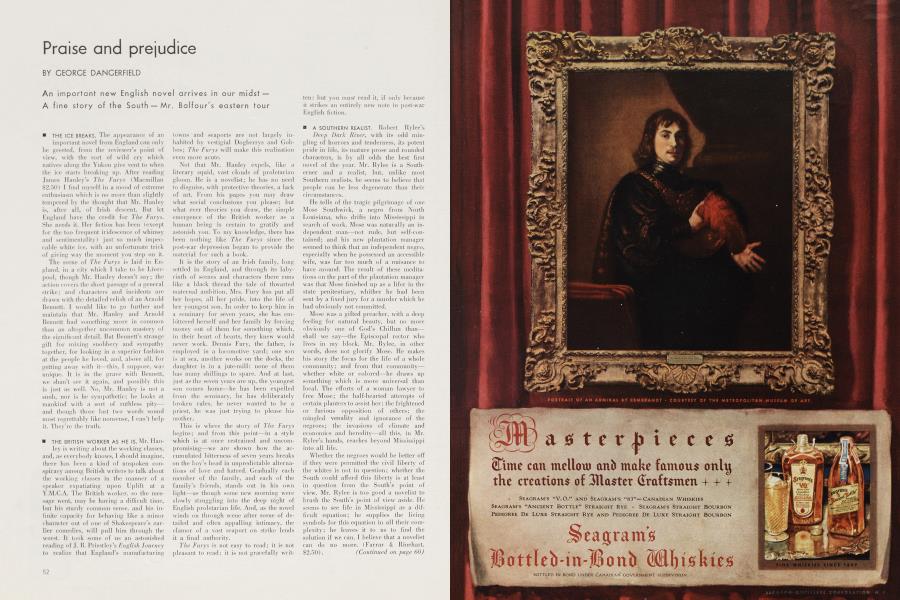
THE ICE BREAKS. The appearance of an important novel from England can only be greeted, from the reviewer's point of view, with the sort of wild cry which natives along the Yukon give vent to when the ice starts breaking up. After reading James Hanley's The Furys (Macmillan $2.50) I find myself in a mood of extreme enthusiasm which is no more than slightly tempered by the thought that Mr. Hanley
is, after all, of Irish descent. But let England have the credit for The Furys. She needs it. Her fiction has been (except for the too frequent iridescence of whimsy and sentimentality) just so much impeccable white ice, with an unfortunate trick of giving way the moment you step on it.
The scene of The Furys is laid in England. in a city which I take to be Liverpool, though Mr. Hanley doesn't say; the action covers the short passage of a general strike; and characters and incidents are drawn with the detailed relish of an Arnold Bennett. 1 would like to go further and maintain that Mr. Hanley and Arnold Bennett had something more in common than an altogether uncommon mastery of the significant detail. But Bennett's strange gift for mixing snobbery and sympathy together, for looking in a superior fashion at the people he loved, and, above all, for getting away with it—this, I suppose, was unique. It is in the grave with Bennett, we shan't see it again, and possibly this is just as well. No, Mr. Hanley is not a snob, nor is he sympathetic; he looks at mankind with a sort of ruthless pity— and though those last two words sound most regrettably like nonsense, I can l help it. They're the truth.
THE BRITISH WORKER AS HE IS. Mr. Hanley is writing about the working classes, and, as everybody knows, I should imagine, there has been a kind of unspoken conspiracy among British writers to talk about the working classes in the manner of a speaker expatiating upon Uplift at a Y.M.C.A. The British worker, so the message went, may be having a difficult time, but his sturdy common sense, and his infinite capacity for behaving like a minor (haracter out of one of Shakespeare's earlier comedies, will pull him through the worst. It look some of us an astonished reading of J. B. Priestley's English Journey to realize that England's manufacturing towns and seaports are not largely inhabited by vestigial Dogberrys and Gobbos; The Furys will make this realization even more acute.
Not that Mr. Hanley expels, like a literary squid, vast clouds of proletarian gloom. He is a novelist; he has no need to disguise, with protective theories, a lack of art. From his pages you may draw what social conclusions you please; but what ever theories you draw, the simple emergence of the British worker as a human being is certain to gratify and astonish you. To my knowledge, there has been nothing like The Furys since the post-war depression began to provide the material for such a book.
It is the story of an Irish family, long settled in England, and through its labyrinth of scenes and characters there runs like a black thread the tale of thwarted maternal ambition. Mrs. Fury has put all her hopes, all her pride, into the life of her youngest son. In order to keep him in a seminary for seven years, she has embittered herself and her family by forcing money out of them for something which, in their heart of hearts, they knew would never work. Dennis Fury, the father, is employed in a locomotive yard; one son is at sea, another works on the docks, the daughter is in a jute-mill: none of them has many shillings to spare. And at last, just as the seven years are up, the youngest son comes home—he has been expelled from the seminary, he has deliberately broken rules, he never wanted to be a priest, he was just trying to please his mother.
This is where the story of The Furys begins; and from this point—in a style which is at once restrained and uncompromising—we are shown how the accumulated bitterness of seven years breaks on the boy's head in unpredictable alternations of love and hatred. Gradually each member of the family, and each of the family's friends, stands out in his own light—as though some new morning were slowly struggling into the deep night of English proletarian life. And, as the novel winds on through scene after scene of detailed and often appalling intimacy, the clamor of a vast seaport on strike lends it a final authority.
The Furys is not easy to read; it is not pleasant to read; it is not gracefully written: but you must read it, if only because it strikes an entirely new note in post-war English fiction.
A SOUTHERN REALIST. Robert Rylee's Deep Dark River, with its odd mingling of horrors and tenderness, its potent pride in life, its mature prose and rounded characters, is by all odds the best first novel of the year. Mr. Rylee is a Southerner and a realist, but, unlike most Southern realists, he seems to believe that people can be less degenerate than their circumstances.
He tells of the tragic pilgrimage of one Mose Southwick, a negro from North Louisiana, who drifts into Mississippi in search of work. Mose was naturally an independent man—not rude, but self-contained; and his new plantation manager seemed to think that an independent negro, especially w hen he possessed an accessible wife, was far too much of a nuisance to have around. The result of these meditations on the part of the plantation manager was that Mose finished up as a lifer in the state penitentiary, whither he had been sent by a fixed jury for a murder which he had obviously not committed.
Mose was a gifted preacher, with a deep feeling for natural beauty, but no more obviously one of God's Chillun than— shall we say—the Episcopal rector who lives in my block. Mr. Rylee, in other words, does not glorify Mose. He makes his story the focus for the life of a whole community; and from that community— whether white or colored—he draws up something which is more universal than local. The efforts of a woman lawyer to free Mose; the half-hearted attempts of certain planters to assist her; the frightened or furious opposition of others; the mingled venality and ignorance of the negroes; the invasions of climate and economics and heredity—all this, in Mr. Rylee's hands, reaches beyond Mississippi into all life.
Whether the negroes would be better off if they were permitted the civil liberty of the whites is not in question; whether the South could afford this liberty is at least in question from the South's point of view. Mr. Rylee is too good a novelist to brush the South's point of view aside. He seems to see life in Mississippi as a difficult equation; he supplies the living symbols for this equation in all their complexity; he leaves it to us to find the solution if we can. 1 believe that a novelist can do no more. (Farrar & Rinehart. $2.50).
Continued on page 60
Continued from page 52
A PERIOD TO PETER FLEMING.—Ii was pleasant to discover, from a small photograph on the jacket of Patrick Balfour's Grand Tour (Harcourt, Brace. $3.75) that Mr. Balfour's was the lean figure which I used to see in the streets of Oxford not a generation ago; it was pleasant to discover as well, from some information beneath the photograph, that his great grandfather was a Presbyterian minister of such moral rigidity that he was known throughout Scotland as Perpendicular Peter; hut the pleasantest discovery of all was that Grand Tour has put an end—a most agreeable and readable end—to all books on the Peter Fleming formula. Mr. Fleming, it will be remembered, went to Brazil because lie answered an advertisement; but through all his subsequent adventures, so gracefully narrated, it was too clear that one of Fleming's eyes was occupied, not with Brazil, but with posterity. Oddly enough, the thought— which amounted to conviction—that posterity would not be at all interested in Mr. Fleming seriously embarrassed me in my reading.
Mr. Balfour also answered an advertisement. He went to India and points further east. And lie wrote, or so it seems, for his own amusement and not for posterity. The result is a really entertaining book, which is doubly enjoyable from the fact that—— so far as the reading public is concerned—the last of the English rovers has answered the call of the advertising columns. For surely nobody else will dare to try it on us again.
FIVE RECOMMENDED BOOKS.—Fiction. Playthings of Time, by Arnold Zweig (Viking. $2.50). The Farmer in the Dell, by Phil Stong (Ilarcourt. Brace. $2.50). The Jury, by Gerald Bullett (Knopf. $2.50). Non-fiction. Eyes on the World, edited by M. Lincoln Schuster. A potent collection of 674 contemporary photographs (Simon & Schuster. $3.75). War Clouds: in the skies of the Far East, by Tom Ireland (Putnam. $2.75).
Subscribers have complete access to the archive.
Sign In Not a Subscriber?Join Now
