Sign In to Your Account
Subscribers have complete access to the archive.
Sign In Not a Subscriber?Join NowNazi nightmare
GEORGE DANGERFIELD
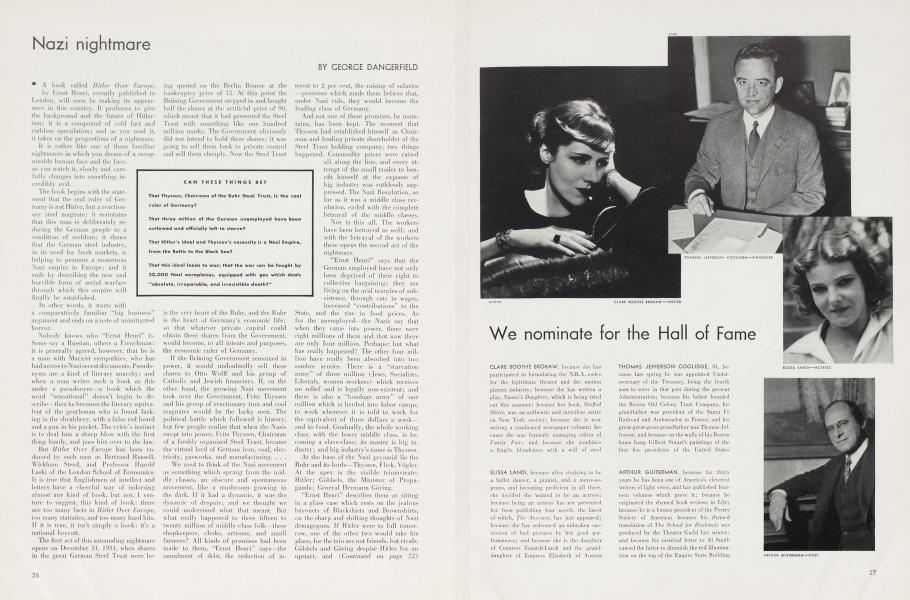
A book called Hitler Over Europe, by Ernst Henri, recently published in London, will soon he making its appearance in this country. It professes to give the background and the future of Hitlerism; it is a compound of cold fact and ruthless speculation; and as you read it, it takes on the proportions of a nightmare.
It is rather like one of those familiar nightmares in which you dream of a recognizable human face and the face, as you watch it, slowly and carefully changes into something incredibly evil.
The book begins with the statement that the real ruler of Germany is not Hitler, but a reactionary steel magnate; it maintains that this man is deliberately reducing the German people to a condition of serfdom; it shows that the German steel industry, in its need for fresh markets, is helping to promote a monstrous Nazi empire in Europe; and it ends by describing the new and horrible form of aerial warfare through which this empire will finally he established.
In other words, it starts with a comparatively familiar "big business" argument and ends on a note of unmitigated horror.
Nobody knows who "Ernst Henri" is. Some say a Russian, others a Frenchman: it is generally agreed, however, that he is a man with Marxist sympathies, who has had access to Nazi secret documents. Pseudonyms are a kind of literary anarchy; and when a man writes such a hook as this under a pseudonym—a hook which the word "sensational" doesn't begin to describe—then he becomes the literary equivalent of the gentleman who is found lurking in the shrubbery, with a false red heard and a gun in his pocket. The critic's instinct is to deal him a sharp blow with the first thing handy, and pass him over to the law.
But Hitler Over Europe has been endorsed by such men as Bertrand Russell, Wickham Steed, and Professor Harold Laski of the London School of Economics. It is true that Englishmen of intellect and letters have a cheerful way of indorsing almost any kind of hook, but not, I venture to suggest, this kind of hook: there are too many facts in Hitler Over Europe, too many statistics, and too many hard hits. If it is true, it isn't simply a hook: it's a national boycott.
The first act of this astounding nightmare opens on December 31, 1931, when shares in the great German Steel Trust were being quoted on the Berlin Bourse at the bankruptcy price of 15. At this point the Brüning Government stepped in and bought half the shares at the artificial price of 90, which meant that it had presented the Steel Trust with something like one hundred million marks. The Government obviously did not intend to hold these shares; it was going to sell them hack to private control and sell them cheaply. Now the Steel Trust is the very heart of the Ruhr, and the Ruhr is the heart of Germany's economic life; so that whatever private capital could obtain these shares from the Government, would become, to all intents and purposes, the economic ruler of Germany.
CAN THESE THINGS BE?
That Thyssen, Chairman of the Ruhr Steel Trust, is the real ruler of Germany?
That three million of the German unemployed have been outlawed and officially left to starve?
That Hitler's ideal and Thyssen's necessity is a Nazi Empire, from the Baltic to the Black Sea?
That this ideal leads to war; that the war can be fought by 20,000 Nazi aeroplanes, equipped with gas which deals "absolute, irreparable, and irresistible death?"
If the Brüning Government remained in power, it would undoubtedly sell these shares to Otto Wolff and his group of Catholic and Jewish financiers. If, on the other hand, the growing Nazi movement took over the Government, Fritz Thyssen and his group of reactionary iron and coal magnates would he the lucky men. The political battle which followed is history, hut few people realize that when the Nazis swept into power, Fritz Thyssen, Chairman of a freshly organized Steel Trust, became the virtual lord of German iron, coal, electricity, gasworks, and manufacturing. . . .
We used to think of the Nazi movement as something which sprang from the middle classes, an obscure and spontaneous movement, like a mushroom growing in the dark. If it had a dynamic, it was the dynamic of despair; and we thought we could understand what that meant. But what really happened to these fifteen to twenty million of middle class folk—these shopkeepers, clerks, artisans, and small farmers? All kinds of promises had been made to them, "Ernst Henri" says—the annulment of debt, the reduction of interest to 2 per cent, the raising of salaries —promises which made them believe that, under Nazi rule, they would become the leading class of Germany.
And not one of these promises, he maintains, has been kept. The moment that Thyssen had established himself as Chairman and leading private shareholder of the Steel Trust holding company, two things happened. Commodity prices were raised all along the line, and every attempt of the small trader to benefit himself at the expense of big industry was ruthlessly suppressed. The Nazi Revolution, so far as it was a middle class revolution, ended with the complete betrayal of the middle classes.
Nor is this all. The workers have been betrayed as well; and with the betrayal of the workers there opens the second act of the nightmare.
"Ernst Henri" says that the German employed have not only been deprived of their right to collective bargaining; they are living on the arid margins of subsistence, through cuts in wages, increased "contributions" to the State, and the rise in food prices. As for the unemployed—the Nazis say that when they came into power, there were eight millions of them and that now there are only four million. Perhaps: but what has really happened? The other four million have really been absorbed into two sombre armies. There is a "starvation army" of three million (Jews, Socialists, Liberals, women workers) which receives no relief and is legally non-existent; and there is also a "bondage army" of one million which is herded into labor camps, to work wherever it is told to work for the equivalent of three dollars a week— and its food. Gradually, the whole working class, with the lower middle class, is becoming a slave-class; its master is big industry; and big industry's name is Thyssen.
At the base of the Nazi pryamid lie the Ruhr and its lords—Thyssen, Flick, Vögler. At the apex is the visible triumvirate: Hitler; Göbbels, the Minister of Propaganda; General Hermann Göring.
"Ernst Henri" describes them as sitting in a glass case which rests on the jealous bayonets of Blackshirts and Brownshirts, on the sharp and shifting thoughts of Nazi demagogues. If Hitler were to fall tomorrow, one of the other two would take his place, for the trio are not friends, but rivals. Göbbels and Goring despise Hitler for an upstart, and Göbbels feels towards Göring "the hatred of the cripple for the drug-fiend". Strong language, Mr. "Henri"; but if it is true, or even partially true, some of those conflicting stories in the papers begin to make a little sense.
Continued on page 72
Continued from page 26
The third act of the nightmare opens with a little house in the Wilhelm-strasse, No. 70a—"in the vicinity of which the passers-by display a tendency to shrink nervously to one side". This is the headquarters of the Foreign Office of the Nazi Party; here sits Dr. Alfred Rosenberg, strategist of the so-called Brown International.
Behind the so-called "Rosenberg Plan" is the monstrous pressure of blast furnaces and pipes and reservoirs and compressors. The Ruhr, the fatal heart of Germany, must expand. It needs the iron ore of Lorraine; it needs Belgian and Dutch coal, Balkan copper. Its own country has grown too small for it; it demands a continent. Its ancient enemy, the Comité des Forges the French Steel Trust), has built a ring of coal and iron around it, and it must break through this ring.
So Alfred Rosenberg is going to translate the Nazi racial policy into terms which the Ruhr demands. He is going to re-chart the map of Europe, to absorb into one group all the so-called "Germanic" peoples—Lorraine, German Switzerland, Flanders, Schleswig. Scandinavia. Silesia, Styria, Moravia, Bohemia, Austria, the Southern Tyrol. How far and how fantastically such a state would spread its borders! It would become a field for all the productive forces of the Ruhr; it would provide an internal market of 100,000.000 consumers; unite the industrial centres of Rhineland with the Danubian peasant plains; place the Balkans under Ruhr control; open up a road to the East.
Suppose this plan can be effected— by federating the Nazi movements of Europe, by the Bismarckian policy of playing one nation against another, by an alliance with Japan . . . then, at one stage or another in the process, there must come a war. The whole Rosenberg Plan is driving towards war; you cannot annex the markets of Europe without fighting for them. At this point in the argument there enters the Schlieffen plan, which the younger Moltke bungled in 1914—the plan of attacking the most dangerous foe with the entire force. The most dangerous foe is still France.
Between Belfort and Luxembourg there lies the greatest military construction in the world, the French "National Trench", a chain of subterranean steel fortresses, against wrhich any army must break. Germany, even if it had the necessary army, could never fight France by land.
But there is another way.
The fourth act in this imagined nightmare features an air-minded Napoleon, General Hermann Göring. General Göring dreams of an army of 20,000 aeroplanes; he is even creating this army today. There is a new branch of the Nazi army, the National Socialist Air Storm Troopers (Luftsturme der S.A.) which is intimately connected with Goring.
Today, the Lufthansa, commercial aeroplanes—1.200 strong—could be turned into deadly fighting machines within four to eight hours; their pilots know the European routes by heart, the wind conditions, the strategical possibilities. Today, the new German aeroplane industry is equipped to produce 2,000 planes a week. Daimler, Benz and other automobile firms are doing their part; Siemens is working three daily shifts; Junkers and Dornier are open again; new serial factories are appearing in Hamburg, Bremen, and in the Rhineland. All the factory personnel is Nazi; the orders come from Nazi district groups; the whole industry is under Party control.
If Göring's deadly force materializes — (and "Ernst Henri", as usual, has a cold array of facts and figures)—what could prevent its flying, by Holland or Switzerland, straight into the heart of France? The great Chemical Trust, interwoven as it is with the Steel Trust, is preparing for this supreme moment —it is said to have invented as many as 1000 new kinds of poison gas. For Göring's air force will not only be the greatest fighting air force in the world ; it will also be equipped with gasbombs, bombs loaded with bacilli, incendiary bombs. There is a gas being manufactured in Oppau, and tested in Kunnersdorf, which can penetrate any known gas mask.
If the moment for attack ever comes, this is the nightmare air army which Goring will release, and the mere existence of such a plan has, as it were, torn up the strategical map of Europe. "Nazi dreadnoughts over the Alps" our author intones, "over Lyons! Over Paris!" Whether all this is true or not, nobody can tell: but a more charnel prophecy has never been made—not since the days of Ezekiel and Daniel and all the minor prophets.
Subscribers have complete access to the archive.
Sign In Not a Subscriber?Join Now
