Sign In to Your Account
Subscribers have complete access to the archive.
Sign In Not a Subscriber?Join NowPortrait of a bird-of-all-work
"Swanee" Taylor, odd-job man and the last of the country's old aerial barnstormers
PAUL GALLICO
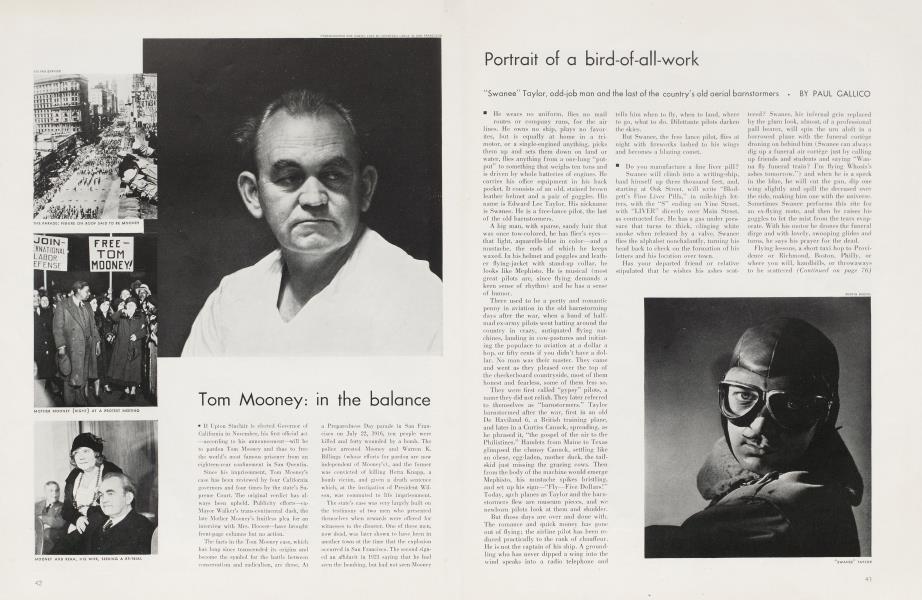
He wears no uniform, flies no mail routes or company runs, for the air lines. He owns no ship, plays no favorites, but is equally at home in a trimotor, or a single-engined anything, picks them up and sets them down on land or water, flies anything from a one-lung "putput" to something that weighs ten tons and is driven by whole batteries of engines. He carries his office equipment in his back pocket. It consists of an old, stained brown leather helmet and a pair of goggles. His name is Edward Lee Taylor. His nickname is Swanee. He is a free-lance pilot, the last of the old barnstormers.
A big man, with sparse, sandy hair that was once tow-colored, he has flier's eyes— that light, aquarelle-blue in color—and a mustache, the ends of which he keeps waxed. In his helmet and goggles and leather flying-jacket with stand-up collar, he looks like Mephisto. He is musical (most great pilots are, since flying demands a keen sense of rhythm) and he has a sense of humor.
There used to be a pretty and romantic penny in aviation in the old barnstorming days after the war, when a band of halfmad ex-army pilots went batting around the country in crazy, antiquated flying machines, landing in cow-pastures and initiating the populace to aviation at a dollar a hop, or fifty cents if you didn't have a dollar. No man was their master. They came and went as they pleased over the top of the checkerboard countryside, most of them honest and fearless, some of them less so.
They were first called "gypsy" pilots, a name they did not relish. They later referred to themselves as "barnstormers." Taylor barnstormed after the war, first in an old De Haviland 6, a British training plane, and later in a Curtiss Canuck, spreading, as he phrased it, "the gospel of the air to the Philistines." Hamlets from Maine to Texas glimpsed the clumsy Canuck, settling like an obese, egg-laden, mother duck, the tailskid just missing the grazing cows. Then from the body of the machine would emerge Mephisto, his mustache spikes bristling, and set up his sign—"Fly—Five Dollars!" Today, spch planes as Taylor and the barnstormers flew are museum pieces, and we newborn pilots look at them and shudder.
But those days are over and done with. The romance and quick money has gone out of flying; the airline pilot has been reduced practically to the rank of chauffeur. He is not the captain of his ship. A groundling who has never dipped a wing into the wind speaks into a radio telephone and tells him when to fly, when to land, where to go, what to do. Dilettante pilots darken the skies.
But Swanee, the free lance pilot, flies at night with fireworks lashed to his wings and becomes a blazing comet.
* Do you manufacture a fine liver pill?
Swanee will climb into a writing-ship, haul himself up three thousand feet, and, starting at Oak Street, will write "Blodgett's Fine Liver Pills," in mile-high letters, with the "S" ending on Vine Street, with "LIVER" directly over Main Street, as contracted for. He has a gas under pressure that turns to thick, clinging white smoke when released by a valve. Swanee flies the alphabet nonchalantly, turning his head back to check on the formation of his letters and his location over town.
Has your departed friend or relative stipulated that he wishes his ashes scattered? Swanee, his infernal grin replaced by the glum look, almost, of a professional pall bearer, will spin the urn aloft in a borrowed plane with the funeral cortege droning on behind him (Swanee can always dig up a funeral air cortege just by calling up friends and students and saying "Wanna fly funeral train? I'm flying Whosis's ashes tomorrow.") and when he is a speck in the blue, he will cut the gun, dip one wing slightly and spill the deceased over the side, making him one with the universe. Sometimes Swanee performs this rite for an ex-flying mate, and then he raises his goggles to let the mist from the tears evaporate. With his motor he drones the funeral dirge and with lovely, swooping glides and turns, he says his prayer for the dead.
Flying lessons, a short taxi hop to Providence or Richmond, Boston, Philly, or where you will, handbills, or throwaways to be scattered from the air, camera jobs of newspapers or motion picture companies, 'chute jumpers, missing persons lost in forests, lyric moonlight flights at night over an enchanted city—call Swanee, the odd jobs man. If it can be done in the air and the weather is right, he will take off.
Continued on page 76
Continued from page 43
And sometimes too when the weather is not right, the odd jobs man will fly, even contrary to his axiom for students and all pilots—"Watch the birds for flying weather. If they're on the ground, YOU stay on the ground. Birds will not fly in had weather." Like all big men who live dangerously, he is a sentimentalist. He flew Santa Claus over Newark one Christmas Day in a roaring blizzard because the children of the poor were waiting.
Swanee was flying a dummy Santa Claus. The live Santa waited inside the Newark Athletic Club. Swanee was to fly over and drop the dummy onto the roof. After a reasonable wait, the other Santa was to run out the front door with the usual "Hello, dear children."
Snow fell. The airlines closed up, grounded their ships and put the mail on the trains. Taylor called up from the airport and said he didn't think he'd fly. The committee knew nothing about aviation or flying weather. They said the children were waiting in the cold outside the building and would he heartbroken. Swanee climbed in and took off from Hadley Field and a few minutes later came batting up Broad Street in a snowstorm with snowflakes as large as two-bit pieces swirling about him. His old Curtiss Canuck was roaring boldly, but if she quit he was a dead man. He got over the Athletic Club. There was a gas tank on the left to keep his eye on and more skyscrapers to the right, and ahead, fog over the marshes. It was too much for Swanee. Against the storm and the propellor backwash, he howled —"Merry Christmas, Nuts!" took the dummy Santa by the neck and pitched it over the side and lit out for the home field, hoping that the thing would not land at the feet of the happy kiddies. Thestuffed Santa fell exactly as it was supposed to fall, and the real Santa had come forth shouting "Merry Christmas, dear children," and everyone was delighted. But Swanee stayed in a cold sweat all the merry Yule day because when he checked his engine after the flight, he found a loose connection which in five more minutes would have sent him and his dummy straight to Hell.
Fog, wind, and weather are the flier's spectres but the real terror is fire. Swanee once caught fire in a Spad single sealer over Kelly Field when he was in the Army, following a threethousand-foot power dive. This was in the pre-chute days. Swanee talks to himself in emergencies. This time he said—"I am a toasted marshmallow. I am a toasted marshmallow"—stuck her up on one wing and side-slipped three thousand feet to the ground. When he arrived there, he found that he had blown the fire out and that he was not a toasted marshmallow. When he got out, he kissed the ground and even chewed a bit of precious clay.
And yet among his odd jobs, Swanee still flies fireworks at night—for the thrill of it as much as anything else. He goes aloft with pinwheels, roman candles, gold and silver rains, and star bursts wired to his wings, and when he gets up he touches them off with an electric switch, one wing at a time, but usually something goes wrong, and both wings go "Ploooof!", blinding bim for fifteen minutes, and he is trying to fly an even course while dodging the flaming balls shot at his head.
Swanee was born Edward Lee Taylor in Marshall, Texas, some forty years ago. Like most old time barnstorming free-lance pilots, the war started him flying, but curiously enough, as a balloonist—in which branch of service he remained until the end of the war, when he abandoned lighter-than-air craft forever. He took a reserve commission and then as noted went a-barnstorming. And when the bottom fell out of that romantic racket, he did s*omething that very few land pilots will do. He entered the U. S. Naval Reserve Force and learned how to fly water craft, the weirdest and most difficult art of all, not that they don't all fly and land alike, but handling seaplanes on the water calls for a knowledge of sailing, motor-boating, ice-boating, tobogganing, navigation, hydroplaning, and strong language.
You do not get to know Swanee until you fly with him as a student and try to take directions from his personal and private sign language or listen to his hurt sarcasm. I was flying him over the Alleghenies one hazy morning in an old Travelair single-engined, six place flying ice-wagon. I was at the controls and Taylor was navigating. Suddenly he placed his lips to my ear and howled—"Paulie—do you see that mountain ahead of us?" I said that I did. "Well here it is on the map. How high does the map say it is?" I looked and shouted back that the map said the mountain was 2,800 feet high. "Right, Paulie, and what does your altimeter say?" I said that the altimeter registered 3,000 feet. "Well, then, for God's sakes, Paulie, will you put more than two hundred feet between me and the top of that mountain. I am a very nervous and fearful man."
All pilots are slightly mad. One of Swanee's axioms is—"No aviator yet has sprouted feathers." But if any ever do, Taylor will be the first. On the ground he is a large, slightly bewildered, sandy-haired man out of his element. He will not fly with a student who has had a drink the night before. "Air and alcohol won't mix," he tells the offending party, and sends him home. Aloft he becomes the complete master of this new art and technique, debonair, capable, efficient, and sometimes purely lyric in the use of the third dimension, as he flies spirals and curves. He never stunts an aeroplane unless instructing. He never takes a chance. He never lost a student or had one seriously hurt. He still instructs— the most dangerous of all his odd jobs, but he would rather not. No student can pay him in money for that agonizing moment when he stands far below on a vast field, a tiny figure in helmet and flying suit, and watches, with sweat oozing from every pore, his student take his first solo flight around the field.
Subscribers have complete access to the archive.
Sign In Not a Subscriber?Join Now
