Sign In to Your Account
Subscribers have complete access to the archive.
Sign In Not a Subscriber?Join NowIndividualism cheats the Coroner
H. L. MENCKEN
The ego, springing eternal in the human breast, gives pause to those who would substitute "state" for "self"
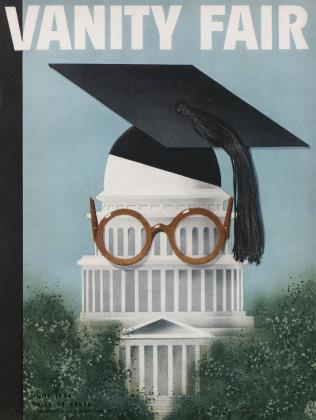
■ In the United States today we hear many discourses directed against the ancient wickedness called Individualism. This individualism, it appears, is to blame for all our woes, whether economic, sociological or moral. Like love it is a conspiracy against virtue, and like alcohol it shuts off the light of the stars. The way to escape from it is by the path of what is called a Planned Economy. The individual must slit the weasand of his freedom on the altar of the common good. He must yield himself to the guidance of inspired and superhuman Führer, chosen for the job by themselves and God. If he hesitates, then he becomes ferae naturae, and may be hunted with hound and horn.
Two massive facts, alas, stand against the realization of this programme. The first is that the self-interest which lies at the bottom of individualism appears to be an integral and ineradicable elemont in the constitution of every man of any human dignity, and that stamping it out, if it were really possible, would probably be as hazardous as extirpating his liver. And the second is that a Planned Economy, far from stamping it out, does not oven diminish it, but simply subordinates the modest self-interest of the general run of men for the swollen self-interest of a small group of excessively prehensile, domineering and damfoolish men. In brief, the choice is not between self-interest and self-surrender but between two kinds of self-interest, and the kind that prevails is often hard to distinguish from the mere pathological lust to rule or ruin.
■ This lust I describe as pathological, and on sound grounds. It is not observed in men of ordinary sense and decency, no matter how eager their desire to butter their own parsnips. They want what they want when they want it, and they like to be let alone, but they do not object to the other fellow wanting what he wants, and they let him alone in his turn. There is, however, a kind of man to whom any such policy of live-and-let-live is a psychological impossibility. He is moved by an implacable impulse to stick his nose into his neighbor's business, to order and regulate his neighbor's life, to run his neighbor in all departments. Usually he describes himself as an altruist, but always, in actuality, he is an egoist of the most brutal and banal variety. To this unhappy faction belong all the tin-pot despots who now rage in the world, and all the Brain Trusts which fill its air with blah. In Hitler, Mussolini and Stalin the fraternity has grand masters, and everywhere it has chapters. The first principle of the politics of these grand masters, whether they function at Berlin or at Rome, at Moscow or at Washington, is always this: that nobody has any rights that the state is bound to respect. And they are the state.
Thus, by a monstrous parody of Gresham's Law, bad individualism seeks to drive out good. The great masses of inferior men are always ready to yield up their free agency, whether for sound reasons or the reverse. As Nietzsche long ago observed, liberty gives them the shivers. They shrink from the burden of deciding for themselves, and are ever eager to join themselves with other men, and to take whatever orders any visible leader chooses to issue. His credentials they seldom examine particularly; so long as he speaks in loud and positive tones they are willing to obey him. Thus they are always eager supporters of government, of organized religion, and of all the other common devices to guide and regiment conduct and opinion. And when everything else is equal they naturally prefer the loudest leader to the wisest, for wisdom makes intolerable demands upon that prudence which they find so painful, and it is much easier and more comfortable to follow the noise. The fact explains the constant success of demagogues on this earth, some of them so preposterous that it is hard to imagine sane adults being taken in by them. They succeed because they avoid all rational argument, which challenges and tortures the judgment, and confine themselves to mere hollering, which boils the blood without touching the mind at all.
Such demagogues find an especially good market for their wares in times of grave public difficulty and concern, for it is then hard for even intelligent men to decide what measures will best serve their interest, and for the common run of men it is quite impossible. So the first quack who comes along with a simple scheme for the general deliverance is certain of an audience, and if he states it with sufficient assurance, waving aside all other proposals as infamous, he will quickly talk down the schemes of wiser men. History bristles with examples. There was a massive one in the South after the horrors of Reconstruction, when the intolerable state of the whole region reduced the majority of men to despair. Some wise leaders arose to counsel them, but they preferred quacks, and in the end the worst of the lot—Vardaman, Blease, and so on—prevailed against all the rest. Thus the recovery of the South was postponed for many years, and even today it is still far from achieved.
In our own time there have been many parallel cases. If Russia, Italy and Germany had come out of the World War unscathed they would have had no revolutions, and no uprising of bogus messiahs. But they emerged badly damaged and demoralized, and so the way was open to the brethren—almost instantly in Russia, after several years of hopeless turmoil in Italy, and only after half a generation of exhausting hauling and pulling in Germany. France, damaged less, has resisted longer, hut even France has a leg off and a silver plate in its skull, and on some near tomorrow—perhaps even before these lines get into type—there may be a new Mussolini marching down the Champs-Élysées, and a new war on individualism under way. In precisely the same way the ancient comedy has been played out in the United States. Every time there has been a Depression there has been a rich flowering of wizards offering to rescue the country at the price of its liberties, but not until the Depression of 1929-33 began to be magnified horribly by the fears and incapacity of Lord Hoover was the stage really set for a coup d'état. The plain people, after some dizzy wobblings, had resisted the Greenbackers in the 70's and Bryan in the 90's, but four years of Hoover threw them headlong into the arms of the Brain Trust.
■ In its programme, luckily, there is nothing genuinely alarming, for most of its professed aims are psychologically and even biologically impossible of attainment. All such outfits come into power announcing a New Day in clarion, confident tones, and all of them subside pianissimo with the re-dawn of the old one. The most that any of them ever actually accomplishes is to substitute a gang of amateur politicians for the old gang of professionals, and even that is commonly only a transient achievement. The professionals at Washington are already sapping and mining the works of the pedagogues, and in a little while they will emerge from their trenches and try to rush the battlements. In that heroic endeavor they will have many advantages, the chief of which is that they are even worse frauds than the pedagogues. In fact, they are all fraud, and so they avoid the grave danger of believing in their own magic, to the demoralization of their strategy and tactics. But whether they gain the day or not it will he all one, for the pedagogues, if they remain in power a year or so longer, will turn into professionals themselves, just as their colleagues of Moscow have turned into professionals. Some of them, indeed, already show plain signs of that inevitable metamorphosis.
(Continued on page 65)
(Continued from page 35)
But the main point is not that these gifted floggers of sophomores are doomed to come to a had end, whether at the hands of the professionals or at that of Mother Nature herself: it is that the individualism they have set out to put down will survive them for many a long year, and is in truth flourishing under their very noses at this minute. Their control of private enterprise, the cornerstone of their polity, began to slacken the instant they tried to exert it. For what they awoke in the objects of their science was a natural reaction amounting almost to a tropism—the instinctive tendency of every healthy man to leap away when a hand reaches for his wallet. In brief, what they awoke was individualism, and it has been giving them plenty to think of ever since. Following the ancient pattern of pseudo - scientists everywhere they sought to dispose of it by giving it a new and fearsome name, to wit, chiseling, but despite the name it kept on operating just the same. It is at this present moment working assiduously in two ways. On the one hand, it is reviving enterprise, getting capitalism on its legs again, and promoting the Recovery. And on the other hand it is gradually pulling the floor from under the New Deal. In another year or so you will see every American of any intelligence running his own affairs once more, without any greater fear of the cops than the bootleggers had by 1928; and that will be the end of the Brain Trust.
Long before that time the last of its literary whoopers-up will have deserted it; indeed, most of them are ratting on it already. These brethren leaped aboard the bandwagon last year after some rough jolting in other vehicles. Nearly all of them had been parlor pinks in their time, and a good many, in the hopeful morning of the Russian buffoonery, had turned Communist, and talked grandly of marching on Wall Street and confiscating the gold of J. Pierpont Morgan. When Technocracy was born they glowed with hope, and when it turned out to be born dead they fell into the arms of a Planned Economy. On the side of the lovely arts they were Dadaists one day, Futurists the next, and New Humanists over Sunday. By locking up Communism and the New Humanism in a dark room they bred a politico-aesthetic theory to the effect that only that writer (or painter, or sculptor, or architect, or composer) who thought in terms of the suffering proletariat was or ever could be a sound artist, thus proving forever the inferiority of Shakespeare and Goethe to J. Llewellyn Fineberg, Bruce I. Margolis, and Mike Gold. The Brain Trust gospel, in its virgin form, seemed a direct answer to their prayers. Like all their own arcana it proposed grandly to upset the smug, wicked villains who were apparently having so good a time in the world, and to hand over their goods and hereditaments to worthy fellows who were not doing so well. So the boys joined the lodge, and for a while General Hugh S. Johnson, J. D., was almost as heroic a figure in their eyes as Diego Rivera.
But all that is now over, and their enthusiasm oozes out as Hugh follows Diego down the chute to the Rockefeller glue-works. They were, in fact, rather badly used by the Brain Trust, which turned out to be extremely bourgeois at heart, despite all its inflammatory talk against money. When it began itself to obtain access to money in large amounts it quite forgot the revolutionary literati, and gave all the soft jobs on its publicity staff to Washington correspondents out of jobs. And for the higher places at GHQ it passed over all the experts in the Marxian dialectic for gabby young professors, first-page lawyers, philosophical chicken-farmers, and similar dubious fauna. There followed a great falling away of converts, and today the Brain Trust is hammered almost as much in Left periodicals as in the Saturday Evening Post.
Alas, it is not easy to make revolutions, either on the politico-economic front or in the domain of the arts. They all collapse when they are permitted to collide with the eternal nature of man. It is not in that nature for a man with what appears to he a likely idea for lining his pockets to yield up its execution to a gang of petty pedagogues and attorneys, just as it is not in that nature for a man with an idea for a novel to write it according to the specifications of a gang of East Side Taines. Such men can be diverted from their native purpose only by putting them to death or heaving them out of the country, as was done in Russia, and even then they leave their poisonous heresies behind them, to upset and afflict the less abject wing of goosesteppers. In brief, deliverance from individualism is possible only on those low levels where there was none to begin with—among the great horde of incompetent, timorous and incurably stupid men. They rejoice every time some quack proposes to exterminate it among their betters, but what they hope for never really happens. Among those betters being an individualist is indistinguishable from being alive.
Thus the grandiose project of the Brain Trust was doomed almost before it was launched, and at its highest point it never achieved anything more than a vague nuisance value. The poor fish who believed seriously that it would lift them out of their mudhole and make them superior to their superiors were simply fooled once more —perhaps for the thousandth time in the history of the world. The progress of Homo sapiens in the United States, hereafter as in the past, will be carried on by men who follow their own ideas and serve their own interests. If the quacks who have lately tried to halt that inevitable process have any actual ideas of their own they may conceivably take a share in it. But so far their so-called ideas have turned out to be only hallucinations.
Subscribers have complete access to the archive.
Sign In Not a Subscriber?Join Now
