Sign In to Your Account
Subscribers have complete access to the archive.
Sign In Not a Subscriber?Join NowPetticoat government
JAY FRANKLIN
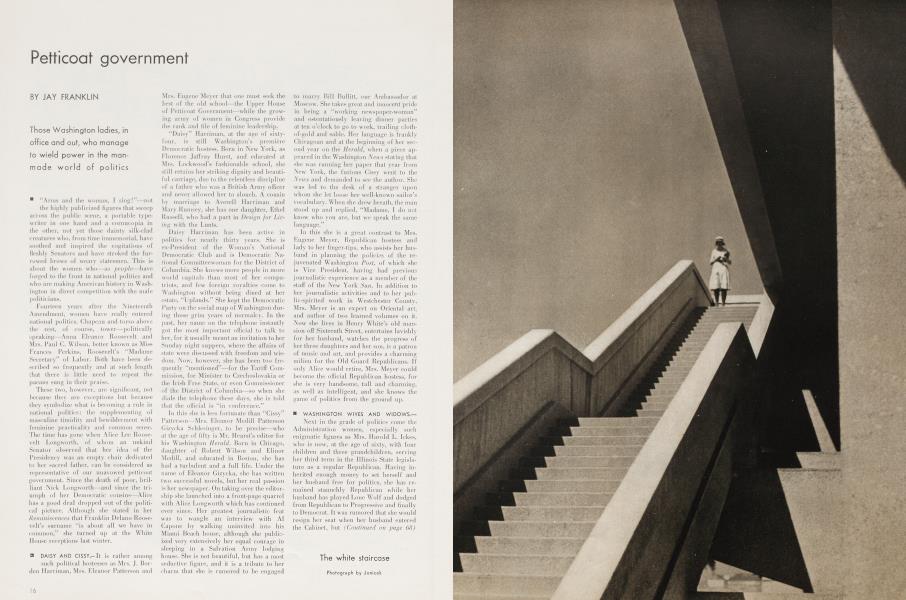
Those Washington ladies, in office and out, who manage to wield power in the manmade world of politics
"Arms and the woman, I sing!"—not the highly publicized figures that sweep across the public scene, a portable typewriter in one hand and a cornucopia in the other, not yet those dainty silk-clad creatures who, from time immemorial, have soothed and inspired the cogitations of fleshly Senators and have stroked the furrowed brows of weary statesmen. This is about the women who—as people—have forged to the front in national politics and who are making American history in Washington in direct competition with the male politicians.
Fourteen years after the Nineteenth Amendment, women have really entered national politics. Chapeau and torso above the rest, of course, tower—politically speaking—Anna Eleanor Roosevelt and Mrs. Paul C. Wilson, better known as Miss Frances Perkins, Roosevelt's "Madame Secretary" of Labor. Both have been described so frequently and at such length that there is little need to repeat the paeans sung in their praise.
These two, however, are significant, not because they are exceptions but because they symbolize what is becoming a rule in national politics: the supplementing of masculine timidity and bewilderment with feminine practicality and common sense. The time has gone when Alice Lee Roosevelt Longworth, of whom an unkind Senator observed that her idea of the Presidency was an empty chair dedicated to her sacred father, can be considered as representative of our unavowed petticoat government. Since the death of poor, brilliant Nick Longworth—and since the triumph of her Democratic cousins—Alice has a good deal dropped out of the political picture. Although she stated in her Reminiscences that Franklin Delano Roosevelt's surname "is about all we have in common," she turned up at the White House receptions last winter.
DAISY AND CISSY.—It is rather among such political hostesses as Mrs. J. Borden Harriman, Mrs. Eleanor Patterson and Mrs. Eugene Meyer that one must seek the best of the old school—the Upper House of Petticoat Government—while the growing army of women in Congress provide the rank and file of feminine leadership.
"Daisy" Harriman, at the age of sixtyfour, is still Washington's premiere Democratic hostess. Born in New York, as Florence Jaffray Hurst, and educated at Mrs. Lockwood's fashionable school, she still retains her striking dignity and beautiful carriage, due to the relentless discipline of a father who was a British Army officer and never allowed her to slouch. A cousin by marriage to Averell Harriman and Mary Rumsey, she has one daughter, Ethel Russell, who had a part in Design for Living with the Lunts.
Daisy Harriman has been active in politics for nearly thirty years. She is ex-President of the Woman's National Democratic Club and is Democratic National Committeewoman for the District of Columbia. She knows more people in more world capitals than most of her compatriots, and few foreign royalties come to Washington without being dined at her estate, "Uplands." She kept the Democratic Party on the social map of Washington during those grim years of normalcy. In the past, her name on the telephone instantly got the most important official to talk to her, for it usually meant an invitation to her Sunday night suppers, where the affairs of state were discussed with freedom and wisdom. Now, however, she has been too frequently "mentioned"—for the Tariff Commission, for Minister to Czechoslovakia or the Irish Free State, or even Commissioner of the District of Columbia—so when she dials the telephone these days, she is told that the official is "in conference."
In this she is less fortunate than "Cissy" Patterson—Mrs. Eleanor Medill Patterson Gizycka Schlesinger, to be precise—who at the age of fifty is Mr. Hearst's editor for his Washington Herald. Born in Chicago, daughter of Robert Wilson and Elinor Medill, and educated in Boston, she has had a turbulent and a full life. Under the name of Eleanor Gizycka, she has written two successful novels, but her real passion is her newspaper. On taking over the editorship she launched into a front-page quarrel with Alice Longworth which has continued ever since. Her greatest journalistic feat was to wangle an interview with A1 Capone by walking uninvited into his Miami Beach house, although she publicized very extensively her equal courage in sleeping in a Salvation Army lodging house. She is not beautiful, but has a most seductive figure, and it is a tribute to her charm that she is rumored to be engaged to marry. Bill Bullitt, our Ambassador at Moscow. She takes great and innocent pride in being a "working newspaper-woman" and ostentatiously leaving dinner parties at ten o'clock to go to work, trailing cloth-of-gold and sable. Her language is frankly Chicagoan and at the beginning of her second year on the Herald, when a piece appeared in the Washington News stating that she was running her paper that year from New York, the furious Cissy went to the News and demanded to see the author. She was led to the desk of a stranger upon whom she let loose her well-known sailor's vocabulary. When she drew breath, the man stood up and replied, "Madame, I do not know who you are, but we speak the same language."
In this she is a great contrast to Mrs. Eugene Meyer, Republican hostess and lady to her finger-tips, who assists her husband in planning the policies of the rejuvenated Washington Post, of which she is Vice President, having had previous journalistic experience as a member of the staff of the New York Sun. In addition to her journalistic activities and to her public-spirited work in Westchester County, Mrs. Meyer is an expert on Oriental art, and author of two learned volumes on it. Now she lives in Henry White's old mansion off Sixteenth Street, entertains lavishly for her husband, watches the progress of her three daughters and her son, is a patron of music and art, and provides a charming milieu for the Old Guard Republicans. If only Alice would retire, Mrs. Meyer could become the official Republican hostess, for she is very handsome, tall and charming, as well as intelligent, and she knows the game of politics from the ground up.
WASHINGTON WIVES AND WIDOWS.— Next in the grade of politics come the Administration women, especially such enigmatic figures as Mrs. Harold L. Ickes, who is now, at the age of sixty, with four children and three grandchildren, serving her third term in the Illinois State legislature as a regular Republican. Having inherited enough money to set herself and her husband free for politics, she has remained staunchly Republican while her husband has played Lone Wolf and dodged from Republican to Progressive and finally to Democrat. It was rumored that she would resign her seat when her husband entered the Cabinet, but she did nothing of the sort. Instead, she commutes between her home at Winnetka, the State Capital at Springfield, her 'dobe summer camp at Gallup, N. M., and Washington, D. C. Tall, gray-haired, but not nearly so severe as she looks in photographs, she keeps a trained eye on state and national politics and has been so much busier holding office while her husband grew dahlias that he was long known as Mrs. Ickes' husband.
(Continued on page 68)
(Continued from page 16)
In this she is simply being herself, as is, in an entirely different way, Mary Harriman Rumsey, head of the Consumers' Advisory Board of the N.R.A. The daughter of E. H. Harriman, the railroad colossus of the early 1900's, and the sister of Averell Harriman, co-publisher of Raymond Moley's Today, Mary Rumsey has some of the vitality of the industrial titans of the railroad era. She founded the Junior League, she studied biology and eugenics so hard at Barnard College that she was nicknamed Eugenia, she once ran a small-town newspaper, she has sponsored cooperative farm movements, and used to sit beside her father at directors' meetings. In 1910 she married Charles Carey Rumsey, the poloist and sculptor, and bore him one daughter and two sons before his death in an automobile accident twelve years later. She is a warm friend of George Russell— "./E"—editor of The Irish Statesman, from whom she got her ideas on cooperatives and who inspired her to organize the Eastern Livestock Cooperative Marketing Association and later the Emergency Exchange Association which enabled the unemployed to barter their labor for food. Small, brown-eyed, slender, bubbling over with spirits and ideas, she does business anywhere, at any time, and always with enthusiasm.
Women who hold elective office are generally widows, to whom the job has been offered as a sort of substitute for a pension. Strangely enough, this illogical method of selection has given us some remarkably able politicians. For one Senator Hattie W. Caraway, Democrat of Jonesboro, Arkansas, who was appointed to succeed her husband in 1931 and reelected by Huey Long to spile Joe Robinson, and who spends most of her time doing cross-word puzzles at her desk in the Senate, there are half a dozen in the lower house who can run circles around the men.
Take, for example, Florence Prag Kahn, widow of Julius Kahn, staunch Republican of California, who has served in Congress since 1925. With Mrs. Edith Nourse Rogers, Mrs. Kahn ranks with any male member for hard work, ability, and understanding of her job. Her political creed is high tariff, big navy, vote regular, but she talks exactly as pleases her own fancy and has taken Calvin Coolidge's place with her dry wit. She has no personal vanity, lets her hair pile up in a messy knot, won't reduce or dress neatly, and when asked why she thought she was so handsomely reelected in 1932 replies that she supposes it was her sex appeal. When she first came to Congress, she was assigned to the Indian Affairs Committee. She balked, saying that the only Indians in her district were wooden ones outside of cigar stores, and that she couldn't do anything for them. Born in Salt Lake City — date unrevealed — educated at the University of California, a former teacher of English at high school, she now revels in free and careless speech and, as a result, dines out, night after night, in Washington's grandest houses, where the "genteel" Congressional ladies are never bidden.
Or take Edith Rogers, who entered Congress the same year as Mrs. Kahn and has been there ever since, representing the Republicans of eastern Massachusetts and, above all, the disabled veterans. She was a Red Cross worker during the war, serving overseas in France, in a Y. M. C. A. Eagle Hut, and no disabled veteran knocks at her door in vain. Her persistence lands jobs for ten men in the Government to her colleagues' one, and she is the final resource of every favorseeking "war hero" turned down by his own hard-boiled Congressman. She is a very hard worker, rarely takes a vacation, and has done really remarkable work in developing legislative support for the U. S. Foreign Service and for Civil Service requirements. She is amusing and light-hearted, and a frequent violator of Congressional courtesies when they stand in the way of common sense.
Or take the newly elected Isabella Greenway, born in Kentucky, educated in New York, one of Mrs. Roosevelt's bridesmaids, widow of two consecutive Rough Riders, Bob Fergson and Jack Greenway, and inheritor of Lewis Douglas's place as Representative of the sovereign State of Arizona. At the age of forty-six, she is turning Washington politics and society upside down. A bona fide beauty of the windblown, Gibson girl type, complete with pompadour and chiffon, she campaigned for A1 Smith in 1928, seconded Roosevelt's nomination in 1932, and has already been mentioned as possible Governor of Arizona.
Then there are the vast army of competent, anonymous secretaries, stenographers, file-clerks, the platoons of office-workers in skirts who save the political big shots the trouble of ninetenths of their routine thinking and fifty per cent of their "inspired" ideas. Such competent figures as "Robbie"— Miss Frances Robinson, to you—who serves as a buffer between the volcanic Hugh Johnson and the outer world; "Missy"—Miss Marguerite Lehand— at the White House, who has been the President's and Mrs. Roosevelt's highly competent and devoted secretary for fourteen years; Miss Durand, who guards the intricate mental processes of that gnarled and gray eminence of the Secretariat, Louis McHenry Howe; and the host of women, old, young or indifferent, who are at their desks at nine A.M. for men who arrive at ten, and who work long after the statutory 4:30 P.M. closing time.
The women have begun to enter politics at the top, but they have found their sex already in occupation of the ground floor of national politics, by virtue of the strongest of political claims—that of being competent, useful, and indispensable to the running of the country.
Subscribers have complete access to the archive.
Sign In Not a Subscriber?Join Now

