Sign In to Your Account
Subscribers have complete access to the archive.
Sign In Not a Subscriber?Join NowThe Inflationary Follies
JAY FRANKLIN
Fantastic schemes for fiat money, silver, and scrip, which Congressmen have offered as national remedies
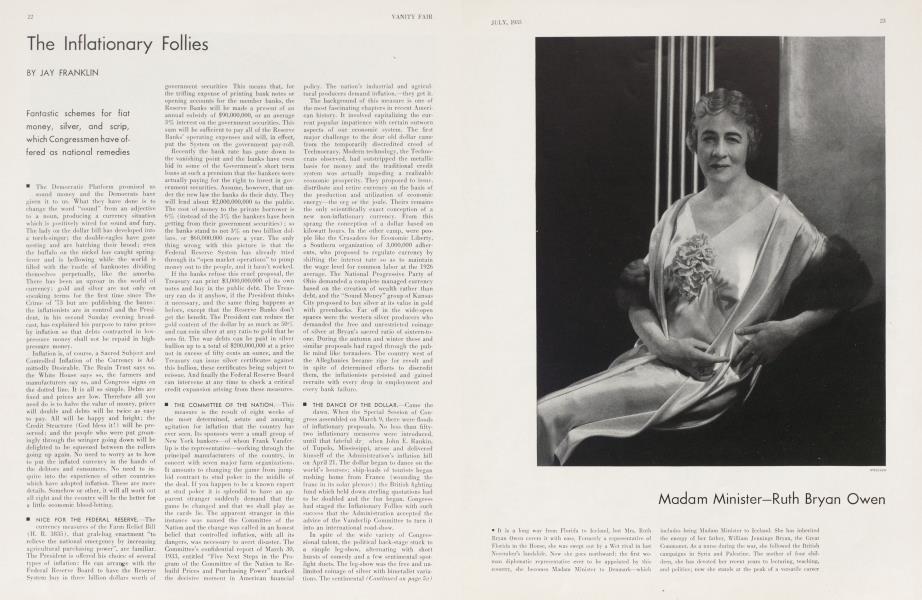
■ The Democratic Platform promised us sound money and the Democrats have given it to us. What they have done is to change the word "sound" from an adjective to a noun, producing a currency situation which is positively wired for sound and fury. The lady on the dollar bill has developed into a torch-singer; the double-eagles have gone nesting anti are hatching their brood; even the buffalo on the nickel has caught spring-fever and is bellowing while the world is filled with the rustle of banknotes dividing themselves perpetually, like the amoeba. There has been an uproar in the world of currency; gold and silver are not only on speaking terms for the first time since The Crime of '73 but are publishing the banns; the inflationists are in control and the President, in his second Sunday evening broadcast, has explained his purpose to raise prices by inflation so that debts contracted in low-pressure money shall not he repaid in high-pressure money.
Inflation is, of course, a Sacred Subject and Controlled Inflation of the Currency is Admittedly Desirable. The Brain Trust says so, the White House says so, the farmers and manufacturers say so, and Congress signs on the dotted line. It is all so simple. Debts are fixed and prices are low. Therefore all you need do is to halve the value of money, prices will double and debts will be twice as easy to pay. All will be happy and bright; the Credit Structure (God bless it!) will be preserved; and the people who were put groaningly through the wringer going down will be delighted to be squeezed between the rollers going up again. No need to worry as to how to put the inflated currency in the hands of the debtors and consumers. No need to inquire into the experience of other countries which have adopted inflation. These are mere details. Somehow or other, it will all work out all right and the country will be the better for a little economic blood-letting.
■ NICE FOR THE FEDERAL RESERVE.—The currency measures of the Farm Relief Bill (H. R. 3835), that grab-bag enactment "to relieve the national emergency by increasing agricultural purchasing power", are familiar. The President is offered his choice of several types of inflation: He can arrange with the Federal Reserve Board to have the Reserve System buy in three billion dollars worth of government securities This means that, for the trifling expense of printing bank notes or opening accounts for the member banks, the Reserve Banks will be made a present of an annual subsidy of §90,000,000, or an average 3% interest on the government securities. This sum will be sufficient to pay all of the Reserve Banks' operating expenses and will, in effect, put the System on the government pay-roll.
Recently the bank rate has gone down to the vanishing point and the banks have even bid in some of the Government's short term loans at such a premium that the bankers were actually paying for the right to invest in government securities. Assume, however, that under the new law the banks do their duty. They will lend about $2,000,000,000 to the public. The cost of money to the private borrower is 6% (instead of the 3% the bankers have been getting from their government securities) ; so the hanks stand to net 3% on two billion dollars, or §60,000.000 more a year. The only thing wrong with this picture is that the Federal Reserve System has already tried through its "open market operations" to pump money out to the people, and it hasn't worked.
If the banks refuse this cruel proposal, the Treasury can print §3,000,000,000 of its own notes and buy in the public debt. The Treasury can do it anyhow, if the President thinks it necessary, and the same thing happens as before, except that the Reserve Banks don't get the benefit. The President can reduce the gold content of the dollar by as much as 50% and can coin silver at any ratio to gold that he sees fit. The war debts can be paid in silver bullion up to a total of §200,000,000 at a price not in excess of fifty cents an ounce, and the Treasury can issue silver certificates against this bullion, these certificates being subject to reissue. And finally the Federal Reserve Board can intervene at any time to check a critical credit expansion arising from these measures.
■ THE COMMITTEE OF THE NATION—This measure is the result of eight weeks of the most determined, astute and amazing agitation for inflation that the country has ever seen. Its sponsors were a small group of New York bankers—of whom Frank Vanderlip is the representative—working through the principal manufacturers of the country, in concert with seven major farm organizations. It amounts to changing the game from jump-bid contract to stud poker in the middle of the deal. If you happen to be a known expert at stud poker it is splendid to have an apparent stranger suddenly demand that the game be changed and that we shall play as the cards lie. The apparent stranger in this instance was named the Committee of the Nation and the change was called in an honest belief that controlled inflation, with all its dangers, was necessary to avert disaster. The Committee's confidential report of March 30, 1933, entitled "Five Next Steps in the Program of the Committee of the Nation to Rebuild Prices and Purchasing Power" marked the decisive moment in American financial policy. The nation's industrial and agricultural producers demand inflation.—they get it.
The background of this measure is one of the most fascinating chapters in recent American history. It involved capitalizing the current popular impatience with certain outworn aspects of our economic system. The first major challenge to the dear old dollar came from the temporarily discredited creed of Technocracy. Modern technology, the Technocrats observed, had outstripped the metallic basis for money and the traditional credit system was actually impeding a realizable economic prosperity. They proposed to issue, distribute and retire currency on the basis of the production and utilization of economic energy—the erg or the joule. Theirs remains the only scientifically exact conception of a new non-inflationary currency. From this sprang the conception of a dollar based on kilowatt hours. In the other camp, were people like the Crusaders for Economic Liberty, a Southern organization of 3,000,000 adherents, who proposed to regulate currency by shifting the interest rate so as to maintain the wage level for common labor at the 1926 average. The National Progressive Party of Ohio demanded a complete managed currency based on the creation of wealth rather than debt, and the "Sound Money" group of Kansas City proposed to buy silver at its value in gold with greenbacks. Far off in the wide-open spaces were the western silver producers who demanded the free and unrestricted coinage of silver at Bryan's sacred ratio of sixteen-to-one. During the autumn and winter these and similar proposals had raged through the public mind like tornadoes. The country west of the Alleghanies became ripe for revolt and in spite of determined efforts to discredit them, the inflationists persisted and gained recruits with every drop in employment and every bank failure.
■ THE DANCE OF THE DOLLAR.—Came the dawn. When the Special Session of Congress assembled on March 9, there were floods of inflationary proposals. No less than fifty-two inflationary measures were introduced, until that fateful de, when John E. Rankin, of Tupelo, Mississippi, arose and delivered himself of the Administration's inflation bill on April 21. The dollar began to dance on the world's bourses; ship-loads of tourists began rushing home from France (wounding the franc in its solar plexus) ; the British fighting fund which held down sterling quotations had to be doubled and the fun began. Congress had staged the Inflationary Follies with such success that the Administration accepted the advice of the Vanderlip Committee to turn it into an international road-show.
In spite of the wide variety of Congressional talent, the political back-stage stuck to a simple leg-show, alternating with short bursts of comedy and a few sentimental spotlight duets. The leg-show was the free and unlimited coinage of silver with bimetalist variations. The sentimental spot-light concentrated on the dear old price level of 1926, as a mammy-singer concentrates on his dear old home in Tennessee: it was frank nostalgia for the economic nur desire to crawl back into the expressed as a longing for a period which was not conspicuously prosperous for the bulk of our people. The bursts of comedy were offered by the playboys, led by Representative Patman of Texas who proposed to pay the bonus at once with fiat money, and took the form of hilarious financial horseplay. The show was staged simultaneously in the Senate and the House of Representatives, thus sparing the necessity for a revolving stage.
(Continued on page 52)
(Continued from page 22)
The first act opened in the Senate, with Thomas of Oklahoma and Key Pittman of Nevada in the leading roles, with a supporting cast. Thomas proposed the unrestricted coinage of silver at 16-to-l, and to pay the bonus by printing paper money. A little later be proposed the issuance of "United States Prosperity Notes" to meet the deficit, pay the cost of government, retire the public debt, and finance public works and farm relief.
THE LEG-SHOW.—The real leg-show began with Pittman's three little bills of March 10: to accept $100,000,000 in silver from Great Britain on account of the war debts at a price not over 45 cents an ounce; to accept five million ounces a month of domestic silver to be paid for by silver Treasury certificates; and to buy $250,000,000 worth of silver at the market price, up to $1.29 an ounce, to be paid for by silver certificates which would be legal tender for all debts except where the gold clause prevailed. After this came the chorus and the comedy. Senator Dill of Washington thought that $1.25 per ounce should be the upper limit and that silver certificates should be used regardless of the gold clause. Senator Bankhead wanted the government to print a billion one-dollar bills, with space for fifty-two 2-cent stamps on the back of each bill. A stamp was to be pasted in place every Wednesday of the year and when all the stamps were aboard, the dollar would be retired by the Treasury. Senator McAdoo wanted the government to issue $8,000,000,000 in "United States Notes", valid for all purposes save payment of import duties and the interest on the public debt. These notes should be issued over a five-year period, instead of short-term borrowings, and should be redeemed at the rate of 3% a year. Senator Connally of Texas introduced a slightly religious note into the proceedings by proposing to reduce the gold content of the dollar by one-third. Curtain!
Congressman Rankin was the leading lady in the House of Representatives, playing opposite to Congressman ("Bonus") Patman. Rankin started on March 9 with a slightly risqué act, which proposed to print "Liberty Notes" up to a total of $4 per capita until the triumphant return of the Prodigal Price Index of 1926.
Clean fun was provided by Congressman Jeff Busby of Houston, Mississippi, who wanted the Government to buy back the public debt at the rate of $300,000,000 a month, with "United States Treasury Notes of 1933" until the dollar bought what it used to buy in good old '26. This brought down the House, as did his proposal to borrow $3,000,000,000 at 1% interest.
But why go into detail on every song-and-dance of this legislative burleycue? A sufficient impression can be had by a glance at the program:
The curtain of the show had already been rung down when Congressman Marland rushed forward with a proposal preceded by twelve luscious "whereases", to buy county bonds up to $50 per capita, these bonds to run for fifty years without interest and the proceeds to be used by county authorities to hire people for "unproductive labor" at 50 cents an hour: thirty hours a week for married men and twelve for bachelors. As an afterthought, he proposed to issue $4,000,000,000 in silver certificates, and to pay the soldiers bonus and the expenses of the government with fiat money if the price index should fall. This is perhaps the gem of the show.
MARRIED NONE TOO SOON.—Legislative high-jinks of this sort, coupled with the quiet promptings of the Committee of the Nation, proved irresistible. The Inflation Bill had its Congressional coming-out party and was publicly married (and none too soon!) to the farm relief bill in the Senate. The House concurred, despite the energetic protests of the Republican leadership. With all of its dangers, it seemed safer to vest inflationary power in the President than to let Congress arrange for the monetary balloon ascension.
For the point of the show is that uncontrolled inflation, in itself, is nothing but trouble. No country which has seriously inflated has had a happy time. All that inflation can do is to cushion the transition from one economic state to another, but as a permanent remedy it is worthless.
With nearly 15,000.000 unemployed in this country, it would be dangerous to assume that we are going to keep our present set-up intact much longer. Bank and credit inflation will prove unsatisfactory to people who have neither wages nor unmortgaged assets. It is not beyond the realm of reasonable conjecture that by next winter we may have modified the present system of rationing our people through wages, profits and dividends, and may have adopted some different method: perhaps a disinfected form of technocracy, perhaps a return to war-time communism through the existing Army Economic War Plan, perhaps by barter organized on a nation-wide scale with the support of the government. To shift gears from the present threat of chaos and revolution^ inflation will provide a powerful lever. The Administration's Bill has freed that lever and the Administration can now use it without legal impediment.
That is the common sense of inflation. as distinguished from the inflationary follies which have enlivened our last winter and spring.
Subscribers have complete access to the archive.
Sign In Not a Subscriber?Join Now
