Sign In to Your Account
Subscribers have complete access to the archive.
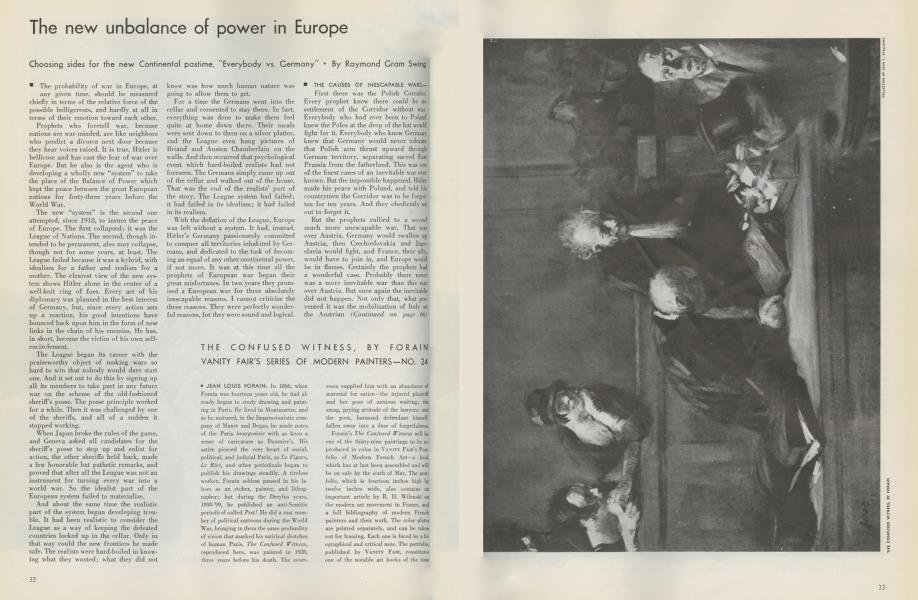
Sign In Not a Subscriber?Join NowThe new unbalance of power in Europe
Choosing sides for the new Continental pastime, "Everybody vs. Germany"
Raymond Gram Swing
The probability of war in Europe, at any given time, should be measured chiefly in terms of the relative force of the possible belligerents, and hardly at all in terms of their emotion toward each other.
Prophets who foretell war, because nations are war-minded, are like neighbors who predict a divorce next door because they hear voices raised. It is true, Hitler is bellicose and has cast the fear of war over Europe. But he also is the agent who is developing a wholly new "system" to take the place of the Balance of Power which kept the peace between the great European nations for forty-three years before the World War.
The new "system" is the second one attempted, since 1918, to insure the peace of Europe. The first collapsed; it was the League of Nations. The second, though intended to be permanent, also may collapse, though not for some years, at least. The League failed because it was a hybrid, with idealism for a father and realism for a mother. The clearest view of the new system shows Hitler alone in the center of a well-knit ring of foes. Every act of his diplomacy was planned in the best interest of Germany, but, since every action sets up a reaction, his good intentions have bounced back upon him in the form of new links in the chain of his enemies. He has, in short, become the victim of his own selfencirclement.
The League began its career with the praiseworthy object of making wars so hard to win that nobody would dare start one. And it set out to do this by signing up all its members to take part in any future war on the scheme of the old-fashioned sheriff's posse. The posse principle worked for a while. Then it was challenged by one of the sheriffs, and all of a sudden it stopped working.
When Japan broke the rules of the game, and Geneva asked all candidates for the sheriffs posse to step up and enlist for action, the other sheriffs held back, made a few honorable but pathetic remarks, and proved that after all the League was not an instrument for turning every war into a world war. So the idealist part of the European system failed to materialize.
And about the same time the realistic part of the system began developing trouble. It had been realistic to consider the League as a way of keeping the defeated countries locked up in the cellar. Only in that way could the new frontiers be made safe. The realists were hard-boiled in knowing what they wanted; what they did not know was how much human nature was going to allow them to get.
For a time the Germans went into the cellar and consented to stay there. In fact, everything was done to make them feel quite at home down there. Their meals were sent down to them on a silver platter, and the League even hung pictures of Briand and Austen Chamberlain on the walls. And then occurred that psychological event which hard-boiled realists had not foreseen. The Germans simply came up out of the cellar and walked out of the house. That was the end of the realists' part of the story. The League system had failed; it had failed in its idealism; it had failed in its realism.
With the deflation of the League, Europe was left without a system. It had, instead, Hitler's Germany passionately committed to conquer all territories inhabited by Germans, and dedicated to the task of becoming an equal of any other continental power, if not more. It was at this time all the prophets of European war began their great misfortunes. In two years they promised a European war for three absolutely inescapable reasons. I cannot criticize the three reasons. They were perfectly wonderful reasons, for they were sound and logical.
THE CAUSES OF INESCAPABLE WARS.First there was the Polish Corrido Every prophet knew there could be no settlement of the Corridor without war. Everybody who had ever been to Poland knew the Poles at the drop of the hat wool fight for it. Everybody who knew Germany knew that Germany would never toleral that Polish arm thrust upward through German territory, separating sacred Ea Prussia from the fatherland. This was OMI of the finest cases of an inevitable war ever known. But the impossible happened. Hitler made his peace with Poland, and told his countrymen the Corridor was to be forgotten for ten years. And they obediently set out to forget it.
But the prophets rallied to a second much more unescapable war. That was over Austria. Germany would swallow up Austria, then Czechoslovakia and Jugoslavia would fight, and France, their ally would have to join in, and Europe would be in flames. Certainly the prophets had a wonderful case. Probably there neve was a more inevitable war than this war over Austria. But once again the inevitable did not happen. Not only that, what prevented it was the mobilization of Italy on the Austrian frontier, one Fascist country against another Fascist country. Due to Italy, there was no war; and, due to Italy's reactions in the Austria crisis, the whole European situation changed in the twinkling of an eye.
Continued on page 66
Continued from page 32
Austria was another wrench for the prophets, but they all rallied bravely and, with a good deal of their old courage, began shaking their heads again, this time over the Saar plebiscite. They began showing what was bound to happen if Germany only won by a sixty or seventy percent vote. German Storm Troopers would hail this as a victory and would swarm in to take command of the province. The French ultimately would have to put them out. And anyhow the Saar would not be handed back to Germany if it had a large minority asking protection of the League. And, if it was not handed back, the Germans would be sure to fight for it. Once more the unexpected happened, Germany got a ninety percent vote, and another war quite illogically was averted.
What the prophets were right about .was their recognition of the belligerent potentialities of Germany under the Nazis.
As long as Germany lies in the heart of Europe, determined to be as strong as anybody else, if not stronger, there is the threat of war. But the threat also set in motion the forces to prevent the war. And the rise of Hitler in Germany had produced changes in Europe which no European prophet would ever have dared to predict. These are the changes which now are working together for the new "system" in Europe.
First of these in Importance is the revival of the entente between France and Russia. Its precise terms are not known, but it is plain that they have agreed to support each other if Germany starts anything.
THE RING AROUND THE REICH.—
That was the beginning of the new system, which can be called a system of EVERYBODY AGAINST GERMANY, or to be a little more scientific, a system of UNbalance, to take the place of the old system of balance. But Russia was only one vital part of it, and to be complete Britain had to join, and most difficult of all, Italy.
The real reason why it was hard to enlist Italy is quite simple. Italy could only join France at the cost of giving up the Fascist dream of Italy one day being master of half the continent. Mussolini has been striving and straining to avoid becoming a partner of France. He has increased his airforce, invigorated his army, built up the navy as much as he could afford, though it has not been enough. And, in eastern Europe, he has been trying to win friends away from France. He has not made much progress. He swallowed up Albania, but it did not make much difference. All the time he had his choice of being blustering and antiFrench, with an eye on the future, or crawling humbly into a partnership with France. There did not seem much chance of his deciding for humility. But once more the unexpected happened, and Hitler made up Mussolini's mind for him.
The first effect of Austria on Mussolini was that it showed there was something still worse than being a partner of France, and that was having a common frontier with Nazi Germany. Barthou, the greatest of modern French ministers, recognized the opportunity. He opened the door softly to Italy, just as he had opened it to Russia. And he was on the point of finishing the rapprochement between France and Italy, when he was assassinated. His death did not alter the underlying factors of the situation. Even the murder of King Alexander did not, though it so much weakened Jugoslavia that Mussolini was tempted for a moment to believe he need not sacrifice the Fascist dream after all. But the temptation was brief, and the rapprochement which Barthou had prepared was completed by Laval. So the whole of the continent, with the exception of Poland, a few Balkan states, and the socalled neutrals, was gathered into the new system of Unbalance.
There remained only England. That was not so hard. What England feared from Germany was attack by the air. So England agreed to the new air Locarno without any hesitation. The new air agreement, embracing France, Ttaly and England provides that if the German air fleet attacks one of them, they will simultaneously send their air fleets to attack the cities of Germany. This is obviously important, for an air force is easy to create, and Germany is bad-tempered enough to build up a great air armada and try to win an ultra-modern war in a great hurry, before anything effective can be done to prevent it. And the only possible answer to this is a threat that a still greater air armada would attack Germany if Germany attacked anybody else.
The British are not committed to an eastern Locarno, which would guarantee the eastern frontiers of Germany's neighbors. For one thing, some British statesmen incline to believe that it may be better to give the Germans an outlet, a chance of expansion. And they dislike Russia because it is Communist and a menace to India, a possibly fertile field for Communism. Such British statesmen would not mind seeing Germany expand at the expense of Russia, just so long as it did not lead to a war involving the British. This is not the official British policy, but it certainly is the British official policy that there are no English soldiers ready to die in defense of Polish, Lithuanian, or other obscure frontiers.
The new European system is fairly near completion. It lacks a few elements, such as the full cooperation of the British. One cannot be sure just what pledges France has made to Italy in return for Italian humility. Mussolini may want to break away again. But there the thing stands, and if it is not yet a completed structure, it is plain enough to see and to describe.
Germany's calm announcement that she intends to conscript an army of thirty-six divisions—some 600,000 men —made a great flutter in the press and in the diplomatic dovecotes, but it did not fundamentally alter the situation.
Continued on page 67
Continued from page 66
Every informed observer who had followed Hitler's line of action during the last year or two knew that an open repudiation of the Versailles Treaty was inevitable sooner or later, and Germany's decision to have a full-sized army—"for defense"—merely forced Europe to accept, in theory, what Downing Street and the Quai d'Orsay had already accepted in fact. Germany will probably be invited to come back into the League, not into the cellar this time, but as an equal member, and on tbe same military footing as everybody else. Why not? Everybody is lined up against Germany, and equal power is safe enough to promise, since it does not mean equal power any more.
Germany is taking the situation coolly. It is the only way to take it. Hitler's one remaining scope for manoeuvres is with England. He may be able to keep the English from insisting on the Eastern Locarno, and he may even be able to tempt the English not to play in too closely with the French. But it is not a very good chance. And for the time being, the prophets will have some trouble finding enough inevitable wars to make the business of prophecy pay.
But in the long run their business may revive. A system of UNbalance is not a system of peace and stability. It is like too large a majority in the Senate, which at the first strain may break in pieces. Sooner or later—and this Hitler knows—it is bound to disintegrate. It probably will take years. But the break-up does not inevitably mean war. It merely means there will be a new possibility of war.
But for the present, Hitler can look upon himself with a peculiar pride, if it is cause for pride to have achieved more impossible things than any other man living. He has done what no other facts or factors could have done. He has united France with communist Russia; he has punctured the Fascist dream in eastern Europe and driven Mussolini to accept a subordinate position to France; he has signed up the British air fleet to attack him if he attacks anybody else, and he has so managed things that with arms equality, he is about as weak relatively as he was without it. The one thing he has to balance these debits is his friendship with Poland. It is a timid friendship on Poland's part, and cannot amount to much unless war can be safely waged on Russia, with the ultimate permission of England. But it is a long way off, it is not even near enough for a prophet to call it inevitable.
Subscribers have complete access to the archive.
Sign In Not a Subscriber?Join Now

