
Sign In to Your Account
Subscribers have complete access to the archive.
Sign In Not a Subscriber?Join NowBOOKS
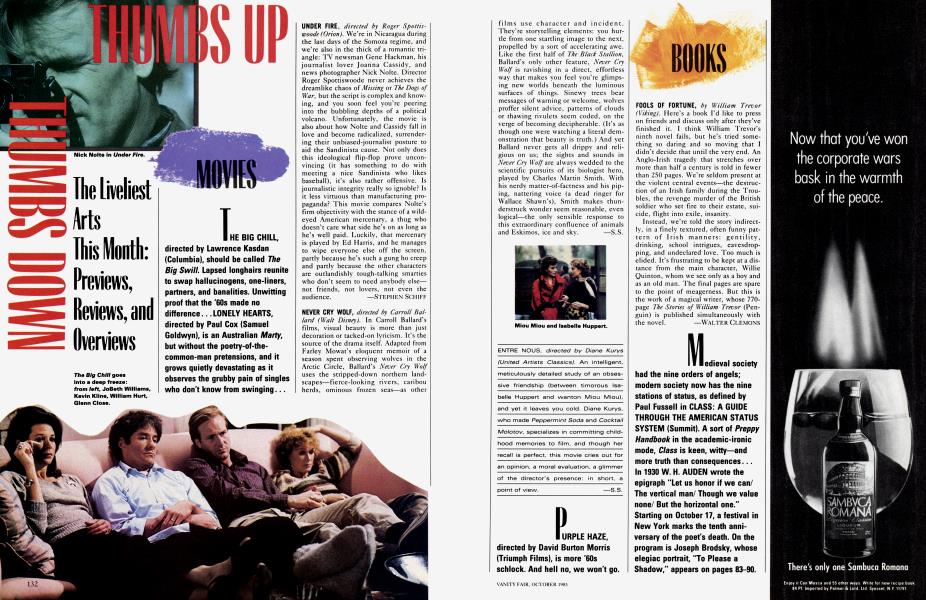
FOOLS OF FORTUNE,by William Trevor (Viking). Here's a book I'd like to press on friends and discuss only after they've finished it. I think William Trevor's ninth novel fails, but he's tried something so daring and so moving that I didn't decide that until the very end. An Anglo-Irish tragedy that stretches over more than half a century is told in fewer than 250 pages. We're seldom present at the violent central events—the destruction of an Irish family during the Troubles, the revenge murder of the British soldier who set fire to their estate, suicide, flight into exile, insanity.
Instead, we're told the story indirectly, in a finely textured, often funny pattern of Irish manners: gentility, drinking, school intrigues, eavesdropping, and undeclared love. Too much is elided. It's frustrating to be kept at a distance from the main character, Willie Quinton, whom we see only as a boy and as an old man. The final pages are spare to the point of meagerness. But this is the work of a magical writer, whose 770page The Stories of William Trevor (Penguin) is published simultaneously with the novel. —WALTER CLEMONS JAPAN'S HIGH SCHOOLS,by Thomas P. Rohlen (University of California Press). THE
WALTER CLEMONS
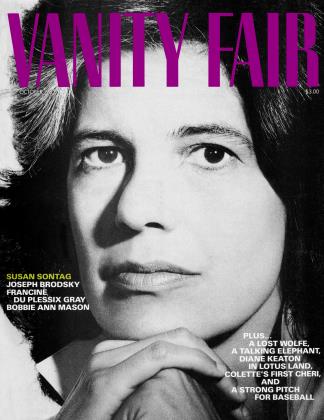
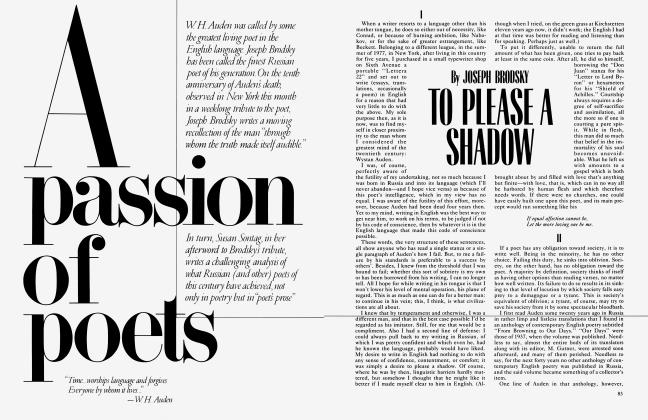
V ledieval society had the nine orders of angels; modern society now has the nine stations of status, as defined by Paul Fussell in CLASS: A GUIDE THROUGH THE AMERICAN STATUS SYSTEM (Summit). A sort of Preppy Handbook in the academic-ironic mode, Class is keen, witty—and more truth than consequences... In 1930 W. H. AUDEN wrote the epigraph "Let us honor if we can/ The vertical man/ Though we value none/ But the horizontal one." Starting on October 17, a festival in New York marks the tenth anniversary of the poet's death. On the program is Joseph Brodsky, whose elegiac portrait, "To Please a Shadow," appears on pages 83-90.
TROUBLED CRUSADE: AMERICAN EDUCATION,
1945-1980,by Diane Ravitch (Basic Books). While American teenagers loiter in the halls, humming anthems of school hate like Bruce Springsteen's version of "Quarter to Three," their Japanese counterparts heat up their skills in an educational pressure cooker that boils over at the time of the famed "exam hell." Something in this difference, however exaggerated, might help to satisfy our insatiable curiosity about how the Japanese do it—how they've acquired their industrial clout, their technocratic efficiency, their smoothly ordered society. It must be the education, we think, because as Henry Steele Commager once observed, education is America's religion: we look to it for the cause and cure of every ill.
In this case, as Japan's High Schools shows, we are right; the schools are responsible. There young citizens are prepared for the arduous and precise work of the technocratic society; there they learn to control public and private behavior; there they learn that they must produce more citizens like themselves. And if these kids also have a passion for comic book heroes who are slothful screwups and crybaby nihilists, such joys are strictly private. So education works wonders in the land of the happy meritocracy, yet as the author of this impressive piece of anthropology observes, "it is a system without much heart."
Back home, we have nothing but heart—and all too many changes of heart at that. Once an impassioned polemicist in the school wars herself, Diane Ravitch has researched every fad and ism that has had its way with our schooling, and this seems to have tempered her taste for ideological warfare. For, as she so ably
shows, just these sorts of wild swings in educational fashion, from progressivism to core curriculum and back again, are responsible for the instability of American education, its confused goals and uncertain procedures. Are they responsible also for our industrial decline and disordered society? Maybe so. Right now there is a whisper of the hickory stick in the air again, as the McGuffey Readers, primers from the rigorous nineteenth century, make their way back into the classroom. Another sea change perhaps, or maybe just another way of testing the troubled waters where quality and equality try to meet. —ELIZABETH POCHODA
Whats old ids new again: Henry James's A LITTLE TOUR IN FRANCE (Farrar, Straus and Giroux) proves that the master is still a sharp, stinging, and (not that it really matters) useful guide to rural France...
DASHIELL HAMMETT: A LIFE,by Diane Johnson (Random House). What does a writer do with the rest of his life when he can't write anymore? At forty, Dashiell Hammett was done, and nothing in Diane Johnson's biography is more harrowing than her account of his continuing to try to write, for more than twenty years. "His discipline was this: to sit down at the typewriter and put in his time." His life away from the desk was uglier than it was portrayed in the mem-
oirs of Lillian Heilman, who authorized this biography. He was unfaithful to Heilman with starlets and prostitutes (in letters to her he called this "practically masturbating"), he was a mean drunk who one day promised to quit and kept his word, he was frequently impotent and clinically depressed.
Johnson talked with Hammett s wife and daughters and has fresh information on his obscure early life in Montana and San Francisco, where his career as a Pinkerton detective was far briefer than I'd supposed. She makes grim comic use of Hammett's FBI file: "His business was stated to be that of a writer. It was noted that subject was rather slow in meeting his commitments." Best of all, she had access to his letters from Alaska, which he loved, as a fifty-year-old enlisted man during World War II. While she provides a collage of quotations from contemporaries whose opinion of Hammett was low, her own attitude is one of respect and grief: "The heroism of his life lay not in his Horatio Alger success, rather it lay in the long years after success, when money and gifts were gone. It is the long blank years that prove the spirit."
—W.C.
THE DEATH OF CHE GUEVARA (Knopf), Jay Cantor's first novel, draws on Che's diaries to create a dense, impassioned portrait of Castro's revolution ...
Subscribers have complete access to the archive.
Sign In Not a Subscriber?Join Now
