
Sign In to Your Account
Subscribers have complete access to the archive.
Sign In Not a Subscriber?Join NowSIMPLY WAUGHHFUL
Even in Thatchers scboolmistressy Britain, the world of Brideshead Revisited is atm
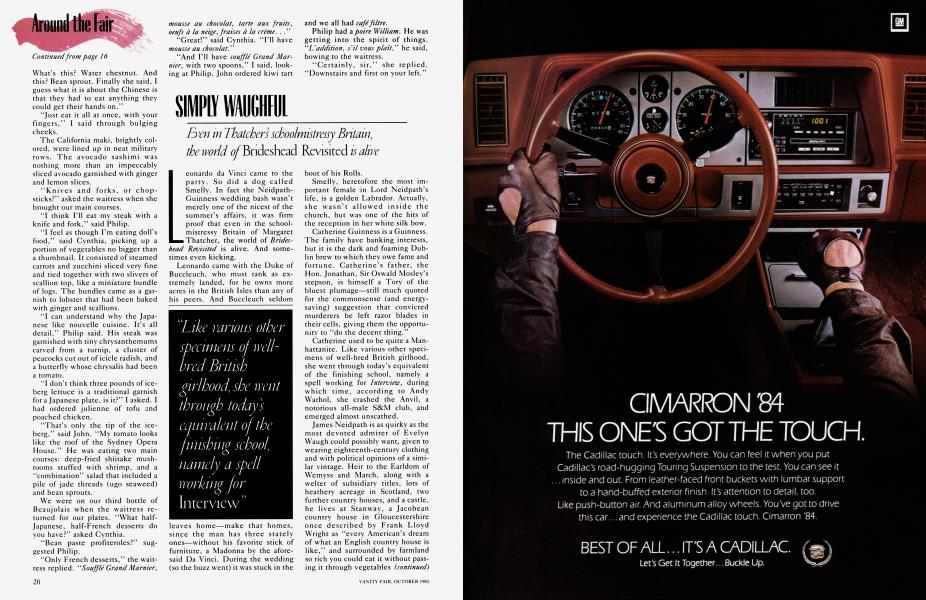
Leonardo da Vinci came to the party. So did a dog called Smelly. In fact the NeidpathGuinness wedding bash wasn't merely one of the nicest of the summer's affairs, it was firm proof that even in the schoolmistressv Britain of Margaret Thatcher, the world of Brideshead Revisited is alive. And sometimes even kicking.
Leonardo came with the Duke of Buccleuch, who must rank as extremely landed, for he owns more acres in the British Isles than any of his peers. And Buccleuch seldom
"Like various other specimens of wellbred British pud hood, she went through today's equivalent of the finishing school namely a spell working for Interview"
leaves home—make that homes, since the man has three stately ones—without his favorite stick of furniture, a Madonna by the aforesaid Da Vinci. During the wedding (so the buzz went) it was stuck in the
boot of his Rolls.
Smelly, heretofore the most important female in Lord Neidpath's life, is a golden Labrador. Actually, she wasn't allowed inside the church, but was one of the hits of the reception in her white silk bow.
Catherine Guinness is a Guinness. The family have banking interests, but it is the dark and foaming Dublin brew to which they owe fame and fortune. Catherine's father, the Hon. Jonathan, Sir Oswald Mosley's stepson, is himself a Tory of the bluest plumage—still much quoted for the commonsense (and energysaving) suggestion that convicted murderers be left razor blades in their cells, giving them the opportunity to "do the decent thing."
Catherine used to be quite a Manhattanite. Like various other specimens of well-bred British girlhood, she went through today's equivalent of the finishing school, namely a spell working for Interview, during which time, according to Andy Warhol, she crashed the Anvil, a notorious all-male S&M club, and emerged almost unscathed.
James Neidpath is as quirky as the most devoted admirer of Evelyn Waugh could possibly want, given to wearing eighteenth-century clothing and with political opinions of a similar vintage. Heir to the Earldom of Wemyss and March, along with a welter of subsidiary titles, lots of heathery acreage in Scotland, two further country houses, and a castle, he lives at Stanway, a Jacobean country house in Gloucestershire once described by Frank Lloyd Wright as "every American's dream of what an English country house is like," and surrounded by farmland so rich you could eat it without passing it through vegetables (continued) first. And although Neidpath once remarked that if he had to spend more than twenty-five dollars on a meal for two he was impotent for a week, this never discouraged a stream of females who trooped up to Stanway (soon nicknamed Strangeway) hoping to become Countess of Wemyss (rhymes with "screams").
Continued from page 20
No wonder the announcement of the Neidpath-Guinness engagement lent a happy glow to everybody's checks. Long before the oblongs of engraved pasteboard hit the post, uneasy conversations could be heard here and ther t.. .Wonderful girl! Haven't seen her for a bit, of course. . ./ wonder if they know my new addressP
The invitations did go out, though, and in a flood.
True, those present included neither the Queen nor the Queen Mother, who sent her former page her regrets and some silver. (It must be stressed that Her Majesty's noshow had nothing to do with the formidable presence of Princess Diana's stepmother, Lady [Raine] Spencer.) Nor did they include Mick Jagger, who was about to turn forty and rumored to be in the glooms as a result. Nor Andy Warhol, though several people swore that they saw him wafting here and there. (Informed opinion said this was merely one of the family ghosts.)
Otherwise, the guest list was impressive and diverse, including, as is expected on such occasions, even dimmer family members, staff, estate members, and those neighboring squires who have not become ungovernably mad. There were so many titles that the formidable list at the door began with dukes and worked its way down. Bryan Ferry filled the rock star slot, and Warhol's place was kept by Interview's indomitable dancing president, Fred Hughes. Lady Jeanne Campbell, granddaughter of the newspaper titan Lord Beaverbrook and a former Mrs. Norman Mailer, won much attention with her broad-brimmed black leather hat. Cristina Monet Zilkha, the songstress, was so striking in her five-inch heels and navy blue microskirt that novelist Martin Amis dubbed her Profile in Courage. Norman St. John-Stevas, a former
minister for the arts, made his mark with a denunciation of the present minister for the arts, Lord Gowrie, for failing to support a national theater museum.
Given Neidpath's qualms about expensive feeding, one fears that, had he been footing the bill himself, the union would not have been blessed with offspring for some dec-
included neither the Queen nor the Queen Mother, who sent her regrets and some silver. Othe rwise, the guest list was impressive and diverse
ades to come. The host, however, was the bride's grandfather, Lord Moyne, and champagne and draught Guinness were being poured as the guests streamed in at seven P.M.
The Pasadena Roof Orchestra struck up. Dinner came and went.
People danced. Breakfast (Britain's only tolerable meal) succeeded dinner. People continued to dance. A sort of golden haze settled. At five in the morning, champagne and Guinness were still flowing, and only Smelly had gone to sleep. One heard guests saying smugly: "This is the last of the big ones." Another melancholy slurp of champagne. "Yes, I'm afraid we won't see anything like this again. . . "
What pixie dust produces an event out of an ordinary name-studded gathering? It just happens. It can be the brawl that lifts a cocktail party at least into the footnotes of literary history. It can be the sense at a memorial service that the wake is for something other than the solitary body in the box. Or it can be the intimation that a gathering such as this wedding is a celebration of a particular, and probably waning, way of life.
As night and her guests staggered toward dawn, Catherine Guinness, now Lady Neidpath, changed into a cowboy hat. Then off to London and a wedding breakfast at Claridge's.
Were they going on a honeymoon? a guest asked Neidpath.
"Catherine wanted to go somewhere she had never been," he said. "So we're going to a bungaloid in Shropshire."
Would it be a long honeymoon?
"Only for a few days. One doesn't want to be away from things for too long... " -UBIQUITOUS
Subscribers have complete access to the archive.
Sign In Not a Subscriber?Join Now
