

Sign In to Your Account
Subscribers have complete access to the archive.
Sign In Not a Subscriber?Join NowProfoundly Practical Jokes
Peter Schjeldahl
The Art of Bruce Nauman
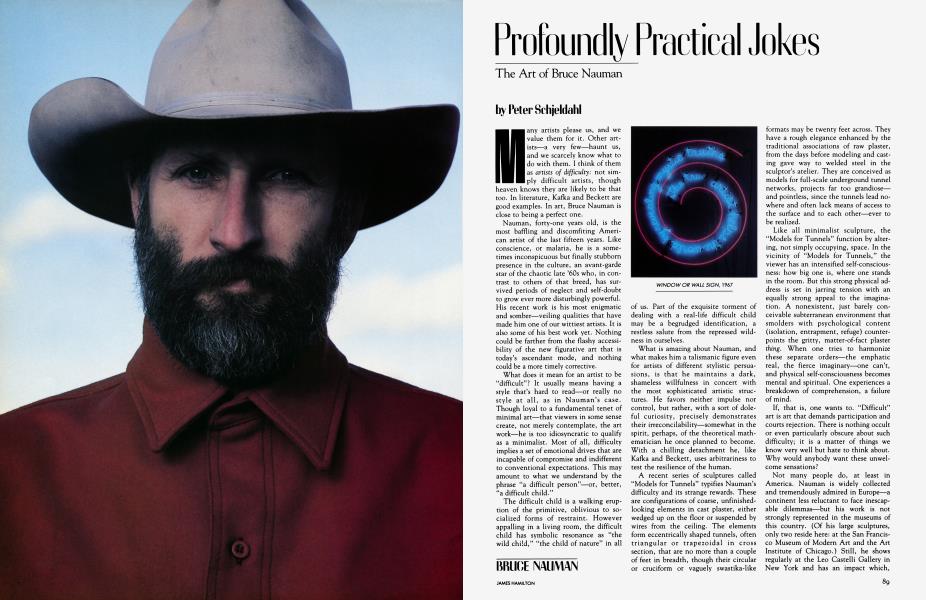
Many artists please us, and we value them for it. Other artists—a very few—haunt us, and we scarcely know what to do with them. I think of them as artists of difficulty: not simply difficult artists, though heaven knows they are likely to be that too. In literature, Kafka and Beckett are good examples. In art, Bruce Nauman is close to being a perfect one.
Nauman, forty-one years old, is the most baffling and discomfiting American artist of the last fifteen years. Like conscience, or malaria, he is a sometimes inconspicuous but finally stubborn presence in the culture, an avant-garde star of the chaotic late ’60s who, in contrast to others of that breed, has survived periods of neglect and self-doubt to grow ever more disturbingly powerful. His recent work is his most enigmatic and somber—veiling qualities that have made him one of our wittiest artists. It is also some of his best work yet. Nothing could be farther from the flashy accessibility of the new figurative art that is today’s ascendant mode, and nothing could be a more timely corrective.
What does it mean for an artist to be “difficult”? It usually means having a style that’s hard to read—or really no style at all, as in Nauman’s case. Though loyal to a fundamental tenet of minimal art—that viewers in some sense create, not merely contemplate, the art work—he is too idiosyncratic to qualify as a minimalist. Most of all, difficulty implies a set of emotional drives that are incapable of compromise and indifferent to conventional expectations. This may amount to what we understand by the phrase “a difficult person”—or, better, “a difficult child.”
The difficult child is a walking eruption of the primitive, oblivious to socialized forms of restraint. However appalling in a living room, the difficult child has symbolic resonance as “the wild child,” “the child of nature” in all of us. Part of the exquisite torment of dealing with a real-life difficult child may be a begrudged identification, a restless salute from the repressed wildness in ourselves.
What is amazing about Nauman, and what makes him a talismanic figure even for artists of different stylistic persuasions, is that he maintains a dark, shameless willfulness in concert with the most sophisticated artistic structures. He favors neither impulse nor control, but rather, with a sort of doleful curiosity, precisely demonstrates their irreconcilability—somewhat in the spirit, perhaps, of the theoretical mathematician he once planned to become. With a chilling detachment he, like Kafka and Beckett, uses arbitrariness to test the resilience of the human.
A recent series of sculptures called “Models for Tunnels” typifies Nauman’s difficulty and its strange rewards. These are configurations of coarse, unfinished-looking elements in cast plaster, either wedged up on the floor or suspended by wires from the ceiling. The elements form eccentrically shaped tunnels, often triangular or trapezoidal in cross section, that are no more than a couple of feet in breadth, though their circular or cruciform or vaguely swastika-like formats may be twenty feet across. They have a rough elegance enhanced by the traditional associations of raw plaster, from the days before modeling and casting gave way to welded steel in the sculptor’s atelier. They are conceived as models for full-scale underground tunnel networks, projects far too grandiose— and pointless, since the tunnels lead nowhere and often lack means of access to the surface and to each other—ever to be realized.
Like all minimalist sculpture, the “Models for Tunnels” function by altering, not simply occupying, space. In the vicinity of “Models for Tunnels,” the viewer has an intensified self-consciousness: how big one is, where one stands in the room. But this strong physical address is set in jarring tension with an equally strong appeal to the imagination. A nonexistent, just barely conceivable subterranean environment that smolders with psychological content (isolation, entrapment, refuge) counterpoints the gritty, matter-of-fact plaster thing. When one tries to harmonize these separate orders—the emphatic real, the fierce imaginary—one can’t, and physical self-consciousness becomes mental and spiritual. One experiences a breakdown of comprehension, a failure of mind.
If, that is, one wants to. “Difficult” art is art that demands participation and courts rejection. There is nothing occult or even particularly obscure about such difficulty; it is a matter of things we know very well but hate to think about. Why would anybody want these unwelcome sensations?
Not many people do, at least in America. Nauman is widely collected and tremendously admired in Europe—a continent less reluctant to face inescapable dilemmas—but his work is not strongly represented in the museums of this country. (Of his large sculptures, only two reside here: at the San Francisco Museum of Modern Art and the Art Institute of Chicago.) Still, he shows regularly at the Leo Castelli Gallery in New York and has an impact which, though narrow, goes far deeper than that of many household names.
My appreciation of Nauman has grown slowly, against my own initial resistance to his work. Part of that resistance, when Nauman made his spectacular debut at Castelli in 1968, was due to Manhattan provincialism. Nauman is a Midwesterner who went to art school in California and had never set foot on the island before the opening of that show. Though he was thoroughly up to speed with the then furiously careening avant-garde, he had sass and eclecticism distinctly at odds with the high style and one-artist/one-image policy of New York. I saw the variety of his show as suspect and thought something like “terrific but lightweight.” Today, paging through the show’s catalogue, I am of another mind. Nauman, at age twenty-seven, had knocked off more than enough ideas to keep a platoon of proper little avant-gardists busy for years. Furthermore, his impudence and invention were merely the leading edge of a philosophical enterprise more serious than any I was ready to imagine.
Besides some sculptures made of loafshaped hunks of fiberglass and hanging strips or slashed sheets of latex rubber— with a very un-New Yorkish, crude, handmade look—the 1968 show presented a number of sharply witty objects that are now classics. There were casts of body parts in green wax, among them someone’s hand, arm, and lower face tautologically titled From Hand to Mouth and a tied-up torso called Henry Moore Bound to Fail. Impressions of the Knees of Five Famous Artists appeared in a fiberglass slab. (To save trouble, Nauman says, he used his own knees.) And there were some extremely beautiful works in neon, a medium that has tempted many artists but in which only Nauman has been consistently successful. (The Baltimore Museum of Art had a striking retrospective of his neons this past winter.) My Last Name Exaggerated Fourteen Times Vertically displayed the artist’s signature stretched to indecipherability in pale purple tubing. Window or Wall Sign, in peach and blue, was a cursive spiral that read, “The true artist helps the world by revealing mystic truths.”
As I did not register at the time, all these works use language to express an ambivalent self-consciousness. Each is a gesture, at once arch and disquieting, toward the condition of being an artist: having a studio, a signature, financial problems, mixed feelings toward artistic forebears, and elevated though possibly idiotic convictions. (Note how that line about “the true artist” oscillates between profundity and gibberish.) The disquieting aspect was that Nauman was objectifying, with a funny but also desolating and potentially self-paralyzing skepticism, things within the normal realm of subjectivity. In so doing, he was following artistic precedents set by Marcel Duchamp and Jasper Johns, among others.
For a while Nauman’s work of that period generated much discussion of him in the art press, discussion keyed either to esoteric analyses or to complaints about his “narcissism” (a wrong-headed take on Nauman’s use of, not indulgence in, self-reference). Both kinds of response slid away from confrontation with the emotional core—the difficult child—in Nauman’s art, the analyses by primly focusing on the work’s intellectual structures and the complaints by defensively thrusting away any possible understanding of or identification with the child inside. Nauman’s work made a lot of people feel like saying, “Go away, kid, you bother me.”
The situation that had brought Nauman to national attention was in many ways an artificial one. The mass audience opened up by pop art in the early ’60s had a hearty but, as it turned out, not unlimited appetite for the new, and general interest in the latest arcana was plummeting even in the period of Nauman’s greatest success. Maintained for a while by the enthusiasm of a young curatorial establishment, art that almost no one would buy and that few people would cross a street to look at was riding for a fall, which it took in the middle ’70s. Nauman had suspected as much from the start; he was well aware that even putative sophisticates missed his points with monotonous regularity. At times he actually seemed bent on assisting casual viewers to the museum exits—as with Bouncing Balls, a film of testicles jiggling, or a sound environment in which a taped voice hectored: “Get out of this room! Get out of my mind!” While in demand, however, he exploited the opportunity to produce a lot of work that, in his words, “you wouldn’t make unless you had someplace to show it.”
His work during this hectic period was of two major kinds. The first involved simple, often rather simpleminded performances: the artist would engage in repetitive actions—playing a violin for the first time, making faces, enacting the obsessive walking behavior of a character in a Beckett novel. He recorded all these performances on film, videotape, still photographs, or holograms. Nauman was fascinated by the tension between a formal, arbitrary program and the unpredictable effects of a human presence, which happened to be his own. Some of these works, such as holograms of the artist “acting crazy,” were eerie and hilarious; others, especially some interminable videotapes, were boring to the point of cruelty.
In the second main category of Nauman’s work then were large installations using constructed walls, sound effects, closed-circuit video, and other elements to impose specific disorientations on the viewer. Some examples: a corridor so narrow it could only be passed through sideways; a soundproof wall that, as one moved past it, reduced one’s sense of ambient noise from stereo to mono; a room-within-a-room, the inner one suspended so that its open bottom floated a few inches off the floor; a room in which the sound of a touch to one wall was tremendously amplified through speakers behind the opposite wall; and— probably the best piece of this kind—a corridor in which one advanced toward a video monitor that showed one’s back receding and another monitor playing a tape, made with the same ceilingmounted camera, that showed the corridor empty, the combination inducing an uncanny sense of presence/absence.
In these pieces, Nauman was interested in what might be called “clarified experience”: physiological self-consciousness tuned to a particular, unsettling pitch. These works were, and are, popular in Europe, where many of them are now in public and private collections. But American viewers—including me— tended to find them oppressive, resenting the feeling of being a rat in a behaviorist’s experiment. It’s hard to savor finesse that threatens to trigger an anxiety attack. But the real trouble was that in this work Nauman withdrew his own emotional presence—or hid it behind the unattractive figure of a godlike puppeteer. This phase soon ended, after shifting fashion reduced Nauman to relative obscurity.
The worldly boom and bust of his career in the six or so years around 1970 left Nauman bruised and depressed, and with a personal life in disarray. Still, accustomed to being an artist in, and of, isolation, he was better able to cope than most of his peers. One late-’60s winter on Long Island is the closest he has ever come to inhabiting the New York art world. In Pasadena throughout the ’70s, he now lives with his two teenage children from a dissolved marriage and his longtime companion Harriet Lindenberg on a pinon-wooded mountainside near Pecos, New Mexico. It is a life of rough-hewn domestic comfort, with diversions that include hunting and fishing and Nauman’s hobby of making fine jackknives. In person, Nauman is rangy and more than a little like Gary Cooper: soft-spoken, laconic, jocular, and shy. Far from prolific, he spends more time reading and thinking in his commodious studio than working. As much for himself as for his viewers, Nauman’s art is a hard discipline with nerve-rackingly abrupt discoveries. He compares it to “going up the stairs in the dark, when you think there is one more step, and there isn’t.”
In his studio recently, I saw the latest, unfinished sculpture in a current series. A handmade wooden chair frame, to be rendered in steel, hung about five feet off the floor. A horizontal X of eighteen-foot, tapered steel I-beams was suspended at eye level at its midpoint. Nudged, the beams rotated; their ends bumped the chair in passing, and they resonated—a deep, lovely, mournful sound. The four previous works in this series, widely shown last year, comprised cast-iron chairs suspended at odd angles within hanging corrals of steel bands or beams that were configured as, respectively, a diamond, a circle, a triangle, and a square. Nauman would like these four sculptures to function as Foucault pendulums—the chairs swinging slightly in response to the earth’s rotation—but for this to be palpable it would require ceilings much higher than any the pieces are ever likely to be installed under. Nauman did not seem terribly disappointed. The idea is enough for him.
Another idea, unusual for Nauman, complicates the new metal sculptures. With titles like South America Triangle and Diamond Africa with Tuned Chair D, E,A, D, they allude to political torture in the third world. The hanging chairs suggest the ordeals of victims, and the surrounding, eye-level steel strips may represent our blindness to those distant crimes. But, as ever in Nauman’s art, the idea will not mesh with the physical facts. The objects, allusions, and real and imagined spaces cling to their separate orders of experience. One yearns to resolve them, in vain.
There is a bleak, high, taunting humor in this, the characteristic humor of the artist of difficulty: the practical joke that intelligence plays on itself, constantly uncovering problems only to demonstrate they cannot be solved. Such a joke is the only truth satisfying to a ruthlessly skeptical and honest mind. Bruce Nauman never tires of playing such jokes—with elegance and clarity so that others may understand them, but if they don’t want to, that’s all right too. All that matters finally is the exact and exacting pratfall.
Subscribers have complete access to the archive.
Sign In Not a Subscriber?Join Now


