


Sign In to Your Account
Subscribers have complete access to the archive.
Sign In Not a Subscriber?Join NowBehaving Like a Great Power
Ronald Steel
"We live in a world perilously similar to that of the European powers in the summer of 1914, arming for a war that nobody wanted, over issues that few considered critical”
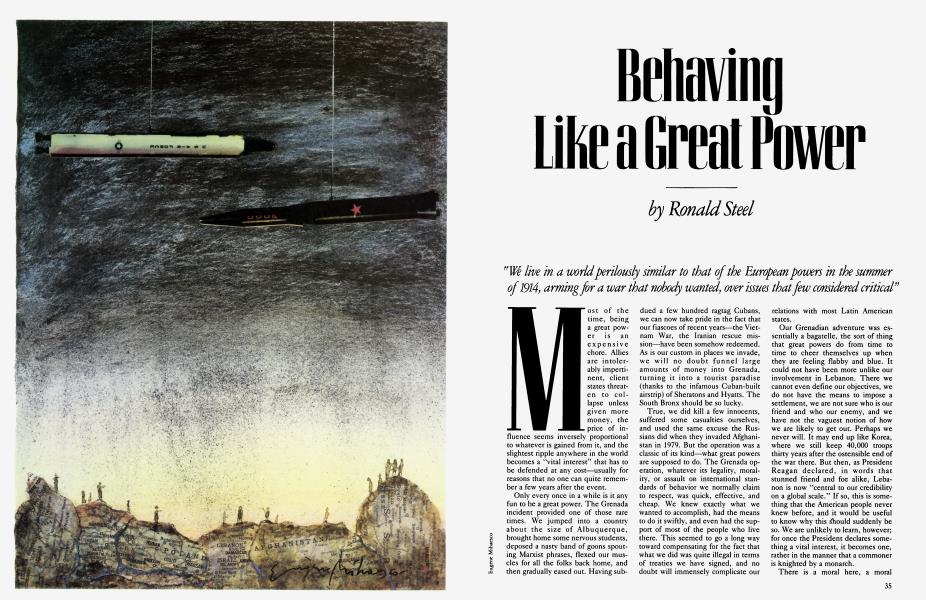
Most of the time, being a great power is an expensive chore. Allies are intolerably impertinent, client states threaten to collapse unless given more money, the price of influence seems inversely proportional to whatever is gained from it, and the slightest ripple anywhere in the world becomes a “vital interest” that has to be defended at any cost—usually for reasons that no one can quite remember a few years after the event.
Only every once in a while is it any fun to be a great power. The Grenada incident provided one of those rare times. We jumped into a country about the size of Albuquerque, brought home some nervous students, deposed a nasty band of goons spouting Marxist phrases, flexed our muscles for all the folks back home, and then gradually eased out. Having subdued a few hundred ragtag Cubans, we can now take pride in the fact that our fiascoes of recent years—the Vietnam War, the Iranian rescue mission—have been somehow redeemed. As is our custom in places we invade, we will no doubt funnel large amounts of money into Grenada, turning it into a tourist paradise (thanks to the infamous Cuban-built airstrip) of Sheratons and Hyatts. The South Bronx should be so lucky.
True, we did kill a few innocents, suffered some casualties ourselves, and used the same excuse the Russians did when they invaded Afghanistan in 1979. But the operation was a classic of its kind—what great powers are supposed to do. The Grenada operation, whatever its legality, morality, or assault on international standards of behavior we normally claim to respect, was quick, effective, and cheap. We knew exactly what we wanted to accomplish, had the means to do it swiftly, and even had the support of most of the people who live there. This seemed to go a long way toward compensating for the fact that what we did was quite illegal in terms of treaties we have signed, and no doubt will immensely complicate our relations with most Latin American states.
Our Grenadian adventure was essentially a bagatelle, the sort of thing that great powers do from time to time to cheer themselves up when they are feeling flabby and blue. It could not have been more unlike our involvement in Lebanon. There we cannot even define our objectives, we do not have the means to impose a settlement, we are not sure who is our friend and who our enemy, and we have not the vaguest notion of how we are likely to get out. Perhaps we never will. It may end up like Korea, where we still keep 40,000 troops thirty years after the ostensible end of the war there. But then, as President Reagan declared, in words that stunned friend and foe alike, Lebanon is now “central to our credibility on a global scale.” If so, this is something that the American people never knew before, and it would be useful to know why this Should suddenly be so. We are unlikely to learn, however; for once the President declares something a vital interest, it becomes one, rather in the manner that a commoner is knighted by a monarch.
There is a moral here, a moral about what it means to be a great power. The United States is still incontestably the richest and strongest nation in the world. It undeniably has interests in many places. It can do many awesome things: move mountains, topple governments, confer riches, and inflict horrors. But our power, great though it is, is neither infinite nor permanent. That power has limits imposed both by our resources and by our ability to influence events. Further, because of the kind of nation we are, our government has to justify to the public the exercise of power according to our own standards of what is honorable behavior.
Being a great power does not mean that we can wave a wand and have our way. Our power, however great, is less great than it seems. We can dissipate our power by expending it on unattainable ends, demean it by using it unjustly, and trivialize it by applying it capriciously. In many cases the raw military power we marshal in our vast arsenals simply is not usable for any rational objective. We are like the owner of a Jaguar who has to do most of his driving on unpaved country roads. We can blow the world to smithereens, but we cannot force the Russians to leave Afghanistan, or even make the Syrians get out of Lebanon. We can send in our troops, no doubt suffering enormous casualties, to chase the Sandinistas out of Managua. But we know that they will come back again as soon as we leave.
This is very frustrating, but it also harbors a lesson. Great powers must use their power sparingly, however tempting it is to do otherwise, and only in situations where they have an overwhelming likelihood of success and an unquestionable security need to succeed. To use military force and then fail, as the United States did in Vietnam and is now doing in Lebanon, is to squander it. The threat of force is often more effective than its application. It is certainly a good deal cheaper. The whole point of being a great power, after all, is not that you have to pay dearly, but that you don’t have to prove your power and pay for it all the time.
It is a truism to say that a great power must defend its interests. The rub is that interests, like allies, are neither so real nor so permanent as they may seem. In May of 1950, for example, hardly anyone in official Washington believed that the United States had a security interest in South Korea. A month later we were fighting a war there. Why? Because our leaders decided that our “credibility” would suffer if we didn’t. Was our security endangered? Of course not. The point is that our leaders, not our enemies, defined security in such a way that the United States could respond only by intervening. They feared that not to respond that way would make them appear weak. They also welcomed the war because it provided justification for the big rearmament program they wanted.
Security, then, is not an objective fact, like a chemical reaction. It is a matter of definition—a definition that expands to fit the amount of power available at any given time. Until 1941 we defined security quite narrowly. For the most part security concerns were satisfied by having congenial governments in the Caribbean and Central America. But by the end of the Second World War, when we had the atomic bomb and bases around the world, we had adopted a global definition of security. There is nothing unusual in this; all imperial nations tend to define their interests in terms of their power. And like them—like Spain, Holland, France, Britain—we will be obliged to narrow our definition of security as our power diminishes.
The banal formula of international relations is that every nation must protect its vital interests. The trouble is that the definition of vital changes according to time and circumstance. (“Right you are if you think you are.”) This is why the debates over foreign policy never end, and rarely, except in times of war, result in an uncontested conclusion. But even for a mighty nation like the United States, which defines its security in terms that sweep across the globe, not all interests are “vital.” Some vital interests are more vital than others. For historical and sentimental reasons, we could call the Caribbean area, including Mexico and Central America, vital. Not because they could be a serious threat to our physical security, but merely because foreign military bases there would be a nuisance, and for reasons of pride, if nothing else, it is reasonable for us not to accept them. Since we give the Russians a free hand in Eastern Europe, we can expect them to do the same for us in Central America—as basically, in fact, they do.
Western Europe, too, is vital. Europe is our civilization. Many Americans, probably most, trace their ancestry there. Sentimental reasons aside, the area is too rich, too important a trading partner, too desirable a place to visit, to be allowed to fall into hostile hands. The Persian Gulf, though not vital, is important. Not for us, of course, since we ourselves use hardly any of its oil anymore. But the Europeans and Japanese depend upon the Gulf, and we need to keep them prosperous.
This raises a delicate point. Our allies seem to be rather less concerned with their own defense than we are for them. They make an effort, to be sure, but a relatively modest one in terms of their own potential. They prefer to let us take care of them, grumbling much of the time about American “dominance.” All this is quite understandable, but in the long run it is not a situation that the American taxpayer should be expected to support, nor one that is appropriate to the increasing wealth of Western Europe, not to mention Japan, our other major ally and vital interest.
These areas apart, nothing else is vital—not if the word has any real meaning. Other places are interesting to us as well as to their inhabitants— South America, the Middle East, southern Africa, China, etc., etc.— but vital, no. And if foreign policy is about anything, other than being a fascinating distraction from domestic problems, it is about the distinction between what is vital, what is important, what is desirable, and what is merely interesting.
Making that distinction is much more crucial today than it used to be. For a long time after the Second World War, we were infinitely richer and more powerful than anyone else, or even any combination of countries. Times have changed. Our industrial lead over others—particularly Japan, but also over Western Europe and even the Soviet Union—has narrowed. Pax Americana—our ability to impose our hold over the world, to make it conform to our interests—was dependent upon that industrial lead, and with the demise of that lead has gone some of our power.
Some people, believing that absolute power, unlike youthful beauty, lasts forever, attribute this demise to a “failure of will.” But it is not that. All the will in the world could not have prevented Japan’s rise to industrial preeminence. The reason that we cannot always call the tune is to be found not in the decline of American will, but in the recovery of the world, a recovery we did so much to make possible. Now we have to learn to live with that recovery. And in the long run, it serves our interests and reduces the drain on our resources that could be put to better use.
Some part of our demise also comes from our infatuation with running the world. It is fun to be a bwana—just ask the army of diplomats, administrators, and military officers who lead lucrative and culturally enriching lives abroad in service of the taxpayers’ “interests.” But in doing so, we have been living beyond our means.
We have also neglected to acknowledge the fact that there is more than one kind of power, and that the varieties of power are inextricably linked to one another. There is military power, which we have in great abundance, even in excess. There is also industrial power, the kind that the strength of almost every modern nation rests upon.
We have neglected our industrial power not because we think it unimportant, but because of our singleminded obsession with military power. Thus we have allowed others, most notably the Japanese, to take over our industrial lead in critical areas. The result is that while we are currently spending more than six percent of our gross national product on defense—compared with about one percent in Japan—we are every day dissipating our lead over our industrial rivals.
Our politicians worry a lot about the United States becoming number two to the Soviet Union in terms of raw military power. But equally dangerous, and far more likely, is that the United States will become number two to Japan as an industrial power. Unless current trends change dramatically, by the end of the century (that is, in sixteen years), Japan, along with the fast-growing countries of Southeast Asia, could overtake us as the world’s number one industrial entity. When that happens, we will be able to take cold comfort in the fact that we can destroy the world more times over than the Russians can. The world will belong to those who produce and who control the means of production; Japan and perhaps a unified Europe. In this sense, our allies pose a more serious long-term threat to us than do the Russians. They are a threat not to our survival but to our ability to adapt and to prosper.
For nearly four decades we have been obsessed with the Soviet Union, obsessed to the point of losing our sense of proportion, of failing to recognize dangers other than military ones, of distorting our economy and our mentality to fit the mold of our rival. Concern with Soviet expansionism and competition is obviously essential. But an obsession is a weakness. At various points during the Cold War, we have been obsessed. We are obsessed today. So as our military might grows ever greater, our economic advantage, and even our standard of living in comparison with that of other industrial nations, steadily declines.
While there are dangers other than military ones, an incessant concentration on military power can be a military danger in itself. This was perhaps less true in a prenuclear age than it is today. Weakness may well invite aggression, but an unrestricted arms race, which is what we have today, carries a very high risk of war, regardless of what the issues may be that impel that race. Nations engaging in arms marathons have historically ended up going to war with one another far more often than not. In the past, such wars, though horribly destructive, were not cataclysmic. This time it would be different.
Nuclear weapons demand an urgent and historically unique approach to arms limitation. There have been only spasmodic attempts by the superpowers to limit nuclear arms over the past four decades. Today both we and the Russians are gripped by fear of falling behind and driven by the hope that we can gain a nuclear advantage that will forever assure supremacy. The notion held by this administration that we can maintain such nuclear supremacy is illusory. We no longer live in that kind of world. The Russians have the means to match us at every level. This, rather than any sentimental view about their imperial ambitions, means that we must either agree mutually to control nuclear weapons or face the prospect that these weapons will eventually be used.
We live in a world perilously similar to that of the European powers in the summer of 1914, desperately arming to prepare for a war that nobody wanted, over issues that few considered critical. Then, as now, the great powers were anxious about their declining status, their inability to hold client states in line, their overlapping spheres of influence, and, above all, their inability to control revolutionary movements.
Today the Russians are facing the prospect, virtually the certainty, of revolution within their East European empire. It has already begun in Poland, though it is temporarily muted there, and is bound to spread throughout the area over the next decade. That revolution may well not be democratic. It may be militaristic, and even more akin to the fascism that prevailed in most of Eastern Europe in the 1920s and 1930s than to the totalitarian brand of communism that exists there today.
But it will come. Nationalism is the driving force of our time—not communism or democratic capitalism, but nationalism. Communists sometimes try to seize control of it and call it revolution, but it is no more theirs than it is ours. Most of the world is not democratic and probably never will be. But most of mankind is intoxicated with nationalism and impelled by the will to national independence. We can defy it, as we do today in Central America and the Russians do in Eastern Europe, only by weakening ourselves. We are living in a revolutionary world, and we will continue to do so throughout our lifetimes.
“A mature great power will make measured and limited use of its power. It will eschew the theory of a global and universal duty which not only commits it to unending wars of intervention but intoxicates its thinking with the illusion that it is a crusader for righteousness, that each war is a war to end all war,” wrote Walter Lippmann in 1965 during the Vietnam War. “I am in favor of learning to behave like a great power, of getting rid of the globalism which would not only entangle us everywhere but is based on the totally vain notion that if we do not set the world in order, no matter what the price, we cannot live in the world safely.”
Behaving as a great power should requires wisdom. It means accepting compromise and one’s own limitations. It means putting away dreams of omnipotence or the innocence of sullen isolation. Not every great nation succeeds. Failure is possible.
Subscribers have complete access to the archive.
Sign In Not a Subscriber?Join Now


