





Sign In to Your Account
Subscribers have complete access to the archive.
Sign In Not a Subscriber?Join NowDIE GRUNEN
GERMANY'S ROMANTIC RADICALS ARE BECOMING A FORCE TO BE RECKONED WITH— AT HOME AND ABROAD
Ronald Steel
This summer nine of West Germany's Green party {die Griinen) paid a working visit to the United States. They flew across the Atlantic economy class. In Washington they stayed at a funky little hotel off Dupont Circle. Sitting around the patio between appointments, they drank apple juice and smiled sweetly at those who came, notebooks eagerly in hand, to ask them obvious questions. One could easily have taken them for a summer-stock cast of Lanford Wilson's Fifth of July, a play about radicals left over from the 1960s. But the Greens aren't left over from anything. They are the most interesting and provocative political party in Europe today.
Four years ago these people gathered around kitchen tables, sipped herbal tea, and wondered how to get somebody to listen to them. Today they rush from television studios to mass rallies to media interviews. Even U.S. government officials, caught between disbelief and dismay, want to hear what they have to say. And what they have to say is far from ordinary: the Greens call for pulling all U.S. nuclear weapons out of Germany and pulling Germany out of NATO, for German neutral-
ism and demilitarization, for shutting down all nuclear power plants, and for a halt to industrial growth. They have turned West German politics on its ear—and they may do the same to America's relations with its most important European ally.
The Greens came to Washington to confront the Pentagon, and they did their best to agitate just about every other Establishment institution they came in contact with, including Congress, the State Department, the Carnegie Endowment for International Peace, and the Washington Post. They marched in front of the White House to protest U.S. nuclear weapons in Europe, conducted seminars with American peace groups, argued with government officials and journalists, and did some sightseeing (they showed more interest in the slums than in the monuments).
Just who are these people, and how did their party come so swiftly to international prominence? They are called Greens because they started out as a group of nature lovers distressed by the onward march of industrial society through Germany's forests and fields. They became, in the words of Petra Kelly, their best-known leader, "a lobby for people without lobbies." The Greens are a cultural grab bag, an amalgam of people with grievances: feminists, nuclear disarmers, Marxists, anarchists, neutralists, ecologists, elderly people, and sexual outsiders. This loose group of two million adherents cuts across professional lines, joining punks and squatters with schoolteachers, lawyers, and engineers. It has become the voice—sometimes shrill, often cacophonous, but increasingly unavoidable—of another Germany that is emerging from behind the smokestacks and skyscrapers of the Wirtschaftswunder.
While distinctly anti-American, the Greens are also critical of the Russians, and condemn both superpowers as menaces to world peace. They have sent protest delegations to East Berlin and Moscow as well as the United States.
The Greens are disillusioned with Western industrial democracy, and no less disillusioned with the communist version; their heart is with the third world. Not only do they empathize with the poor and the exploited there (many have worked among them as volunteers), they ac-
tually admire the underdevelopment that these countries are trying so hard to escape. Many of the Greens are against economic growth not because of its by-products—pollution and the waste of valuable resources—but because they consider it bad in itself. It distorts human values and encourages compulsive consumerism. People, they believe, ought to work fewer hours, enjoy themselves more, share unpleasant tasks, and do things cooperatively in small groups.
All of this, of course, has overtones of the 1960s in the United States. But the Greens, while strongly influenced by American protest groups, are very German. Their movement is rooted in a deep German love of nature and a romanticization of preindustrial life. There is more Kaspar David Friedrich than Karl Marx in the Greens' mythology. The Nazis, of course, also invoked the national passion for mountains and forests. But they hardly invented it. In reacting against the factory and the autobahn, war and the bomb, the Greens hark back to an earlier Germany. They are ashamed of Germany's military past and embarrassed by its possession-glutted present. In preaching disarmament, neutralism, and deindustrialization, they are looking for other ways of being German.
Their quest may be sentimental, even naive, but their methods are not. The Greens know how to dramatize issues and how to organize. In 1979, however, their party was little more than the notion of an organization: a bunch of people worried about nuclear power plants, a group protesting the extension of the Frankfurt airport, ecologists concerned with chemical pollution, bomb banners, and feminists. These groups exerted some influence locally, but they lacked a single issue that could pull them all together into a critical mass. Then in December 1979 the Carter administration, prodded by the West German government, agreed to put on German soil a new generation of U.S. nuclear missiles aimed at the Soviet Union. The Greens had their issue.
Nobody really wants the new missiles. Not the Social Democrats, who were in power when the decision was made and have been backpedaling from it ever since. Not the Christian Democrats, who won the general election last March with the pledge to encourage the Americans to seek an arms accord with Moscow that would make the missiles unnecessary. Not the Free Democrats, a minuscule liberal party that holds the balance of power in the Bundestag. But none of these traditional parties were willing to say no. They would negotiate, they said. They would work out some compromise with the Americans and the Russians.
The Greens said no. No to all U.S. missiles, new or old; no to the very possibility of nuclear war on German soil. As a result, they won twenty-seven seats in the Bundestag, astounding both themselves and their opponents. In addition, they placed a thousand members in state legislatures and municipal councils. It was a remarkable achievement for a group that, only a few months previously, wasn't sure that it wanted to be a political party or put up candidates for the Bundestag. On election eve Petra Kelly thought it unlikely that the Greens would get the 5 percent of the total vote necessary to win seats under the proportional representation system. She was wrong. In fact, had the victorious Christian Democrats done a little less well against the Social Democrats, had the Free Democrats not managed to squeeze back into the Bundestag by their fingernails, the Greens might even have found themselves holding the balance of power.
I talked to the Greens while they were in Washington about their plans for using their new political clout. "We are educating people to see the danger of accepting these new U.S. nuclear weapons," said Gert Bastian, a former general in the German army and now a member of the West German parliament.
"We are even educating our colleagues in the Bundestag," said Maria-Luisa Beck-Oberdorf, an attractive young schoolteacher with an American accent picked up at high school in Michigan. "They were not so nice to us at first, all those men in their three-piece suits. They think we look funny; we think they do. They tried to ridicule us. But it's better now. Some of them even play volleyball with us."
I also talked to Petra Kelly. During the few minutes I had with her, I wanted to make her laugh, or smile, or at least let down her guard. But
she wouldn't. Or maybe she couldn't. She was late for a meeting, a demonstration, an interview. There was the atomic bomb, and the nuclear missiles about to be lowered into their silos. And the subjugation of women. And the peasants of the third world. And all those crazy people in the White House and the Pentagon. She had to hurry. What was my question, she wanted to know. It was so late.
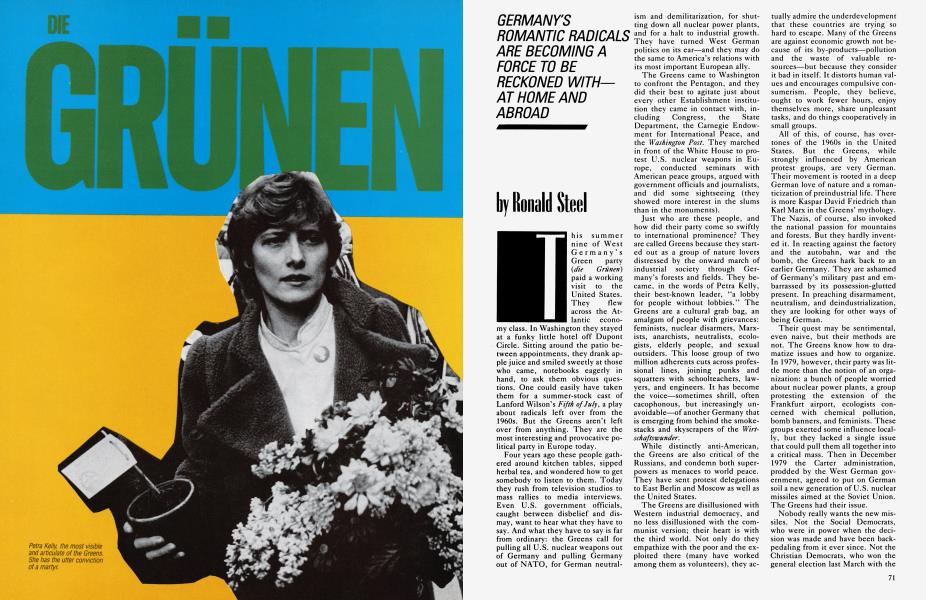
Even though Kelly (her Irish name comes from an American stepfather) is only one of the Greens' leaders, she is by far the most familiar in this country. She is certainly photogenic, with her short-cropped blond hair, her intense blue eyes, her sharp cheekbones, and her sense of style. Three large silver rings and a turquoise one adorn her thin, nervous hands. Kelly has the frame of an incipiently anorectic adolescent: wiry energy covering over deep fatigue. Her eyes suggest that she hasn't slept more than a few hours a night for several years, and she is perpetually saying how tired she is as she rushes off to another appointment. Perhaps because of the nervous energy she is extremely attractive, especially when she relaxes her usually furrowed brow and allows a smile to creep across her face.
To listen to Kelly address an audience is to be both impressed and exasperated. She knows so many facts: the throw weight of this missile and the calorie intake of that oppressed group. She feels so strongly about every issue. The global subjugation of the weak by the strong, she says, is really an extension of the domination of women by men; nonviolent resistance to nuclear weapons can lead us out of the arms race. She is so absolutely sure of herself, the way you imagine Joan of Arc to have been. And like the Maid of Orleans, she is a hard cross to bear: shrill, humorless, dogmatic.
Kelly, who was a high school student not far from Washington during Martin Luther King's famous march through the capital in 1963, was inspired by the civil rights movement. She later participated in Vietnam War protests, and worked for Robert Kennedy's presidential campaign. "Nonviolence is a way of changing a society that is itself based on violence," she told me in explanation of her party's tactics.
Those tactics will be tested this fall when the Greens try to prevent the deployment of U.S. Pershing II missiles in West Germany. The Greens are pledged to resist the missiles, just as the Kohl government—despite its hope that the Americans can somehow be persuaded to work out a compromise with the Russians that will make deployment unnecessary—is pledged to provide a home for them. The Greens vow that it will be a heisser Herbst, a hot autumn.
"THEIR MOVEMENT IS ROOTED IN A DEEP GERMAN LOVE OF NATURE THE NAZIS, OF COURSE, ALSO INVOKED THE NATIONAL PASSION FOR MOUNTAINS AND FORESTS. BUT THEY HARDLY INVENTED IT"
Even many who sympathize with the Greens and their objectives are troubled by such threats. West Germany is, after all, a democratic society. The decision to accept the American missiles was made by a democratically elected government that received wide popular support. Even the Social Democrats, now in the opposition, have not officially challenged that decision. What right have the Greens to block it? The question is especially sensitive in a country where memories are still fresh of another "movement"—in the 1930s—that had contempt for the parliamentary process. But the Greens, most of whom were born after the Nazi era, have an answer. "No one can decide over others in questions of life and death," Petra Kelly explained to me. "Thus the Greens take the position that even where a majority supports deployment of cruise and Pershing II missiles, such a decision is inimical to the dictates of our conscience, and we would continue to protest it with nonviolent resistance."
To challenge Kelly and the Greens you have to reject their essential premise—that nuclear weapons themselves are the greatest danger to humanity, and that their very existence makes eventual nuclear war a near certainty. You have to start thinking in terms of "deterrence" or "minimal damage" or "acceptable risk." For people who do so, Petra Kelly also has an answer: "The deformed human mind is the ultimate doomsday weapon."
Though the Greens all seem to agree on the nuclear issue, they are torn by a score of different motives. The anarchists among them eschew any organization; the Marxists have a theory for every malady. Some Greens want to ensure the movement's purity by shunning any collaboration with the conventional political parties; others would join forces with the Social Democrats to
form a left-wing coalition government. At the moment, the movement is broad enough to encompass romantic idealists like Petra Kelly with her vision of a preindustrial Germany as well as Marxist organizers who believe in economic growth as long as the working class gets the fruits.
In the end, however, this very breadth may be the weakness that prevents the Greens from exercising the power of a political party. Even though they have real representatives in a real parliament, they still think and act like a counterculture movement. They remain unsure whether to call themselves a party, a movement, or simply a group. And they cannot quite deal with the fact that they are inside the citadel of power. They will unquestionably stay there throughout this term of parliament, but the influence they wield will depend on their ability to act coherently. The Greens face a dilemma: If they play the parliamentary game, they will exert influence within the government, but they may lose their ideological purity, and with it many of their adherents. If they refuse to behave like a real party, they may waste the chance to make significant changes in the society. At the moment the question is open, and the debate is beginning to take place.
Before leaving the Greens, I asked them if they had any message for their American counterparts. Working with the American peace movement was, after all, one of the reasons for their visit to the U.S. "Build local constituencies," said Otto Schily, a razor-sharp Berlin lawyer who gained notoriety during the 1960s for defending radicals and is now one of the party's chief theoreticians. "Don't dissipate your strength on single issues. Take a strong stand on the issues you really care about. Don't backtrack, and don't worry about how ridiculous your opponents try to make you look."
"One more thing, if I may," added Walter Schwenninger, a giant man with shoulder-length hair, a ferocious beard, and a gentle voice. "Americans who want to change the world should also find a little time to dance. I live in a house with many people. We cook and eat together, and share our times. Sometimes after dinner we dance. It is important, you know, not to forget to dance." Q
THE GREENS ARE PLEDGED TO RESIST THE DEPLOYMENT OF U.S. PERSHING II MISSILES. THEY VOW THAT IT WILL BE A HEISSER HERBST, A HOT AUTUMN
Subscribers have complete access to the archive.
Sign In Not a Subscriber?Join Now


