Sign In to Your Account
Subscribers have complete access to the archive.
Sign In Not a Subscriber?Join NowEven on Sunday
Diplomacy as a Full-time Job
Ronald Steel
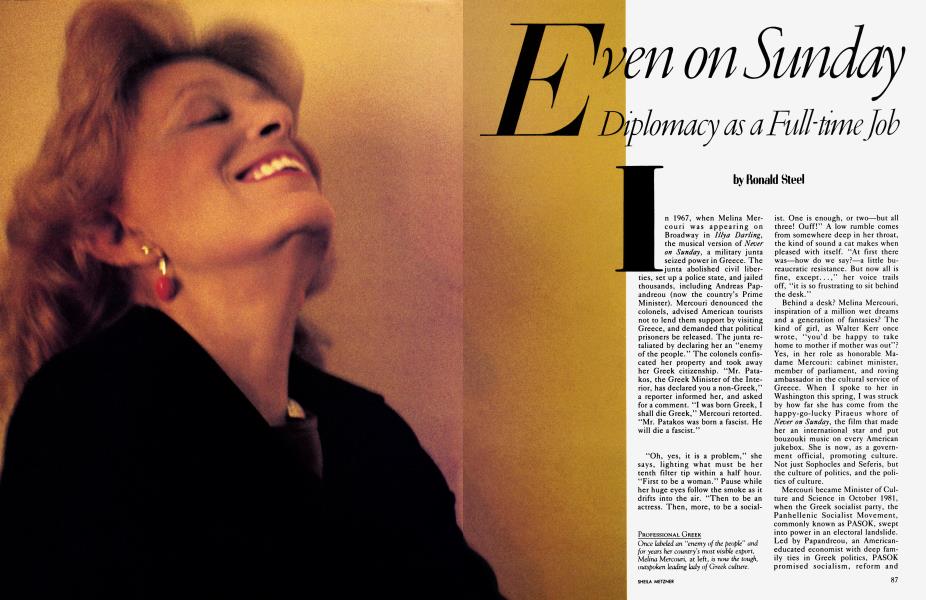
1967, when Melina MerIn couri was appearing on Broadway in Iliya Darling, the musical version of Never on Sunday, a military junta seized power in Greece. The abolished civil liberties, set up a police state, and jailed thousands, including Andreas Papandreou (now the country's Prime Minister). Mercouri denounced the colonels, advised American tourists not to lend them support by visiting Greece, and demanded that political prisoners be released. The junta retaliated by declaring her an "enemy of the people." The colonels confiscated her property and took away her Greek citizenship. "Mr. Patakos, the Greek Minister of the Interior, has declared you a non-Greek," a reporter informed her, and asked for a comment. "I was born Greek, I shall die Greek," Mercouri retorted. "Mr. Patakos was born a fascist. He will die a fascist."
"Oh, yes, it is a problem," she says, lighting what must be her tenth filter tip within a half hour. "First to be a woman." Pause while her huge eyes follow the smoke as it drifts into the air. "Then to be an actress. Then, more, to be a socialist. One is enough, or two—but all three! Ouff!" A low rumble comes from somewhere deep in her throat, the kind of sound a cat makes when pleased with itself. "At first there was—how do we say?—a little bureaucratic resistance. But now all fine, except...," her voice trails off, "it is so frustrating to sit behind the desk."
Behind a desk? Melina Mercouri, inspiration of a million wet dreams and a generation of fantasies? The kind of girl, as Walter Kerr once wrote, "you'd be happy to take home to mother if mother was out"? Yes, in her role as honorable Madame Mercouri: cabinet minister, member of parliament, and roving ambassador in the cultural service of Greece. When I spoke to her in Washington this spring, I was struck by how far she has come from the happy-go-lucky Piraeus whore of Never on Sunday, the film that made her an international star and put bouzouki music on every American jukebox. She is now, as a government official, promoting culture. Not just Sophocles and Seferis, but the culture of politics, and the politics of culture.
Mercouri became Minister of Culture and Science in October 1981, when the Greek socialist party, the Panhellenic Socialist Movement, commonly known as PASOK, swept into power in an electoral landslide. Led by Papandreou, an Americaneducated economist with deep family ties in Greek politics, PASOK promised socialism, reform and an end to foreign (i.e., United States) interference in Greek affairs. Mercouri was a clever choice for the cultural ministry. Her grandfather had been a revered mayor of Athens and her father a well-known politician, both centrists. She herself had long been active in leftist causes; she had been a socialist member of parliament since 1977, representing a working-class district of Piraeus, and for a couple of decades she has been, without much doubt, Greece's most visible export.
To be born
After the fascists came to power, she used her popularity to gain foreign platforms, attacking the colonels and the American government's tacit support of them. She dramatized the plight of those in Greece who had been jailed and tortured, and she criticized Dean Acheson, the former Secretary of State, for saying that Greeks needed a little authoritarian rule. Anonymous threats were made on her life, and the FBI was sent to guard her. She toured Europe to rally opposition against the junta and went to Hollywood, as she says in her autobiography, / Was Born Greek, "to make money to buy bombs."
In 1969 she went to Europe with her American husband, film director Jules Dassin, to work, to resist as best she could, to wait. During those anxious years, until the junta was forced out in 1974 and democracy was restored, she remained an optimist. "Everywhere in the world, young people are taking a stand," she wrote in her book during that period. "The revolution they are preparing is more than scientific or technological. They demand that life be meaningful. They demand that life be lit by some large vision of beauty and goodness and truth."
But it's not easy to be so optimistic when you're sitting behind a government desk. "To be born Greek is to be magnificently cursed," Mercouri summed it up even before she became culture czarina. "To a surprisingly large number of people, it means you personally built the Acropolis, you created Delphi, the theater, and you sired the concept of democracy. The truth is that you're poor, many of your people can't read, and the rare moments that you tasted of democracy and independence, foreign protectors and their Greek stooges snatched away."
Greek is to be magnificently cursed 'y>
Like most Greeks, Mercouri is imbued with a sense of history. She feels the four centuries of Turkish occupation, when Greece was under Ottoman rule, as a personal affliction. She knows of the Germanspeaking kings the British put on the throne to do their bidding after Britain took over from Turkey, and how the Americans, who took over in 1947 when the British pleaded bankruptcy, showed more concern with Greece's cold war loyalties than with democracy and social reform in Athens. To be a Greek patriot does not mean to be anti-anyone. But it does mean to be resistant—resistant to whatever country or culture dominates Greece, whether by intent or simply by sheer size. That, in fact, is the politics of Papandreou, who has turned stubborn independence into a tool of diplomacy, getting concessions from NATO, money from the Americans, who want Greek bases, and huge subsidies from the Common Market. The power to say no is the tyranny of the weak.
Mercouri is more diplomatic than her boss. She does not say no, so much as yes, but. "We Greeks must learn about our own culture," she explains, "instead of seeing the world through the eyes of others. You Americans inundate the world, both with your wonderful things and with your not-wonderful things, like soap operas. You have quality, you have talent, you have money. We are open to your culture, to the culture of all nations. I do not want to restrict that. But I want to emphasize the culture of Greece and to make our people aware of our own culture and our artistic creation.
"Your films are shown in every theater in Greece. How many Greek films have had wide distribution in the United States? Two. Your average film has a $10 million budget. If one of our films costs $200,000 it is considered a superproduction. Your best authors are translated into Greek. How many of ours can you find in English? We cannot compete with you, but neither can we lose our Greek identity. It is my job to defend our culture and preserve our identity, to ask for a better balance between our culture and yours. I don't want to fight against anyone else's culture," she underlined, "but I will fight for my own."
No one would doubt that Mercouri is a fighter. Even in the elegance of silk and suede, graceful, smaller than one would think from her films, and even vulnerable, she evokes the charismatic peasant heroine of her greatest film, He Who Must Die. In this dramatization of the novel Christ Recrucified, by Nikos Kazantzakis, she captured the passion and idealism of a woman who lives for a cause greater than herself.
Culture in Mercouri's view, as for many of the socialists who came to power in Papandreou's electoral victory two years ago, is a way of achieving the ideal of socialism. "Culture is not just books and films," she said. "Culture is politics and economics. Culture is society. Culture is life. It comes from our history and from our ideas." In a country where the left has been blocked from power for generations—by the monarchy, the foreigners, the military, the war, the cold war—the socialists' victory seemed to offer the chance to transform society. "Since the day that I became Minister of Culture," Mercouri told me, "I have taken refuge in Jean-Paul Sartre's sublime motto: 'Socialism is a kind of humanism.' For our socialist government of Greece, this is the starting point."
That, to many socialists, was what their 1981 victory was all about. It unblocked the political system, showed that those who had always been on the outside—students, teachers, peasants, the working class—would be allowed to govern. This was not just switching from one party to the other, as in the United States, but legitimizing a different political tradition. Never mind that Papandreou, for all his leftist rhetoric and overdue reforms, is far more a traditional Greek political godfather than a revolutionary. Never mind, too, that he probably chose Mercouri as Culture Minister more for her name and glamour than for her credentials as a cultural bureaucrat.
It was a brilliant appointment, and Mercouri has known how to use it. Does she enjoy flying around the world cutting blue ribbons for Greek art exhibitions, pleading for the British to return the Elgin marbles to Athens, trying to get the Greeks to watch political round tables on television instead of Dallas? I doubt it. When I spoke with her, she had just come from Athens for a Greek benefit, and from Sydney two days before that. She had all but lost her voice, and seemed to be running on sheer grit and cigarettes. I wanted to know if, in choosing this life, she had renounced the other. "Will you never return to the theater?" I asked. "Oh, I very much enjoy the work I do," she responded, choosing her words carefully. "But you can never say never. When you say never, something dies."
For many, politics is a game, or a means of self-aggrandizement. With Mercouri one cannot help feeling that it remains a cause. Though very articulate, she is not an intellectual. But she does care about ideas. She cares about Greece's cultural identity, which is why she has tried to decentralize cultural life beyond Athens by setting up regional libraries, theaters and museums. It is also why she has made such an issue of the Elgin marbles. "I don't want to empty the world's museums," she explained. "This is a special case. These sculptures were torn from the frieze of the Parthenon when Greece was under Turkish occupation. They are not just any sculptures, but belong to a monument that is absolutely crucial to Greek civilization." "Is this really an artistic issue or a political one?" I asked her a bit smugly. "It is an issue," she replied looking me square in the eye, "of the soul of the Greeks."
Subscribers have complete access to the archive.
Sign In Not a Subscriber?Join Now


