Sign In to Your Account
Subscribers have complete access to the archive.
Sign In Not a Subscriber?Join NowROBERT WILSON AND THE OLYMPIC SCANDAL
ALAN RICH reports on our failure to support one of our own
Performance
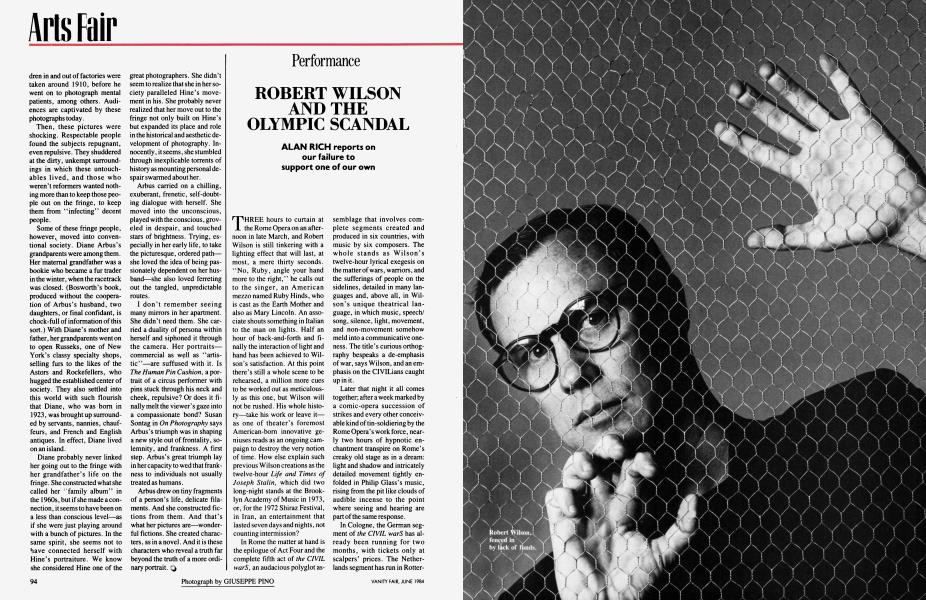
THREE hours to curtain at the Rome Opera on an afternoon in late March, and Robert Wilson is still tinkering with a lighting effect that will last, at most, a mere thirty seconds. “No, Ruby, angle your hand more to the right,” he calls out to the singer, an American mezzo named Ruby Hinds, who is cast as the Earth Mother and also as Mary Lincoln. An associate shouts something in Italian to the man on lights. Half an hour of back-and-forth and finally the interaction of light and hand has been achieved to Wilson’s satisfaction. At this point there’s still a whole scene to be rehearsed, a million more cues to be worked out as meticulously as this one, but Wilson will not be rushed. His whole history—take his work or leave it— as one of theater’s foremost American-born innovative geniuses reads as an ongoing campaign to destroy the very notion of time. How else explain such previous Wilson creations as the twelve-hour Life and Times of Joseph Stalin, which did two long-night stands at the Brooklyn Academy of Music in 1973, or, for the 1972 Shiraz Festival, in Iran, an entertainment that lasted seven days and nights, not counting intermission?
In Rome the matter at hand is the epilogue of Act Four and the complete fifth act of the CIVIL warS, an audacious polyglot assemblage that involves complete segments created and produced in six countries, with music by six composers. The whole stands as Wilson’s twelve-hour lyrical exegesis on the matter of wars, warriors, and the sufferings of people on the sidelines, detailed in many languages and, above all, in Wilson’s unique theatrical language, in which music, speech/ song, silence, light, movement, and non-movement somehow meld into a communicative oneness. The title’s curious orthography bespeaks a de-emphasis of war, says Wilson, and an emphasis on the CIVILians caught up in it.
Later that night it all comes together; after a week marked by a comic-opera succession of strikes and every other conceivable kind of tin-soldiering by the Rome Opera’s work force, nearly two hours of hypnotic enchantment transpire on Rome’s creaky old stage as in a dream; light and shadow and intricately detailed movement tightly enfolded in Philip Glass’s music, rising from the pit like clouds of audible incense to the point where seeing and hearing are part of the same response.
In Cologne, the German segment of the CIVIL warS has already been running for two months, with tickets only at scalpers’ prices. The Netherlands segment has run in Rotterdam and Paris, also in sold-out houses. Japan’s segment is ready to go, as is a section produced in France. An American section, including betweenscenes interludes staged to music by David Byrne, of Talking Heads, is in rehearsal in Minneapolis and is scheduled to premiere April 26. It was planned to all come together in Los Angeles this summer as America’s entry in an arts-festival counterpart to the Olympic Games... a homecoming for our own Robert Wilson, a message to the creative world that America, too, knows its major innovative artists and shows their work proudly. Now, however, just as the Roman flank of the CIVIL warS falls into place, Wilson has in his pocket a cable from the Los Angeles Olympic Organizing Committee: the CIVIL warS will not be waged—not in Los Angeles, at any rate, where it would cost an estimated $2.6 million to present the complete work. Seven hundred thousand dollars was raised from public, private, and corporate sources—including $200,000 from the L. A.O.O.C. —and another $700,000 was projected for potential box-office and benefit returns. That still left a $1.2 million deficit.
Still later we sit around a rickety table in a run-down hotel, all of us, Wilson and Glass included, exhilarated by the quiet beauty of what we’ve seen and heard, stunned by the news from Los Angeles. For Wilson it’s simply the latest put-down in an ongoing unrequited love affair with the land of his birth. Meanwhile, he’s going broke, one of this century’s major artists, only a few months out of debt from the 1976 productions of Einstein on the Beach (another collaboration with Glass) at the Metropolitan Opera; now he’s even had to sell his original sketches for the CIVIL warS and put himself in debt again just to cover preproduction expenses. “Bob Fitzpatrick [head of the Olympic Arts Festival] approached me three years ago. Now he’s canceled two days ahead of our funding deadline. He’d already haggled the running time from twelve hours down to eight, but somewhere along the line he decided he just didn’t want it to happen in any way or shape. ’ ’
“I don’t think it’s Fitzpatrick,” someone else chimes in. “After all, he’s the head of California Institute of the Arts, as progressive a school as you’ll find. I think the people above Fitzpatrick got scared. All they knew about was a twelve-hour opera, with modem music, including electronic, and a crackpot title. All they saw was overtime, empty seats, huge financial losses. Someone spread the story that it was going to cost the Olympics some astronomical sum—$ 13 and $ 14 million have been going around. It was a lie, but it blended in with all those other half-truths.”
“You want the real figures?” asks Wilson. “By the time all the foreign segments were produced, transported to Los Angeles, and with salaries and accommodations figured in, the six countries would have spent a total of just over three million. Every country raised its share with no trouble, either from governmental arts funding or, in Japan, from private sources: a kimono manufacturer and the head of a hamburger chain who wants a toehold in the States. When I needed cash for a deposit to reserve the Shrine Auditorium, I got it from France, no questions asked.”
It’s the old runaround. Where Wilson is known, in Germany and France and the Netherlands, where he regularly produces spellbinding theater art that remains in the repertories of major houses and draws cheering crowds, he writes his own ticket. In the United States, where no major Wilson creation has been seen in eight years, he remains an outsider, exiled for a daring which is extreme even by Olympic standards. After the cancellation of the CIVIL warS, several European critics raised the question of America’s cultural integrity, asking along the way how it happens that while most nations, through government and/or private sources, are able to Finance their own cultural teams at the Olympic Arts Festival—England’s Royal Shakespeare Company, France’s avantgarde Theatre du Soleil, several extraordinary groups from Japan—the host nation cannot or will not do the same. Well might they ask, and wonder, too, about those millions already raised abroad. And about the down payment on six weeks’ time at the Shrine Auditorium.
Embarrassment enough? No; consider that little Cologne, where the magic of Bob Wilson’s radiant theatrical lyricism has filled its Schauspielhaus with cheers week after week, has announced that the complete, unadulterated CIVIL warS in all its arrogant glory is more than welcome. That Robert Wilson’s art deserves a showcase in his own country is, I hope, beyond argument. Whether his own country deserves Bob Wilson or his art is, however, open to argument.
Subscribers have complete access to the archive.
Sign In Not a Subscriber?Join Now


