Sign In to Your Account
Subscribers have complete access to the archive.
Sign In Not a Subscriber?Join NowVenetian Class
Geldzahler and Noguchi, the Biennale's odd couple
VISUAL ART
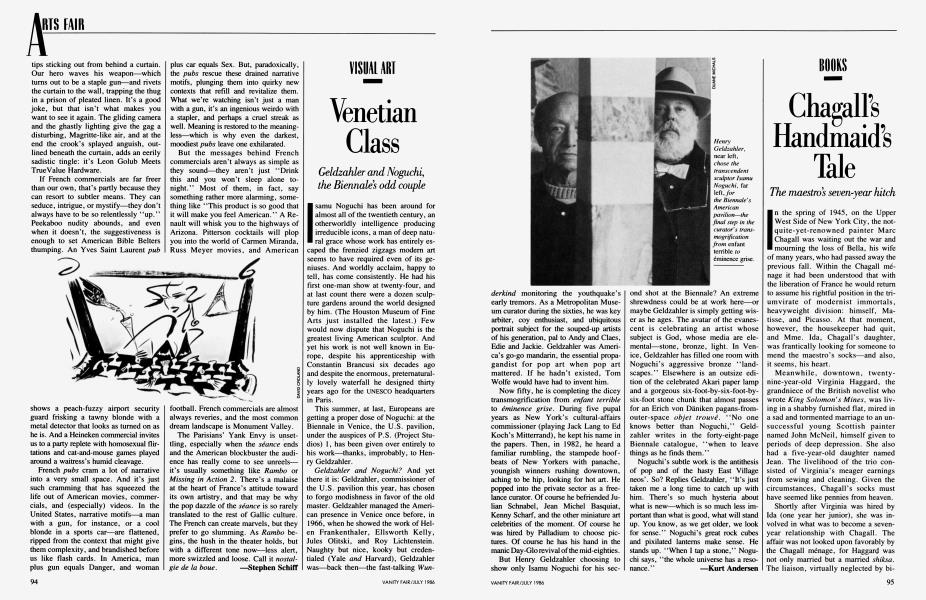
I samu Noguchi has been around for almost all of the twentieth century, an otherworldly intelligence producing irreducible icons, a man of deep natural grace whose work has entirely escaped the frenzied zigzags modem art seems to have required even of its geniuses. And worldly acclaim, happy to tell, has come consistently. He had his first one-man show at twenty-four, and at last count there were a dozen sculpture gardens around the world designed by him. (The Houston Museum of Fine Arts just installed the latest.) Few would now dispute that Noguchi is the greatest living American sculptor. And yet his work is not well known in Europe, despite his apprenticeship with Constantin Brancusi six decades ago and despite the enormous, preternatural -ly lovely waterfall he designed thirty years ago for the UNESCO headquarters in Paris.
This summer, at last, Europeans are getting a proper dose of Noguchi: at the Biennale in Venice, the U.S. pavilion, under the auspices of P.S. (Project Studios) 1, has been given over entirely to his work—thanks, improbably, to Henry Geldzahler.
Geldzahler and Noguchi? And yet there it is: Geldzahler, commissioner of the U.S. pavilion this year, has chosen to forgo modishness in favor of the old master. Geldzahler managed the American presence in Venice once before, in 1966, when he showed the work of Helen Frankenthaler, Ellsworth Kelly, Jules Olitski, and Roy Lichtenstein. Naughty but nice, kooky but credentialed (Yale and Harvard), Geldzahler was—back then—the fast-talking Wun- derkind monitoring the youthquake's early tremors. As a Metropolitan Museum curator during the sixties, he was key arbiter, coy enthusiast, and ubiquitous portrait subject for the souped-up artists of his generation, pal to Andy and Claes, Edie and Jackie. Geldzahler was America's go-go mandarin, the essential propagandist for pop art when pop art mattered. If he hadn't existed, Tom Wolfe would have had to invent him.
Now fifty, he is completing the dicey transmogrification from enfant terrible to eminence grise. During five pupal years as New York's cultural-affairs commissioner (playing Jack Lang to Ed Koch's Mitterrand), he kept his name in the papers. Then, in 1982, he heard a familiar rumbling, the stampede hoofbeats of New Yorkers with panache, youngish winners rushing downtown, aching to be hip, looking for hot art. He popped into the private sector as a freelance curator. Of course he befriended Julian Schnabel, Jean Michel Basquiat, Kenny Scharf, and the other miniature art celebrities of the moment. Of course he was hired by Palladium to choose pictures. Of course he has his hand in the manic Day-Glo revival of the mid-eighties.
But Henry Geldzahler choosing to show only Isamu Noguchi for his second shot at the Biennale? An extreme shrewdness could be at work here—or maybe Geldzahler is simply getting wiser as he ages. The avatar of the evanescent is celebrating an artist whose subject is God, whose media are elemental—stone, bronze, light. In Venice, Geldzahler has filled one room with Noguchi's aggressive bronze "landscapes." Elsewhere is an outsize edition of the celebrated Akari paper lamp and a gorgeous six-foot-by-six-foot-bysix-foot stone chunk that almost passes for an Erich von Daniken pagans-fromouter-space objet trouve. "No one knows better than Noguchi," Geldzahler writes in the forty-eight-page Biennale catalogue, "when to leave things as he finds them."
Noguchi's subtle work is the antithesis of pop and of the hasty East Village neos'. So? Replies Geldzahler, "It's just taken me a long time to catch up with him. There's so much hysteria about what is new—which is so much less important than what is good, what will stand up. You know, as we get older, we look for sense." Noguchi's great rock cubes and pixilated lanterns make sense. He stands up. "When I tap a stone," Noguchi says, "the whole universe has a resonance ."
Kurt Anderson
Subscribers have complete access to the archive.
Sign In Not a Subscriber?Join Now
