

Sign In to Your Account
Subscribers have complete access to the archive.
Sign In Not a Subscriber?Join NowJohn Hersey's Call
James C. Thomson, Jr.
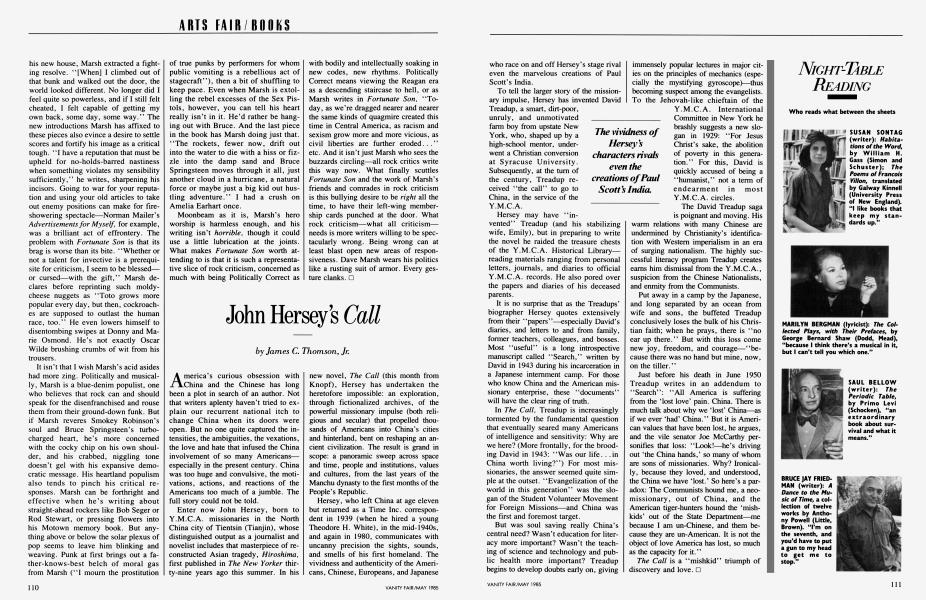
A merica's curious obsession with China and the Chinese has long been a plot in search of an author. Not that writers aplenty haven't tried to explain our recurrent national itch to change China when its doors were open. But no one quite captured the intensities, the ambiguities, the vexations, the love and hate that infused the China involvement of so many Americans— especially in the present century. China was too huge and convulsive, the motivations, actions, and reactions of the Americans too much of a jumble. The full story could not be told.
Enter now John Hersey, born to Y.M.C.A. missionaries in the North China city of Tientsin (Tianjin), whose distinguished output as a journalist and novelist includes that masterpiece of reconstructed Asian tragedy, Hiroshima, first published in The New Yorker thirty-nine years ago this summer. In his
new novel, The Call (this month from Knopf), Hersey has undertaken the heretofore impossible: an exploration, through fictionalized archives, of the powerful missionary impulse (both religious and secular) that propelled thousands of Americans into China's cities and hinterland, bent on reshaping an ancient civilization. The result is grand in scope: a panoramic sweep across space and time, people and institutions, values and cultures, from the last years of the Manchu dynasty to the first months of the People's Republic.
Hersey, who left China at age eleven but returned as a Time Inc. correspondent in 1939 (when he hired a young Theodore H. White), in the mid-1940s, and again in 1980, communicates with uncanny precision the sights, sounds, and smells of his first homeland. The vividness and authenticity of the Americans, Chinese, Europeans, and Japanese who race on and off Hersey's stage rival even the marvelous creations of Paul Scott's India.
To tell the larger story of the missionary impulse, Hersey has invented David Treadup, a smart, dirt-poor, unruly, and unmotivated farm boy from upstate New York, who, shaped up by a high-school mentor, underwent a Christian conversion at Syracuse University. Subsequently, at the turn of the century, Treadup received "the call" to go to China, in the service of the Y.M.C.A.
Hersey may have "invented" Treadup (and his stabilizing wife, Emily), but in preparing to write the novel he raided the treasure chests of the Y.M.C.A. Historical Library— reading materials ranging from personal letters, journals, and diaries to official Y.M.C.A. records. He also pored over the papers and diaries of his deceased parents.
It is no surprise that as the Treadups' biographer Hersey quotes extensively from their "papers"—especially David's diaries, and letters to and from family, former teachers, colleagues, and bosses. Most "useful" is a long introspective manuscript called "Search," written by David in 1943 during his incarceration in a Japanese internment camp. For those who know China and the American missionary enterprise, these "documents" will have the clear ring of truth.
In The Call, Treadup is increasingly tormented by the fundamental question that eventually seared many Americans of intelligence and sensitivity: Why are we here? (More frontally, for the brooding David in 1943: "Was our life. . .in China worth living?") For most missionaries, the answer seemed quite simple at the outset. "Evangelization of the world in this generation" was the slogan of the Student Volunteer Movement for Foreign Missions—and China was the first and foremost target.
But was soul saving really China's central need? Wasn't education for literacy more important? Wasn't the teaching of science and technology and public health more important? Treadup begins to develop doubts early on, giving
immensely popular lectures in major cities on the principles of mechanics (especially the mystifying gyroscope)—thus becoming suspect among the evangelists. To the Jehovah-like chieftain of the Y.M.C.A. International Committee in New York he brashly suggests a new slogan in 1929: "For Jesus Christ's sake, the abolition of poverty in this generation." For this, David is quickly accused of being a "humanist," not a term of endearment in most Y.M.C.A. circles.
The David Treadup saga is poignant and moving. His warm relations with many Chinese are undermined by Christianity's identification with Western imperialism in an era of surging nationalism. The highly successful literacy program Treadup creates earns him dismissal from the Y.M.C.A., suspicion from the Chinese Nationalists, and enmity from the Communists.
Put away in a camp by the Japanese, and long separated by an ocean from wife and sons, the buffeted Treadup conclusively loses the bulk of his Christian faith; when he prays, there is "no ear up there." But with this loss come new joy, freedom, and courage—"because there was no hand but mine, now, on the tiller. ' '
Just before his death in June 1950 Treadup writes in an addendum to "Search": "All America is suffering from the 'lost love' pain. China. There is much talk about why we 'lost' China—as if we ever 'had' China." But it is American values that have been lost, he argues, and the vile senator Joe McCarthy personifies that loss: "Look!—he's driving out 'the China hands,' so many of whom are sons of missionaries. Why? Ironically, because they loved, and understood, the China we have 'lost.' So here's a paradox: The Communists hound me, a neomissionary, out of China, and the American tiger-hunters hound the 'mishkids' out of the State Department—me because I am un-Chinese, and them because they are un-American. It is not the object of love America has lost, so much as the capacity for it. ' '
The Call is a "mishkid" triumph of discovery and love. □
The vividness of Hersey ⅛ characters rivals even the
creations of Paul Scott's India.
Subscribers have complete access to the archive.
Sign In Not a Subscriber?Join Now
