
Sign In to Your Account
Subscribers have complete access to the archive.
Sign In Not a Subscriber?Join NowHot Type
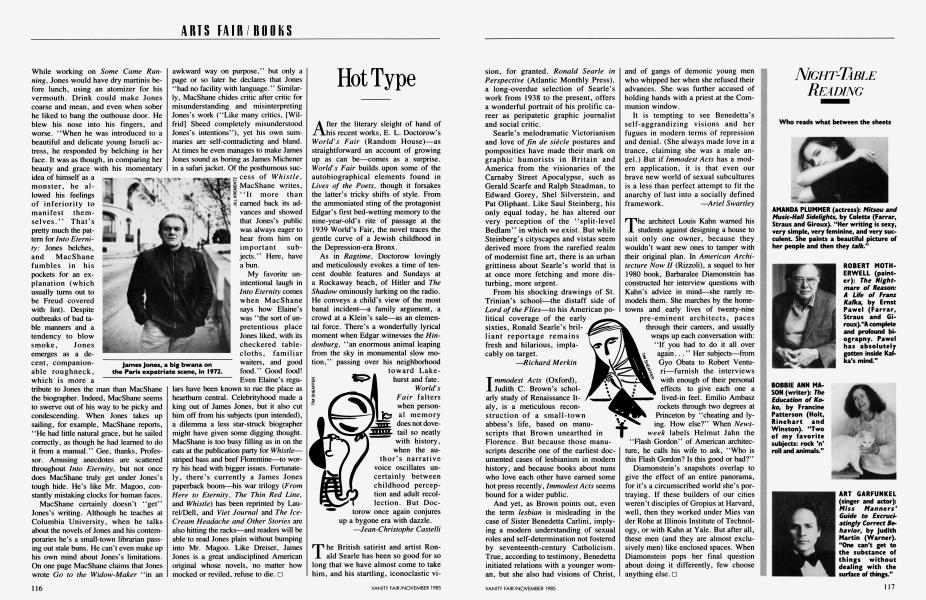
After the literary sleight of hand of his recent works, E. L. Doctorow's World's Fair (Random House)—as straightforward an account of growing up as can be—comes as a surprise. World's Fair builds upon some of the autobiographical elements found in Lives of the Poets, though it forsakes the latter's tricky shifts of style. From the ammoniated sting of the protagonist Edgar's first bed-wetting memory to the nine-year-old's rite of passage at the 1939 World's Fair, the novel traces the gentle curve of a Jewish childhood in the Depression-era Bronx.
As in Ragtime, Doctorow lovingly and meticulously evokes a time of tencent double features and Sundays at a Rockaway beach, of Hitler and The Shadow ominously lurking on the radio. He conveys a child's view of the most banal incident—a family argument, a crowd at a Klein's sale—as an elemental force. There's a wonderfully lyrical moment when Edgar witnesses the Hindenburg, "an enormous animal leaping from the sky in monumental slow motion," passing over his neighborhood toward Lakehurst and fate.
World's Fair falters when personal memory does not dovetail so neatly with history, when the au-
thor's narrative voice oscillates uncertainly between childhood perception and adult recollection. But Doc-
torow once again conjures up a bygone era with dazzle.
Jean-Christophe Castelli
The British satirist and artist Ronald Searle has been so good for so long that we have almost come to take him, and his startling, iconoclastic vision, for granted. Ronald Searle in Perspective (Atlantic Monthly Press), a long-overdue selection of Searle's work from 1938 to the present, offers a wonderful portrait of his prolific career as peripatetic graphic journalist and social critic.
Searle's melodramatic Victorianism and love of fin de siecle postures and pomposities have made their mark on graphic humorists in Britain and America from the visionaries of the Carnaby Street Apocalypse, such as Gerald Scarfe and Ralph Steadman, to Edward Gorey, Shel Silverstein, and Pat Oliphant. Like Saul Steinberg, his only equal today, he has altered our very perception of the "split-level Bedlam'' in which we exist. But while Steinberg's cityscapes and vistas seem derived more from the rarefied realm of modernist fine art, there is an urban grittiness about Searle's world that is at once more fetching and more disturbing, more urgent.
From his shocking drawings of St. Trinian's school—the distaff side of Lord of the Flies—to his American political coverage of the early sixties, Ronald Searle's brilliant reportage remains fresh and hilarious, implacably on target.
Richard Merkin
Immodest Acts (Oxford), Judith C. Brown's scholarly study of Renaissance Italy, is a meticulous reconstruction of a small-town abbess's life, based on manuscripts that Brown unearthed in Florence. But because those manuscripts describe one of the earliest documented cases of lesbianism in modem history, and because books about nuns who love each other have earned some hot press recently, Immodest Acts seems bound for a wider public.
And yet, as Brown points out, even the term lesbian is misleading in the case of Sister Benedetta Carlini, implying a modem understanding of sexual roles and self-determination not fostered by seventeenth-century Catholicism. True, according to testimony, Benedetta initiated relations with a younger woman, but she also had visions of Christ,
and of gangs of demonic young men who whipped her when she refused their advances. She was further accused of holding hands with a priest at the Communion window.
It is tempting to see Benedetta's self-aggrandizing visions and her fugues in modern terms of repression and denial. (She always made love in a trance, claiming she was a male angel.) But if Immodest Acts has a modern application, it is that even our brave new world of sexual subcultures is a less than perfect attempt to fit the anarchy of lust into a socially defined framework.
Ariel Swartley
The architect Louis Kahn warned his students against designing a house to suit only one owner, because they wouldn't want new ones to tamper with their original plan. In American Architecture Mow II (Rizzoli), a sequel to her 1980 book, Barbaralee Diamonstein has constructed her interview questions with Kahn's advice in mind—she rarely remodels them. She marches by the hometowns and early lives of twenty-nine pre-eminent architects, paces through their careers, and usually wraps up each conversation with: "If you had to do it all over again..." Her subjects—from Gyo Obata to Robert Venturi—furnish the interviews with enough of their personal effects to give each one a lived-in feel. Emilio Ambasz rockets through two degrees at Princeton by "cheating and lying. How else?" When Newsweek labels Helmut Jahn the "Flash Gordon" of American architecture, he calls his wife to ask, "Who is this Flash Gordon? Is this good or bad?"
Diamonstein's snapshots overlap to give the effect of an entire panorama, for it's a circumscribed world she's portraying. If these builders of our cities weren't disciples of Gropius at Harvard, well, then they worked under Mies van der Rohe at Illinois Institute of Technology, or with Kahn at Yale. But after all, these men (and they are almost exclusively men) like enclosed spaces. When Diamonstein pops her final question about doing it differently, few choose anything else.
Subscribers have complete access to the archive.
Sign In Not a Subscriber?Join Now
