
Sign In to Your Account
Subscribers have complete access to the archive.
Sign In Not a Subscriber?Join NowHot Type
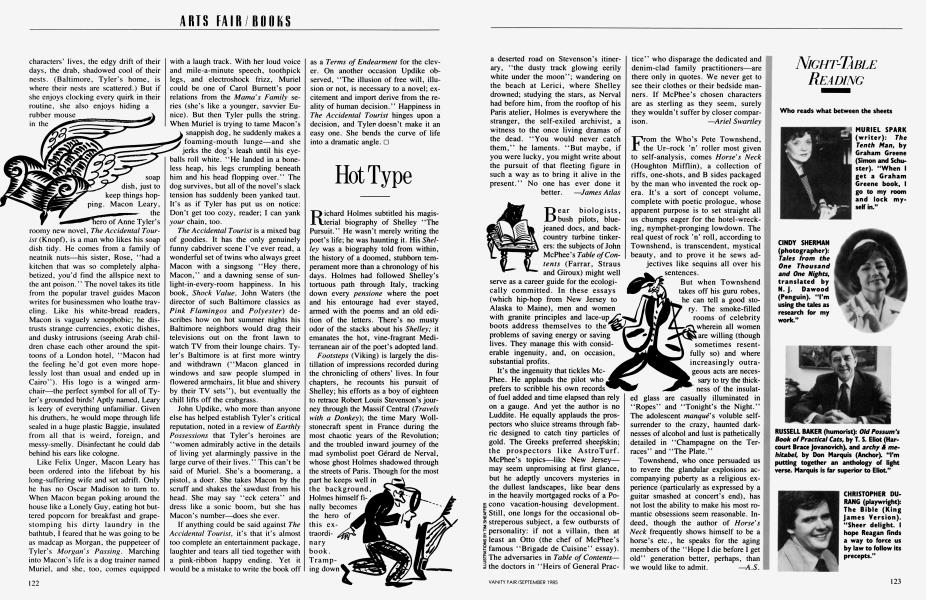
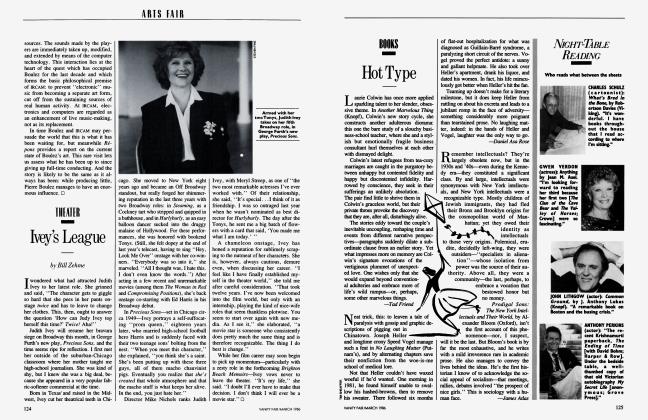
Richard Holmes subtitled his magisterial biography of Shelley "The Pursuit." He wasn't merely writing the poet's life; he was haunting it. His Shelley was a biography told from within, the history of a doomed, stubborn temperament more than a chronology of his days. Holmes had followed Shelley's tortuous path through Italy, tracking down every pensione where the poet and his entourage had ever stayed, armed with the poems and an old edition of the letters. There's no musty odor of the stacks about his Shelley; it emanates the hot, vine-fragrant Mediterranean air of the poet's adopted land.
Footsteps (Viking) is largely the distillation of impressions recorded during the chronicling of others' lives. In four chapters, he recounts his pursuit of Shelley; his efforts as a boy of eighteen to retrace Robert Louis Stevenson's journey through the Massif Central (Travels with a Donkey); the time Mary Wollstonecraft spent in France during the most chaotic years of the Revolution; and the troubled inward journey of the mad symbolist poet Gerard de Nerval, whose ghost Holmes shadowed through the streets of Paris. Though for the most part he keeps well in the background,
Holmes himself fi-, nally becomes the hero of this extraordinary book. Tramping down a deserted road on Stevenson's itinerary, "the dusty track glowing eerily white under the moon"; wandering on the beach at Lerici, where Shelley drowned; studying the stars, as Nerval had before him, from the rooftop of his Paris atelier, Holmes is everywhere the stranger, the self-exiled archivist, a witness to the once living dramas of the dead. "You would never catch them," he laments. "But maybe, if you were lucky, you might write about the pursuit of that fleeting figure in such a way as to bring it alive in the present." No one has ever done it better. —James Atlas
Bear biologists, bush pilots, bluejeaned docs, and backcountry turbine tinkerers: the subjects of John McPhee's Table of Contents (Farrar, Straus and Giroux) might well serve as a career guide for the ecologically committed. In these essays (which hip-hop from New Jersey to Alaska to Maine), men and women with granite principles and lace-up y boots address themselves to the^| problems of saving energy or saving lives. They manage this with considerable ingenuity, and, on occasion, substantial profits.
It's the ingenuity that tickles McPhee. He applauds the pilot who prefers to scribble his own records of fuel added and time elapsed than rely on a gauge. And yet the author is no Luddite. He equally applauds the prospectors who sluice streams through fabric designed to catch tiny particles of gold. The Greeks preferred sheep'skin; the prospectors like AstroTurf. McPhee's topics—like New Jersey— may seem unpromising at first glance, but he adeptly uncovers mysteries in the dullest landscapes, like bear dens in the heavily mortgaged rocks of a Pocono vacation-housing development. Still, one longs for the occasional obstreperous subject, a few outbursts of personality: if not a villain, then at least an Otto (the chef of McPhee's famous "Brigade de Cuisine" essay). The adversaries in Table of Contents— the doctors in "Heirs of General Prac-
tice" who disparage the dedicated and denim-clad family practitioners—are there only in quotes. We never get to see their clothes or their bedside manners. If McPhee's chosen characters are as sterling as they seem, surely they wouldn't suffer by closer comparison. —Ariel Swartley
From the Who's Pete Townshend, the Ur-rock 'n' roller most given to self-analysis, comes Horse's Neck (Houghton Mifflin), a collection of riffs, one-shots, and B sides packaged by the man who invented the rock opera. It's a sort of concept volume, complete with poetic prologue, whose apparent purpose is to set straight all us chumps eager for the hotel-wrecking, nymphet-pronging lowdown. The real quest of rock 'n' roll, according to Townshend, is transcendent, mystical beauty, and to prove it he sews adjectives like sequins all over his sentences.
But when Townshend takes off his guru robes, he can tell a good story. The smoke-filled rooms of celebrity wherein all women are willing (though sometimes resentfully so) and where increasingly outrageous acts are necessary to try the thickness of the insulated glass are casually illuminated in "Ropes" and "Tonight's the Night." The adolescent manque's voluble selfsurrender to the crazy, haunted darknesses of alcohol and lust is pathetically detailed in "Champagne on the Terraces" and "The Plate."
Townshend, who once persuaded us to revere the glandular explosions accompanying puberty as a religious experience (particularly as expressed by a guitar smashed at concert's end), has not lost the ability to make his most romantic obsessions seem reasonable. Indeed, though the author of Horse's Neck frequently shows himself to be a horse's etc., he speaks for the aging members of the "Hope I die before I get old" generation better, perhaps, than we would like to admit. —A.S.
Subscribers have complete access to the archive.
Sign In Not a Subscriber?Join Now
