










Sign In to Your Account
Subscribers have complete access to the archive.
Sign In Not a Subscriber?Join NowARTS FAIR
Motels with orange roofs turn out to be great ideas.
JAMES ATLAS
In the Black
READING
Max Apple's Propheteers
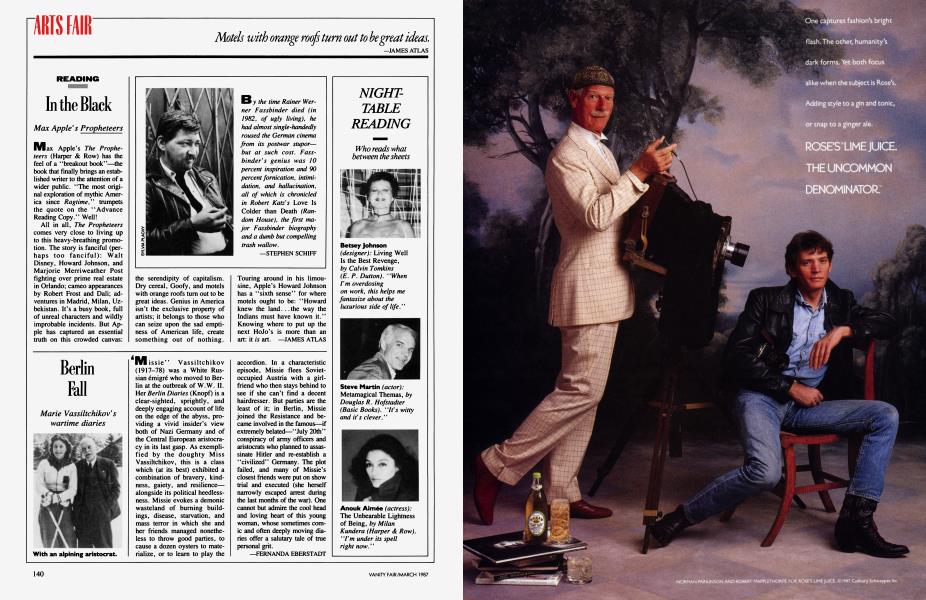
Max Apple's The Propheteers (Harper & Row) has the feel of a "breakout book"—the book that finally brings an established writer to the attention of a wider public. "The most original exploration of mythic America since Ragtime," trumpets the quote on the "Advance Reading Copy." Well!
All in all, The Propheteers comes very close to living up to this heavy-breathing promotion. The story is fanciful (perhaps too fanciful): Walt Disney, Howard Johnson, and Marjorie Merriweather Post fighting over prime real estate in Orlando; cameo appearances by Robert Frost and Dali; adventures in Madrid, Milan, Uzbekistan. It's a busy book, full of unreal characters and wildly improbable incidents. But Apple has captured an essential truth on this crowded canvas: the serendipity of capitalism. Dry cereal, Goofy, and motels with orange roofs turn out to be great ideas. Genius in America isn't the exclusive property of artists; it belongs to those who can seize upon the sad emptiness of American life, create something out of nothing.
Touring around in his limousine, Apple's Howard Johnson has a "sixth sense" for where motels ought to be: "Howard knew the land... the way the Indians must have known it." Knowing where to put up the next HoJo's is more than an art: it is art.
JAMES ATLAS
By the time Rainer Werner Fassbinder died (in 1982, of ugly living), he had almost single-handedly roused the German cinema from its postwar stupor— but at such cost. Fassbinder's genius was 10 percent inspiration and 90 percent fornication, intimidation, and hallucination, all of which is chronicled in Robert Katz's Love Is Colder than Death (Random House), the first major Fassbinder biography and a dumb but compelling trash wallow.
STEPHEN SCHIFF
Subscribers have complete access to the archive.
Sign In Not a Subscriber?Join Now