Sign In to Your Account
Subscribers have complete access to the archive.
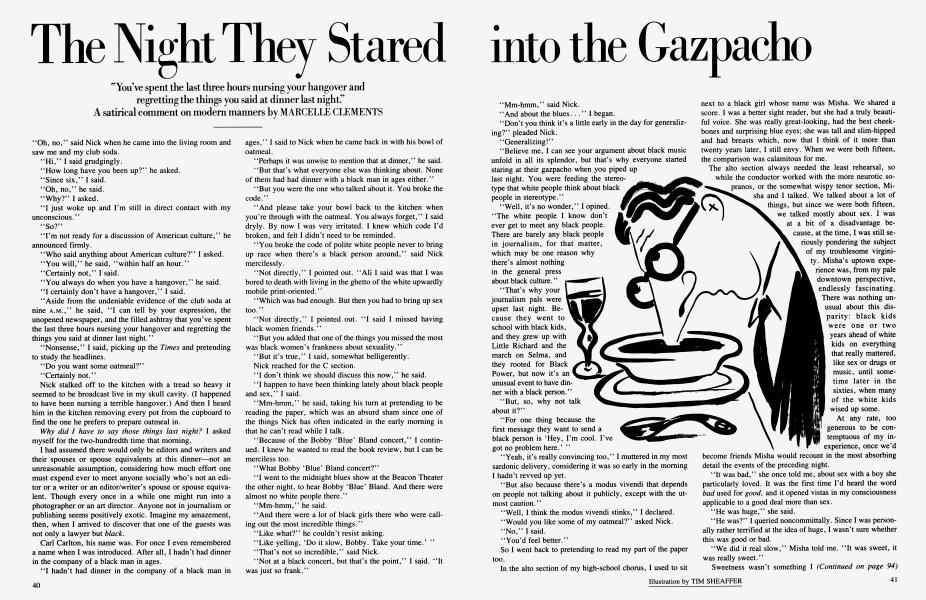
Sign In Not a Subscriber?Join NowThe Night They Stared into the Gazpacho
"You've spent the last three hours nursing your hangover and regretting the things you said at dinner last night." A satirical comment on modern manners by MARCELLE CLEMENTS
MARCELLE CLEMENTS
"Oh, no," said Nick when he came into the living room and saw me and my club soda.
"Hi," I said grudgingly.
"How long have you been up?" he asked.
"Since six," I said.
"Oh, no," he said.
"Why?" I asked.
"I just woke up and I'm still in direct contact with my unconscious."
"So?"
"I'm not ready for a discussion of American culture," he announced firmly.
"Who said anything about American culture?" I asked.
"You will," he said, "within half an hour."
"Certainly not," I said.
"You always do when you have a hangover," he said.
"I certainly don't have a hangover," I said.
"Aside from the undeniable evidence of the club soda at nine A.M.," he said, "I can tell by your expression, the unopened newspaper, and the filled ashtray that you've spent the last three hours nursing your hangover and regretting the things you said at dinner last night."
"Nonsense," I said, picking up the Times and pretending to study the headlines.
"Do you want some oatmeal?"
"Certainly not."
Nick stalked off to the kitchen with a tread so heavy it seemed to be broadcast live in my skull cavity. (I happened to have been nursing a terrible hangover.) And then I heard him in the kitchen removing every pot from the cupboard to find the one he prefers to prepare oatmeal in.
Why did I have to say those things last night? I asked myself for the two-hundredth time that morning.
I had assumed there would only be editors and writers and their spouses or spouse equivalents at this dinner—not an unreasonable assumption, considering how much effort one must expend ever to meet anyone socially who's not an editor or a writer or an editor/writer's spouse or spouse equivalent. Though every once in a while one might run into a photographer or an art director. Anyone not in journalism or publishing seems positively exotic. Imagine my amazement, then, when I arrived to discover that one of the guests was not only a lawyer but black.
Carl Carlton, his name was. For once I even remembered a name when I was introduced. After all, I hadn't had dinner in the company of a black man in ages.
"I hadn't had dinner in the company of a black man in ages," I said to Nick when he came back in with his bowl of oatmeal.
"Perhaps it was unwise to mention that at dinner," he said.
"But that's what everyone else was thinking about. None of them had had dinner with a black man in ages either."
"But you were the one who talked about it. You broke the code."
"And please take your bowl back to the kitchen when you're through with the oatmeal. You always forget," I said dryly. By now I was very irritated. I knew which code I'd broken, and felt I didn't need to be reminded.
"You broke the code of polite white people never to bring up race when there's a black person around," said Nick mercilessly.
"Not directly," I pointed out. "All I said was that I was bored to death with living in the ghetto of the white upwardly mobile print-oriented."
"Which was bad enough. But then you had to bring up sex too."
"Not directly," I pointed out. "I said I missed having black women friends."
"But you added that one of the things you missed the most was black women's frankness about sexuality."
"But it's true," I said, somewhat belligerently.
Nick reached for the C section.
"I don't think we should discuss this now," he said.
"I happen to have been thinking lately about black people and sex," I said.
"Mm-hmm," he said, taking his turn at pretending to be reading the paper, which was an absurd sham since one of the things Nick has often indicated in the early morning is that he can't read while I talk.
"Because of the Bobby 'Blue' Bland concert," I continued. I knew he wanted to read the book review, but I can be merciless too.
"What Bobby 'Blue' Bland concert?"
"I went to the midnight blues show at the Beacon Theater the other night, to hear Bobby 'Blue' Bland. And there were almost no white people there."
"Mm-hmm," he said.
"And there were a lot of black girls there who were calling out the most incredible things."
"Like what?" he couldn't resist asking.
"Like yelling, 'Do it slow, Bobby. Take your time.' "
"That's not so incredible," said Nick.
"Not at a black concert, but that's the point," I said. "It was just so frank."
"Mm-hmm," said Nick.
"And about the blues. .. " I began.
"Don't you think it's a little early in the day for generalizing?" pleaded Nick.
"Generalizing!"
"Believe me, I can see your argument about black music unfold in all its splendor, but that's why everyone started staring at their gazpacho when you piped up last night. You were feeding the stereotype that white people think about black people in stereotype."
"Well, it's no wonder," I opined.
"The white people I know don't ever get to meet any black people.
There are barely any black people in journalism, for that matter, which may be one reason why there's almost nothing in the general press about black culture."
"That's why your journalism pals were upset last night. Because they went to school with black kids, and they grew up with Little Richard and the march on Selma, and they rooted for Black Power, but now it's an unusual event to have dinner with a black person."
"But, so, why not talk about it?"
"For one thing because the first message they want to send a black person is 'Hey, I'm cool. I've got no problem here.' "
"Yeah, it's really convincing too," I muttered in my most sardonic delivery, considering it was so early in the morning I hadn't revved up yet.
"But also because there's a modus vivendi that depends on people not talking about it publicly, except with the utmost caution."
"Well, I think the modus vivendi stinks," I declared.
"Would you like some of my oatmeal?" asked Nick.
"No," I said.
"You'd feel better."
So I went back to pretending to read my part of the paper too.
In the alto section of my high-school chorus, I used to sit next to a black girl whose name was Misha. We shared a score. I was a better sight reader, but she had a truly beautiful voice. She was really great-looking, had the best cheekbones and surprising blue eyes; she was tall and slim-hipped and had breasts which, now that I think of it more than twenty years later, I still envy. When we were both fifteen, the comparison was calamitous for me.
The alto section always needed the least rehearsal, so while the conductor worked with the more neurotic sopranos, or the somewhat wispy tenor section, Misha and I talked. We talked about a lot of things, but since we were both fifteen, we talked mostly about sex. I was at a bit of a disadvantage because, at the time, I was still seriously pondering the subject of my troublesome virginity. Misha's uptown experience was, from my pale downtown perspective, endlessly fascinating. There was nothing unusual about this disparity: black kids were one or two years ahead of white kids on everything that really mattered, like sex or drugs or music, until sometime later in the sixties, when many of the white kids wised up some.
At any rate, too generous to be contemptuous of my inexperience, once we'd become friends Misha would recount in the most absorbing detail the events of the preceding night.
"It was bad," she once told me, about sex with a boy she particularly loved. It was the first time I'd heard the word bad used for good, and it opened vistas in my consciousness applicable to a good deal more than sex.
"He was huge," she said.
"He was?" I queried noncommittally. Since I was personally rather terrified at the idea of huge, I wasn't sure whether this was good or bad.
"We did it real slow," Misha told me. "It was sweet, it was really sweet."
Sweetness wasn't something I associated with sex, either. For one thing, I was accustomed to hearing the word sweet used synonymously with cute, often condescendingly. This was a new construct, interesting to bounce off not just sex but also, say, music, beauty, mood. And even though I didn't possess the sensory knowledge to truly understand Misha's use of the word sweet in the context of sex, in order to begin to extrapolate its meaning I had to rid myself for the moment of what I had already been indoctrinated to associate with sex: fear, shame, barter, and nebulous romance. This other view of pleasure, honest but tantalizingly girdled in the gentle restraint of sweetness, was much more sophisticated than anything I would have come up with on my own. So after I'd heard the inflection in Misha's voice when she said "It was sweet," it started me thinking. That is, there are certain things I never thought of the same way again. In fact, I'd say my brain took a turn it's never quite recovered from, fortunately for me, by the time our chorus got through with Handel's Israel in Egypt, a Mozart Mass in C, and Faure's hokey but lovable Requiem.
(Continued on page 94)
(Continued from page 41)
But the last fascinating thing Misha told me was: "Then his mother came home, so we had to jump out of bed and put our clothes on fast. Then we quickly opened all the windows because, you know, sex smells different when you're pregnant."
I sighed.
"What?" said Nick.
"I'm depressed," I said.
"Why?" he asked.
"I was just thinking about this black girl who was my friend in high school. She had to drop out when she was fifteen. She's probably somewhere in Harlem now bringing four kids up on welfare."
"Maybe she isn't. How do you know? Maybe she wound up going to medical school."
"Chances are she didn't," I said.
"That's true," he admitted.
"While I have three more appointments this week for gourmet dinners out in the white upwardly mobile print-oriented ghetto."
"That's why it's a lousy modus vivendi," he said.
"Then why are you reproaching me for saying those things last night?" I demanded.
"I'm not," he said. "I didn't mind."
"You didn't?"
"No, I was the only white person who didn't stare into the gazpacho, which gave me the opportunity to look around the table and note that the only other person not staring into the gazpacho was Carl Carlton, who, I believe, was interested in what you were saying."
"I'll never know," I said. "The subject was changed with head-spinning rapidity."
"I think," said Nick, "he noticed that too and didn't want to embarrass anyone."
"Really?"
"I don't know for sure. As you say, the speed with which the subject was changed was vertiginous."
"And to Porky's Revenge too. Porky's Revengel Every dinner you go to, that's what people are talking about. They'd much rather talk about movies than about anything. They'd rather talk about movies than about life. I mean, it's incredible! I can't believe they'd rather talk about movies than about sex!"
"They'd certainly rather talk about movies than about race, unless it's a movie about race."
I expelled an exasperated sigh.
"It's complicated,'' said Nick. "These particular people feel off the hook about racism, because they believe they're not racists, and because they in fact admire blacks. In many ways, they're jealous of blacks. But at the same time they know they wouldn't want to be black."
"Well, I know it's complicated."
"People are uneasy," said Nick.
"For crying out loud," I said. "It's not as if I'd brought up the size of black men's cocks or anything."
"Thank God," said Nick, picking up his newspaper again when he saw I felt better.
"Why?" I asked. "Do you know that I saw an article the other day in a national magazine about condoms that specifically mentioned that they manufacture condoms in smaller sizes for Japanese men."
"Do you know what time it is?" asked Nick.
I looked at my watch.
"Nine-forty-five," I said.
"It's too early in the morning to discuss Japanese penises."
This annoyed me.
"It's true," I said.
"What?" he asked.
"They're huge.''
"What?''
"Black men."
"Oh God," he said.
"Well," I said, "it's as good a metaphor as anything else. It all has to do with fear."
Nick folded the paper.
"The reason it's all right to write in national magazines about Japanese penises," I declared, "is not just to make people feel O.K. about having honkie weenies, but because ultimately American whites are less afraid of yellow people than of black people."
My head was clearing; I was starting to feel more like myself.
"I win," I said.
"What?"
"It's over half an hour and I haven't used the words American culture once," I pointed out.
Nick stood and neatly centered his oatmeal-caked bowl on the coffee table.
"You know," he said as he headed out of the room, "when you get up before I do, my life is a vale of tears."
Subscribers have complete access to the archive.
Sign In Not a Subscriber?Join Now


