




Sign In to Your Account
Subscribers have complete access to the archive.
Sign In Not a Subscriber?Join NowSTRIVER'S ROW
John Biglow was one of the strongest oarsmen in Yale's history, obsessed with the solitary, punishing sport of amateur rowing. DAVID HALBERSTAM followed his quest for an Olympic medal
DAVID HALBERSTAM
John Biglow of Seattle, Washington, athletically obsessed child of the American middle class, former stroke, but never captain, of the Yale crew, arrived in Cambridge just before Easter last year to test himself in races scheduled by Harry Parker, the Olympic sculling coach. He had spent the winter rowing in a double scull with his friend Paul Enquist, and while he was working well and it was possible and even likely that he and Enquist would form the American double in the upcoming Olympics, Biglow was disappointed. His heart belonged to the single scull. In the hermetically sealed world of rowing, the single-scull championship is a showcase event. Biglow had been the best sculler in America in 1981 and 1982, and he had captured a bronze in the world championships in both those years, but a bad back had kept him from rowing well the previous season, and now he was probably not going to have a chance at the single, the spot taken by the best American oarsman.
Biglow showed up in Cambridge without his own scull. In the past he had used one belonging to Harvard, but this time Harry Parker, who was also the Harvard crew coach, had given it to another rower. That struck Biglow as an ominous sign. It was as if his place had already been taken. He asked Parker if there was an extra shell around, and was pointed toward a terrible fat old boat, a loser's boat for sure. That diminished Biglow's confidence even more, but then he remembered a sculler named Andy Sudduth, who had ordered a new top-ofthe-line shell before deciding to compete as a sweep oarsman instead of a sculler. Biglow asked if he could use Sudduth's boat for a week, and Sudduth said yes.
With Biglow thought to be out of the running, it was generally assumed that either Tiff Wood or Joe Bouscaren would be the Olympic sculler. The tension between Wood and Bouscaren was palpable, and Biglow, who was close to both men, as they were not close to each other, picked up on it immediately. His relationship with Enquist seemed almost forgotten. It was as if he smelled the competition between Wood and Bouscaren, and wanted to get in on it. Harry Parker sensed this, as did Paul Enquist. "There it goes,'' he said to Parker as they watched Biglow trailing Wood and Bouscaren around the boathouse.
At the Saturday races Biglow and Enquist manned the winning double shell. On Sunday, Parker decided that everyone would race in singles, over a twothousand-meter course, roughly a mile and a quarter, the standard distance. It was a rainy, windy day, hardly ideal for rowing, but both Bouscaren and Wood got very good starts and went out quickly on Biglow. In the second five hundred meters they didn't gain any distance, however, and in the third five hundred Biglow began to move. He was still wary of pushing his bad back too hard, and he did not go all out, but in the fourth five hundred he passed both Wood and Bouscaren. It was Easter Sunday, and Biglow thought of his victory as a kind of religious experience. For the first time in a year he had been able to row at a high level without his back betraying him and his legs going numb. And he had beaten his two principal competitors.
When the scullers returned to Newell Boathouse, Enquist caught Parker's eye and made a downward circular motion with his thumb. The meaning was unmistakable. Their double had just gone down the drain. Biglow was going to try once more for the event he cherished, single-scull rowing.
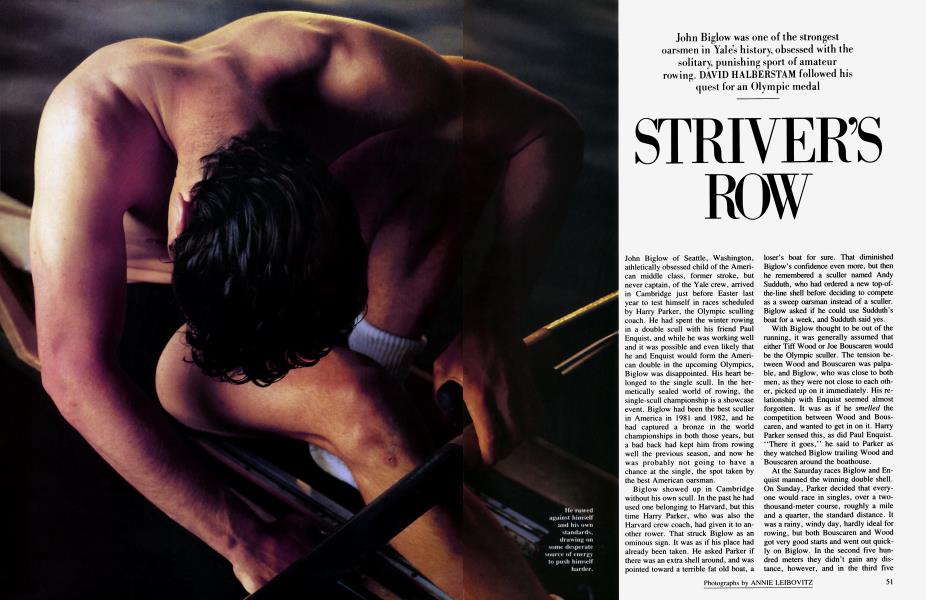
In John Biglow's senior year the Yale Daily News printed a picture that his friends thought revealed a great deal about him. The photo showed Biglow rowing alone in a single scull, not in a race, simply rowing against himself and his own standards, drawing on some last desperate source of energy to push himself a little harder. His face was contorted in pain. Rowing seemed to touch something deep and terrifying in him, a dark place filled with rage. (Biglow's high-school coach, Frank Cunningham, had a slightly different view of the face. "It's like. . ."—Cunningham paused to find the right metaphor— "...like a predatory animal about to pounce on some smaller animal.'')
Biglow was a fascinating athlete, a kind of man-child, sensitive and innocent and yet cold-blooded and relentless. He studied his competitors shrewdly, was a great gamesman, and had the best finishing drive of any sculler in America. Biglow himself thought that he rowed with such intensity because there were parts of his emotional life which were unresolved and rowing provided an outlet for them. He had once asked Brad Lewis, a top sculler from California, why he rowed. "It's the one positive outlet I have for my aggression and hostility," Lewis answered. "You're that same way, John. You have a lot of hostility, too. But you just ritualize it better and hide it better through rowing.'' Biglow thought about that for a while and decided that Lewis was probably right.
Biglow had grown up privileged in Seattle, the son of caring and demanding parents who had moved from the East to escape old-fashioned Wasp family pressure. Grandfather Biglow, Lucius Horatio Biglow, had been both an oarsman and a football player at Yale, captain of the '07 team. Grandmother Biglow, still alive and formidable in her nineties, monitored not just the progress of her own family but the progress of all Yale athletics. She listened to Yale football games with a program spread out in front of her so she could keep track of who went in and who was out.
John Biglow had gone to Lakeside, the best country day school in Seattle. His father sent him out every morning with a small rhyme he himself had learned as a boy. "Happy day / All A's.'' Predictably, John did very well. "What can you tell me about John?" a fourth-grade teacher once asked his mother. "He wants to excel," she had answered. But excelling, it turned out, took more of a toll than anyone knew. In the seventh grade his teacher discovered that he had a serious reading disability. "You cannot believe how hard reading is for him," she told his parents. He did well in school, but it was never easy; indeed, the idea of reading for pleasure was inconceivable. This affected his manner; he was provocative, pushing other people, asking questions of them lest they ask questions of him. But there was one activity that came to him naturally: rowing. He rowed in his freshman year and liked it, although he thought that Frank Cunningham pushed the oarsmen too hard to do things that did not matter, such as taking care of the boathouse, Cunningham, for his part, thought Biglow was a little spoiled and something of a gamesman. Biglow was an exceptionally gifted athlete, but Cunningham tired of his endless questions.
This all came to a head one day at the end of a workout in his senior year. Biglow asked Cunningham a question about technique. Cunningham brushed him aside. Biglow persisted. Again Cunningham brushed him aside.
"But, Mr. Cunningham, I need to know in order to improve."
It was one time too many. "John, I just don't care," Cunningham said.
"But, Mr. Cunningham," Biglow pleaded, "don't you want me to improve?"
"John," said Cunningham, "your mother wants to see you improve. Your father wants to see you improve. But me, I just don't give a good goddamn."
Biglow went from Lakeside to Yale, where his grandfather and father had gone. It seemed to him that his father's affection was available only to the degree that he succeeded, and Yale was a symbol of success. But he was never entirely comfortable at Yale, where everyone else seemed more facile, more verbal, and more social. When he returned to Seattle, a friend asked him what he thought of school. "I liked the athletics there a lot," he replied. What about the school itself, the friend inquired. "I didn't like it at all," he said. "It was very hard for me." What saved him at Yale was rowing. It became the dominant part of his undergraduate life.
Yale is one of the handful of schools in America that take rowing seriously, but its program had slipped badly by the time Biglow arrived. It is traditional in rowing that the losers give their crew shirts to the winners. Yale had lost so often that its elegant team shirts—blue with white trim and a satin sash—had been replaced by simple blue T-shirts. Harvard had beaten Yale in their annual four-mile race every year since 1963. The turnaround in Yale rowing began the year before Biglow arrived, but he played a central part in the renaissance, and there were many of his contemporaries who thought of him as the model oarsman—powerful, relentless, and indestructible. Biglow was strong, and they would meet his standards and they too would be strong. Yet many of them had a certain ambivalence about Biglow as a person. He lacked social graces, he was aggressive, and he seemed to take a perverse delight in making others feel uncomfortable. Was he a hick pretending to be a sophisticate, or was he a sophisticate pretending to be a hick? Was he an idiot or a genius?
At Yale the dominant style among rowers was a kind of eastern, Ivy League cool. There were certain clothes you wore and certain clothes you never wore, certain things you said and certain things you never said. Biglow seemed almost willfully a hick. He wore the wrong clothes, and he said the wrong things. He asked too many questions. He was always telling the other oarsmen what to do. Those who had rowed at eastern prep schools simply could not figure him out. His style of rowing was influenced by the University of Washington crews, and to eastern eyes it seemed rough. It included a small amount of backsplash at the catch when he drove his oar. Very early on, Biglow had an argument with Ed Chandler on the merits of backsplash. Chandler, who had rowed at Exeter, insisted that backsplash was a sign the boat was being checked, its progress impeded. They took their argument to Buzz Congram, the Yale freshman coach. Chandler had rarely been so sure of anything as of this. "Well, actually," said Congram, "John is right." Chandler was stunned. "You won't believe this," he said to his friends in the boathouse, "but I've just lost an argument on technique to Biglow."
(Continued on page 95)
(Continued from page 53)
The prep-school oarsmen decided that although Biglow might have a good technique, he wasn't really pulling hard. The tip-off was that the puddles left by his oars were not particularly large. Puddle size was a bone of contention among oarsmen: some claimed that you could tell how hard an oarsman was pulling by the size of his puddles; others contended that though on occasion it was a good measurement, it could also be faked, oddly enough by poor technique. If Biglow's stroke was all finesse and no muscle, no wonder that the technique was so good.
That argument ended one day during the winter, when the oarsmen measured their scores on an ergometer. The erg was a particularly cruel machine that simulated a race on the water; it tested strength and endurance, and it left strong men gasping for breath. Erg day was a day of judgment. Everyone seemed to know everyone else's scores and to measure their fellow rowers by them.
Each oarsman was to row for ten minutes. Dan Goldberg, the freshman coxswain, monitored the machine, checking the scores so that the coach would have not just the final figure but the splits—how an oarsman was pulling at each increment of time. Some of the rowers asked him to goad them, to push them to work harder. Biglow wanted none of that. "I don't want you to say anything to me," he said, "except to give me my stroke rating every minute. Do not say anything else." All the other oarsmen had gone out as hard and as high as they could, and then had tailed off in the final couple of minutes. Biglow did not go out hard, but he went out very smoothly. His splits were consistent, and with about half of the test done, his scores were a little behind the best ones. Then Biglow's splits began to go up, higher and higher. This was his sprint; he was finishing strongly, and he had scaled his energy to the test almost perfectly. His score was roughly 10 percent higher than that of anyone else.
All the other top oarsmen had more or less collapsed over the machine at the end of the test. Biglow got up calmly and walked away as if he had been doing nothing more serious than reading a newspaper. Goldberg and some of the other oarsmen checked to see if the machine was broken. Could this freshman of rather modest size (by rowing standards at least, for Biglow was only six feet three and perhaps 185 pounds and a truly big oarsman is closer to six feet five and 215 pounds) have pulled these scores? They were not only higher than all the other freshman scores but higher than the scores posted by the strongest men on the varsity. There was nothing wrong with the machine. It was just that one of the strongest oarsmen in Yale history had arrived.
Dan Goldberg, the coxswain, decided that what made Biglow stand out was his profound sense of the "ethics of crew." It was as if, frustrated and unhappy in the real world around him, he sought in the world of rowing a more ordered, purer universe. Biglow and Goldberg had a tempestuous relationship; they irritated each other at first, and it took them a long time to become friends. Goldberg had been a boxer in high school in Iowa, and he was new to rowing. He had heard that part of the job of a coxswain was to provoke and push the rowers, and he had done that in the beginning, trying to push them at the end of the race by screaming, "How much do you want it? How much do you want it?" The former football players who were rowing for the first time seemed to like these exhortations. It was the way their high-school coaches had pushed them. But Biglow hated it. "Don't ever say that to me again," he had told Goldberg. "It is never a question of that. Never."
If rowers were not doing well, it was not because they did not want to win badly enough. The pain in a race is so great and so constant and such a given of rowing that all oarsmen who compete have already passed a test and deserve never to be questioned. Out of that comes a sense of humility. Every race is as much a race against yourself as it is against opponents. No matter how good your crew, you are bound to lose, if not a race, then the ephemeral feeling of "swing," the feeling that comes when a boat is moving perfectly. Because there are no records, and times are largely meaningless (currents, tides, and winds are different for every race), rowing is a sport which is impossible to master. A runner knows if he has bettered the records of those who went before him, but the oarsman in a boat which has won every race always wonders if his boat is better than one which was victorious six years earlier. The only clue that his boat is probably faster comes from other sports, for swimmers and runners are constantly improving on the records set by their predecessors. But there is no empirical evidence. Therefore you do not boast of what you would do or had done, nor do you embarrass a loser.
When Biglow was a sophomore, Yale won the Eastern Sprints. In his junior year, with Biglow stroking, Yale and Harvard rowed what many observers believed was the greatest race in the two schools' history. It was a truly heroic race, with the lead changing several times before Harvard finally won by 2.5 seconds. Two and a half seconds, over four miles. A year later Biglow graduated. Unsure of what he wanted to do, he started taking pre-med courses. He also started sculling, which meant that instead of handling one oar, as he did for crew, he used two oars, one in each hand. It also meant that instead of rowing with teammates he now rowed alone. In 1981, in his first chance in a single trial, he surprised almost all the experts and beat Tiff Wood. A fierce and rare rivalry grew up between the two of them. They were close friends, they practiced together, and they competed ferociously. In 1982 Biglow won again; in 1983 Wood won both the American trials and the world bronze. (Someone asked Biglow if he had been pleased for Tiff, who was a remarkably supportive rival. "No," he answered. "I was jealous. Jealous as hell.") Biglow, his back ailing, had not rowed well. That was why he was so pleased when he beat both Wood and Bouscaren in the warm-up races Harry Parker held on Easter Day 1984.
Now he had a shot at winning the American trials at Princeton—a oneshot event, only one boat to qualify. It was a sports event from another age. Television would not cover the race, the print media would send stringers, and in most major newspapers the results would barely make agate type. Yet that did not dim the passion for the event among the participants: the best scullers in America, some of whom had been waiting for this event for eight years, would be there to row that crucial two thousand meters, for roughly seven minutes.
Biglow always rowed his own race. If someone else went out quickly at the start, he did not panic. Secure in the knowledge that he was a strong finisher, gifted at setting a pace, extremely sensitive to how much energy his body retained and how best to dole it out, he usually rowed a consistent race, with his splits very even. He arrived in Princeton in May with a certain confidence generated by his Easter victory, and he rowed an acceptable race in the first heat. But then in the semifinal he was off-balance on the first stroke. For a moment he felt himself panicking. Because the first stroke had been poor, it had taken him several strokes to settle down, and in a state of immense anxiety he thought of giving up, of not rowing at all. That happened to him sometimes at the beginning of a race. The anxiety came, he knew, from the pain, as if his body were trying to get him to quit. It was a form of terror, and he had never given in to it. On this day, he gradually settled down and rowed well. What pleased him at the end was his knowledge that race by race he was rowing more strongly.
In the final he had expected to key off Tiff Wood, but Wood was rowing sluggishly. Joe Bouscaren, who was a fast starter, took the early lead. Then, near the midway point, Biglow received a shock. Brad Lewis suddenly surged past the other boats, catching them completely by surprise. Lewis knew that the other rowers expected him to fade at this moment, and he had two lengths on them before they realized what had happened. Biglow thought of coasting in. Two lengths was a huge lead for the final five hundred, and it would be extremely painful to try to catch Lewis, assuming he could be caught. But it seemed wrong that Brad Lewis should be the Olympic sculler. Brad as the sculler offended Biglow's sense of order and hierarchy. Perhaps it was right that Tiff Wood should be the champion. Tiff would be O.K. He was good with the media. But Brad was difficult—alternately friendly and distant, confident and anxious. Biglow decided he did not like the idea of Brad Lewis as the single sculler, and with five hundred meters to go he set out to catch him.
Biglow had a sense, as they neared the finish line, that Lewis was falling back. Was he coasting at the finish because he was so much in control and the finish line was so near? That was a possibility, but the other possibility was that he was falling short and dying right out there. Seeing him fall back gave Biglow an extra boost, and he poured on everything he had. With thirty strokes left, he heard people on the shore chanting, and he thought they were shouting "Biggy, Biggy.'' That meant he still had a chance.
Biglow knew as he crossed the finish line that he had closed on Lewis, but he was sure that Lewis had won. It was as close a race as he could remember. The only thing that gave him some hope was the possibility that he had looked at the finish from a bad angle. He saw the judges conferring and looking at videotape, and then he saw Tony Johnson, his old Yale coach, give him a thumbsup sign. Even then he was not sure he had won. Finally the decision was announced. Biglow had won in 7:27.1, Lewis was second in 7:28, and Tiff Wood was third in 7:28.1. Bouscaren was fourth in 7:32.05.
At the Olympic camp in California, Biglow felt that he was in his element. He loved being surrounded by athletes who shared his sense of purpose, who had sacrificed years of their lives to be there. He loved being with the Romanian coach, Victor Mociani, although communication was difficult, since neither spoke the other's language. But Mociani seemed to like him, calling his name out enthusiastically and trying, through a kind of sign language, to convey a sense of friendship.
Biglow knew many of the other oarsmen in the camp from previous regattas. Pertti Karppinen—the great Finnish sculler, gold medalist in 1976, gold medalist in 1980—was there, not so much aloof as apart, a man clearly troubled by the language barrier; but he always nodded his head to Biglow when they met, and shook hands. Peter-Michael Kolbe, the West German who seemed doomed to harvest the silver behind Karppinen's gold, was being quite friendly with everyone, but Biglow was wary of Kolbe. He was being friendly to the Americans now that he was in America, but when the races had been held in Germany he had been distant and uncommunicative.
The schedule for the single scullers was brutal. The heats were on Tuesday, the reps, for those who did not win their heats, were on Wednesday, the semifinal was Thursday, and the final was Sunday. That might mean three days of back-to-back racing if Biglow did not qualify for the semi in his first race. Nor was he likely to. He drew both Kolbe and Karppinen in his heat. A part of him was shaken by that, but a larger part was delighted because it gave him a chance to row against both of them without the pressure of being in a final. It was a final without being a final.
He went out very quickly in the heat, which was unusual for him, but he gradually fell behind. Kolbe took the early lead, then in the last few hundred meters Karppinen made a move. This would be Karppinen's race, without a challenge at the end. Biglow fell farther and farther back, and he seemed tired. Karppinen beat him by ten seconds, Kolbe, easing himself in, by three. The gap between Biglow and them had never seemed so large. It was clear that what he had feared from the start was true. The ceiling for him here was a bronze.
The rep the next day was relatively easy. All he had to do was finish among the top three to make the semi. He wanted to win, however, because he drew an easier semi if he won, and he won handily, beating Gary Reid of New Zealand by five seconds. But he had not rowed easily; he had not been able to coast through on three-quarter pressure.
The win gave him a place in the semifinal against Kolbe and Ricardo Ibarra of Argentina. Ibarra, who had won his heat, had had a day off; for Biglow the semi was his third race in three days and he felt tired. Kolbe and Ibarra shot out quickly, and they were gone from him in the early part of the race. At five hundred meters he was sixth. For the first time he began to worry about making the final. Slowly he passed some of the other oarsmen. At 1,500 meters he was even with Bengt Nilsson of Sweden, whom he had expected to beat easily. Then Nilsson began to fade. In the end Biglow finished third, two and a half seconds behind Kolbe, who was first, and behind Ibarra, who was second. He was not pleased with himself, but he had made the final, and he had two days to rest.
The power which a few years ago had been so readily available now could no longer be summoned. It was a physical problem, and yet it was not easily definable. It showed up on no tests. During the last few weeks of practice Biglow had done his usual five-hundred-meter pieces and then told Parker, "I just feel weak." During the Olympics he found himself saying the same thing. The lack of power seemed to lie in his legs. He was not the same sculler he had been in 1981 and 1982. There were things he had once done easily that he could no longer do. Parker, watching him struggle, was convinced that his back was still bothering him. Yet Parker thought he had an excellent chance for the bronze.
I will row my own race, Biglow vowed to himself as he waited at the starting line. I can make only my own boat go fast. I can do that and only that. I cannot slow anyone else down. I will not think of the other boats or let them disrupt me. He would be behind at the thousand-meter mark, and then he would start charging. That was the style he was most comfortable with. But the others went out very quickly, and he had, even within his own game plan, gotten a terrible start. At the five-hundred-meter mark he was much farther behind than he had intended to be. He was sixth, and the only boat he could even see was that of the Greek, Konstantinos Kontomanolis. Shortly after the thousand-meter mark he pulled slightly ahead of Kontomanolis. But the race was turning into a disaster.
Far ahead of him a magnificent race was beginning to take shape. Kolbe, in what was almost surely his last chance against Karppinen and his last chance for a gold, had made his move and had taken a considerable lead over the Finn. But that was another country. Farther back in the third five hundred, Biglow sighted Ibarra and Robert Mills, a Canadian. Mills, to his surprise, was farther ahead than Ibarra. He went after Ibarra and started coming through him. That left Mills. Mills seemed too far ahead, and for a moment he thought of not even trying, and then he decided that he simply had to try, that this was the last race of his life. He did not, as he sometimes did during a sprint, shorten his stroke; he simply tried to feed more power in. In the last three hundred meters, he seemed to fly; the boat was almost lifted out of the water, and he kept closing on Mills. Ahead of him Karppinen was finally making a powerful, determined challenge, beating Kolbe in the last fifty meters on pure muscle.
Biglow's surge had come too late. If he had started 150 meters earlier it might have worked. But Mills took third. Mills had beaten him by 1.62 seconds. That meant Biglow had cut an amazing 4.6 seconds off Mills with his extraordinary closing drive. But Biglow had missed the medal. He wondered briefly whether he could have rowed just a little harder, reached back for a little more. Some of his disappointment lasted long after the race was over. The source of it was not just that he could not compete at the very highest level with Karppinen and Kolbe, but that he had not improved in the three years since he had won his first world bronze. If anything, he might have slipped a little. He felt he had been a more dominating oarsman in 1981 and 1982 than he was now.
After the race Harry Parker came over to see him and ruffled his hair. The gesture surprised Biglow because he did not really know if Parker liked him. Biglow tried to explain his race. "John," Parker said, "you were ready to race today." Then Biglow went into the stands to visit with his family. Later, looking at the pictures of those moments, he was stunned by how happy he looked. His dream had ended, without a medal, and yet the photos showed a relaxed, happy young man. He was sure that what showed on his face was the relief that he did not have to row again. He was freed not so much from the rowing itself, or the practices, or the workouts, but from having to live up to other people's hopes and expectations.
In the weeks that followed, Biglow prepared for medical school at Dartmouth. He wrote letters to all of his friends, and he enclosed Olympic rowing pins for most of them. The letter to his old friend Dan Goldberg, the former Yale coxswain, said, in part, "It is not going to be easy to give up this sport. I am satisfied about the single, i.e., knowing my potential, but have unknown potential in the double and quad." Any number of friends offered him videotapes of the final of the single scull, but he did not accept them. Biglow did not need to see the race again. He remembered perfectly, too perfectly in fact, how it had gone.
Subscribers have complete access to the archive.
Sign In Not a Subscriber?Join Now


