



Sign In to Your Account
Subscribers have complete access to the archive.
Sign In Not a Subscriber?Join NowThe Connecticut Axis
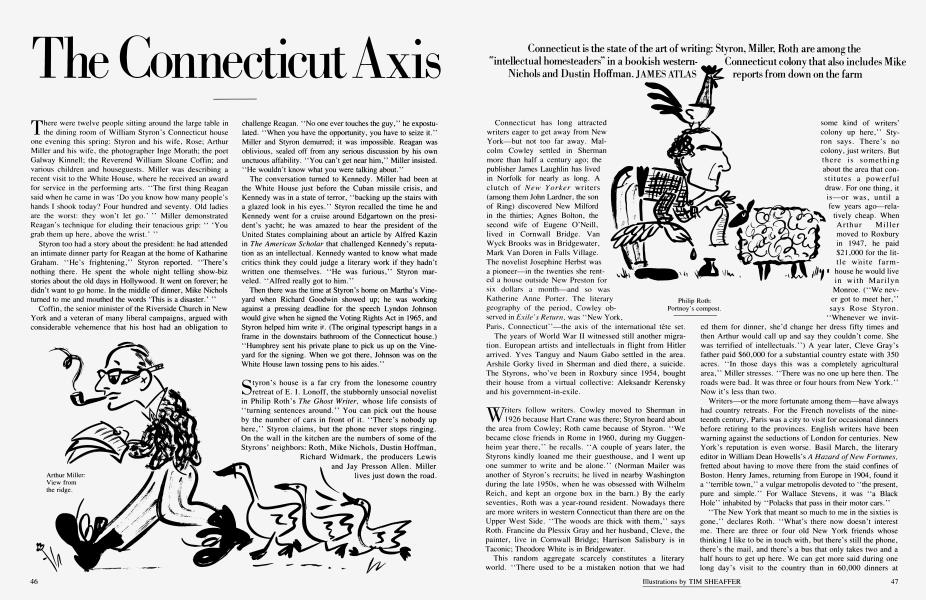
There were twelve people sitting around the large table in the dining room of William Styron's Connecticut house one evening this spring: Styron and his wife, Rose; Arthur Miller and his wife, the photographer Inge Morath; the poet Galway Kinnell; the Reverend William Sloane Coffin; and various children and houseguests. Miller was describing a recent visit to the White House, where he received an award for service in the performing arts. "The first thing Reagan said when he came in was 'Do you know how many people's hands I shook today? Four hundred and seventy. Old ladies are the worst: they won't let go.' " Miller demonstrated Reagan's technique for eluding their tenacious grip: " 'You grab them up here, above the wrist.' ''
Styron too had a story about the president: he had attended an intimate dinner party for Reagan at the home of Katharine Graham. "He's frightening,'' Styron reported. "There's nothing there. He spent the whole night telling show-biz stories about the old days in Hollywood. It went on forever; he didn't want to go home. In the middle of dinner, Mike Nichols turned to me and mouthed the words 'This is a disaster.' " Coffin, the senior minister of the Riverside Church in New York and a veteran of many liberal campaigns, argued with considerable vehemence that his host had an obligation to challenge Reagan. "No one ever touches the guy,'' he expostulated. "When you have the opportunity, you have to seize it." Miller and Styron demurred; it was impossible. Reagan was oblivious, sealed off from any serious discussion by his own unctuous affability. "You can't get near him," Miller insisted. "He wouldn't know what you were talking about."
The conversation turned to Kennedy. Miller had been at the White House just before the Cuban missile crisis, and Kennedy was in a state of terror, "backing up the stairs with a glazed look in his eyes." Styron recalled the time he and Kennedy went for a cruise around Edgartown on the president's yacht; he was amazed to hear the president of the United States complaining about an article by Alfred Kazin in The American Scholar that challenged Kennedy's reputation as an intellectual. Kennedy wanted to know what made critics think they could judge a literary work if they hadn't written one themselves. "He was furious," Styron marveled. "Alfred really got to him."
Then there was the time at Styron's home on Martha's Vineyard when Richard Goodwin showed up; he was working against a pressing deadline for the speech Lyndon Johnson would give when he signed the Voting Rights Act in 1965, and Styron helped him write it. (The original typescript hangs in a frame in the downstairs bathroom of the Connecticut house.) "Humphrey sent his private plane to pick us up on the Vineyard for the signing. When we got there, Johnson was on the White House lawn tossing pens to his aides."
Styron's house is a far cry from the lonesome country retreat of E. I. Lonoff, the stubbornly unsocial novelist in Philip Roth's The Ghost Writer, whose life consists of "turning sentences around." You can pick out the house by the number of cars in front of it. "There's nobody up here," Styron claims, but the phone never stops ringing. On the wall in the kitchen are the numbers of some of the Styrons' neighbors: Roth, Mike Nichols, Dustin Hoffman, Richard Widmark, the producers Lewis and Jay F'resson Allen. Miller lives just down the road.
Connecticut is the state of the art of writing: Styron, Miller, Roth are among the "intellectual homesteaders" in a bookish western. Connecticut colony that also includes Mike Nichols and Dustin Hoffman. JAMES ATLAS reports from down on the farm
JAMES ATLAS
Connecticut has long attracted writers eager to get away from New York—but not too far away. Malcolm Cowley settled in Sherman more than half a century ago; the publisher James Laughlin has lived in Norfolk for nearly as long. A clutch of New Yorker writers (among them John Lardner, the son of Ring) discovered New Milford in the thirties; Agnes Bolton, the second wife of Eugene O'Neill, lived in Cornwall Bridge. Van Wyck Brooks was in Bridgewater, Mark Van Doren in Falls Village. The novelist Josephine Herbst was a pioneer—in the twenties she rented a house outside New Preston for six dollars a month—and so was Katherine Anne Porter. The literary geography of the period, Cowley observed in Exile's Return, was "New York, Paris, Connecticut''—the axis of the international tete set.
The years of World War II witnessed still another migration. European artists and intellectuals in flight from Hitler arrived. Yves Tanguy and Naum Gabo settled in the area. Arshile Gorky lived in Sherman and died there, a suicide. The Styrons, who've been in Roxbury since 1954, bought their house from a virtual collective: Aleksandr Kerensky and his government-in-exile.
Writers follow writers. Cowley moved to Sherman in 1926 because Hart Crane was there; Styron heard about the area from Cowley; Roth came because of Styron. "We became close friends in Rome in 1960, during my Guggenheim year there,'' he recalls. "A couple of years later, the Styrons kindly loaned me their guesthouse, and I went up one summer to write and be alone.'' (Norman Mailer was another of Styron's recruits; he lived in nearby Washington during the late 1950s, when he was obsessed with Wilhelm Reich, and kept an orgone box in the barn.) By the early seventies, Roth was a year-round resident. Nowadays there are more writers in western Connecticut than there are on the Upper West Side. "The woods are thick with them," says Roth. Francine du Plessix Gray and her husband, Cleve, the painter, live in Cornwall Bridge; Harrison Salisbury is in Taconic; Theodore White is in Bridgewater.
This random aggregate scarcely constitutes a literary world. "There used to be a mistaken notion that we had some kind of writers' colony up here," Styron says. There's no colony, just writers. But there is something about the area that constitutes a powerful draw. For one thing, it is—or was, until a few years ago—relatively cheap. When Arthur Miller moved to Roxbury in 1947, he paid $21,000 for the little white farmhouse he would live in with Marilyn Monroe. ("We never got to meet her," says Rose Styron.
"Whenever we invited them for dinner, she'd change her dress fifty times and then Arthur would call up and say they couldn't come. She was terrified of intellectuals.") A year later, Cleve Gray's father paid $60,000 for a substantial country estate with 350 acres. "In those days this was a completely agricultural area," Miller stresses. "There was no one up here then. The roads were bad. It was three or four hours from New York." Now it's less than two.
Writers—or the more fortunate among them—have always had country retreats. For the French novelists of the nineteenth century, Paris was a city to visit for occasional dinners before retiring to the provinces. English writers have been warning against the seductions of Fondon for centuries. New York's reputation is even worse. Basil March, the literary editor in William Dean Howells's A Hazard of New Fortunes, fretted about having to move there from the staid confines of Boston. Henry James, returning from Europe in 1904, found it a "terrible town," a vulgar metropolis devoted to "the present, pure and simple." For Wallace Stevens, it was "a Black Hole" inhabited by "Polacks that pass in their motor cars."
"The New York that meant so much to me in the sixties is gone," declares Roth. "What's there now doesn't interest me. There are three or four old New York friends whose thinking I like to be in touch with, but there's still the phone, there's the mail, and there's a bus that only takes two and a half hours to get up here. We can get more said during one long day's visit to the country than in 60,000 dinners at Elio's. What's more, we can even hear what we're saying." Roth has given up the pied-a-terre he used to keep on the Upper East Side. The Millers have an apartment in the city, and Styron rents a studio, but it's small, and reminds him of the squalid room inhabited by Stingo in Sophie's Choice—''a cramped cubicle, eight by fifteen feet," with a "single grime-encrusted window." "Whenever I go into the city," he says, "I start to feel anx^ ious within a day, like I'm wasting my time. You know: 'Time's winged chariot,' and all that." For Styron, Connecticut is a refuge from the barbarity of New York, a city that scarcely resembles the more innocent metropolis he knew when he lived there briefly after World War II and worked for McGraw-Hill. "On hot summer nights we'd go sleep in Central Park," he says. "You thought nothing of falling asleep in the subway at two o'clock in the morning. There was no such thing as crime."
Miller doesn't miss New York much, either. "I was just as isolated there as I am out here," he claims. "When I lived in Brooklyn Heights I didn't come out of my house for weeks at a time." Does he ever feel the need to replenish his imagination, which is so rooted in the New York of his youth? "Most writers find their matrix of experience early on. It's all there from the start. You don't need stimulation. You just need peace and quiet." One of his favorite stories concerns the playwright Paddy Chayefsky, a very urban character, who asked him once how he could stand living in the country: "What do you do when you want to go for a walk?"
The city people that Malcolm Cowley encountered in the Connecticut countryside in the thirties lived in their homes "as they might live in a summer hotel," he noted in Exile's Return. "The ownership of an old house full of Boston rockers and Hitchcock chairs did not endow them with a past. The land for which they were overassessed was not really theirs; it did not stain their hands or color their thoughts. They had no functional relation to it: they did not clear new fields, plant crops, depend on its seasons or live by its fruits; in a Connecticut valley, as in Manhattan, there remained the problem 'of whether or not I belong here.' " But those who stayed—and those who came later—eventually found that they did belong. "It's not like the Hamptons or Provincetown," Roth explains. "People have actually struck roots here." For these urban-intellectual homesteaders, Connecticut isn't exactly the wilderness, but it's a haven in a hectic world—"a place," says Francine Gray, "for nervous temperaments who can't take the pace of New York." It's not social in the Hamptons sense; there's no "scene," she insists. What western Connecticut offers is a way "to keep the world at bay and yet supply the energy to feed us."
"I'm not here for a community," says Roth. "I'm here to be left alone to do my work in a place where silence and seclusion are a natural phenomenon and not something you have to struggle for. Of course, I have friends I enjoy seeing—a local doctor, a local builder, a couple of sculptors, a painter, a few writers, and, when she isn't working and can be with me, I have an actress too [Claire Bloom]. But mostly I talk to a typewriter and listen to a book. When I want something new, I usually visit Europe to listen to what's going on there."
Nathan Zuckerman, the breathless young writer who pays a call on E. I. Lonoff in The Ghost Writer, is awed by the elder novelist's monastic way of life: "Purity. Serenity. Simplicity. Seclusion. All one's concentration and flamboyance and originality reserved for the grueling, exalted, transcendent calling." Noting the simple furnishings, the fire popping in the grate, the snowy fields beyond the window, Zuckerman resolves: "This is how I will live." Roth made the same resolve. "I'd first come to appreciate that kind of farming country as a college student in the Susquehanna valley of Pennsylvania in the early fifties," he recalls. "Even then I'd thought I would someday like to make my home in a place where I could take my thoughts on a sixor seven-mile hike, and have the four vivid seasons of the American Northeast as the backdrop to my reading and writing."
One of the chief attractions of western Connecticut, he notes, is that it's "remote from New York, but still New England." Most of the houses in the area date from the eighteenth century. Miller's Colonial house was built in 1740. Surrounded by fifty acres of land, it sits on a hill with a view of the mountains, and open fields all around. Miller's study, a simple shack behind the main house, has a cot, a desk, a stove, and a linoleum floor. He seems utterly at home in the country; he chops wood, gardens, does woodworking and carpentry in the bam—what he calls "intensive hobbies." He built his study himself, and a darkroom for Inge Morath. On the wall are photographs of Picasso, Nadezhda Mandelstam, Mary McCarthy—and an impromptu portrait of Miller done by his neighbor Alexander Calder "one night when he was sort of drunk at a party." Walking around his property in a windbreaker and a peaked cap, the Harlemborn Miller could pass for a local farmer—"a Hamsun and Rolvaag of the soil," as Norman Mailer enviously described him in Marilyn. "I have a lot of land, and I go for hikes. It reassures me to be around imperial nature; the turning of the seasons reminds me how petty our troubles are."
Styron is equally rhapsodic about rural life. A tall, shambling figure with the suggestion of a Jamesian embonpoint, he's not quite as countrified as Miller; he prefers to warm himself, glass in hand, before the fireplace in the high-ceilinged den, a silver-haired suburban baron in a baggy pullover. But he has an abiding love of the area, a profound sense of place more characteristic of British writers' attachment to where they live. "Ever since I left the South I've been looking for a home," says Styron. "This is where my roots are now. I like the rhythm of my days, working afternoons, walking my dogs out on the road."
Still, winters in Connecticut can be hard and lonely, even with the new shopping malls that have sprung up over the last decade. One secret of living here is leaving often. Philip Roth spends winters in London. The Grays go to Rome. Miller travels a good deal; last year he was in China, and this spring he was off to Istanbul, on a mission with Harold Pinter "to get some Turkish writers out of jail." Styron was on his way to Poland and Czechoslovakia to visit dissident writers with Rose, who chairs the National Advisors Council of Amnesty International U.S.A. and is a member of the executive board of PEN. They used to spend part of each winter on a private island in the Bahamas that had been discovered by J. P. Marquand, Jr. "There was no electricity, and just a few rustic shacks," Styron recalls. "I got an incredible amount of writing done there." But the Styrons winter in Roxbury now. Summers are spent on Martha's Vineyard, in a large white clapboard house on the water in Vineyard Haven. "I've become as attached to the Vineyard as I have to Connecticut," says Styron. "I feel like a bigamist."
There are no struggling writers in Connecticut. The popularity of Miller's plays, which are produced all over the world, has made him a rich man—so rich that he seems indifferent to the $500,000 advance Harper & Row paid for his unwritten autobiography: "I didn't sign with them for the money. I have enough." Rose Styron is from the wealthy Burgunder family of Baltimore, once owners of a department store in Washington, and Styron has been making money as a novelist ever since he published Lie Down in Darkness, when he was twenty-six. The Confessions of Nat Turner was a best-seller, and Sophie's Choice was a tremendous commercial success. In the bathroom (the same one where Richard Goodwin's historic speech is on display) is a plaque reproducing the New York Times best-seller list, with Styron's novel at the top. Their yellow clapboard house has a casual but affluent air about it. The shutters are freshly painted, the lawns cropped, the flower beds well kept. Across the road is a new tennis court. Even the old stone walls have a Sturbridge Village look.
Strolling around their property, Miller and Styron remind one of the landed gentry in Turgenev, those progressive, moneyed landowners who sit by the hearth on a cold night drinking brandy and denouncing the government. They're serious liberals; they contribute to good causes and work hard in their behalf. Miller is active on PEN'S Helsinki Watch Committee, monitoring the persecution of writers all over the world. Styron has given readings in support of North Carolinians Against the Death Penalty, signed protest letters, and sponsored the obligatory prisoner. Rose is virtually a fulltime human-rights activist.
Far from having fled the world, the Connecticut literati are in danger of attracting it. What one writer in the area calls the "sexual-industrial complex" has started buying in: Bill Blass, Oscar de la Renta, Diane Von Furstenberg, and Henry Kissin-
ger own homes in the area. Calvin Klein bought a house, then put it on the market. The two groups rarely mingle. "We're considered Reds," says Francine Gray. But just as the fashionable world discovered the Hamptons after Pollock and de Kooning, it's discovering Connecticut. Fashion follows art.
Late at night, after the plates had been cleared and many bottles of wine had been consumed, the conversation at the Styrons' table turned to burial sites. Galway Kinnell and the Reverend Coffin had already chosen their plots, in Vermont. Miller was fascinated by the phenomenon of aboveground burial in mausoleums; he told a gruesome story about someone who left her father's ashes in a bar. Styron didn't warm to the subject; he didn't want to think about it. And somehow, in that cozy dining room with the bottles on the table and the candles flickering and everyone talking at once, the whole idea did seem pretty hard to grasp.
Subscribers have complete access to the archive.
Sign In Not a Subscriber?Join Now


