

Sign In to Your Account
Subscribers have complete access to the archive.
Sign In Not a Subscriber?Join NowMonkeys Does
An affecting, mother-haunted first novel
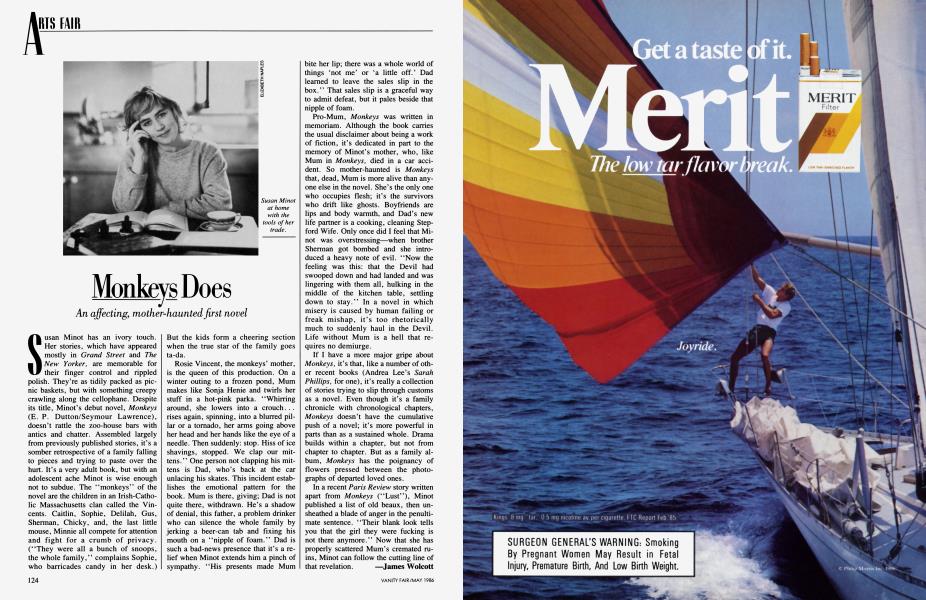
Susan Minot has an ivory touch. Her stories, which have appeared mostly in Grand Street and The New Yorker, are memorable for their finger control and rippled polish. They're as tidily packed as picnic baskets, but with something creepy crawling along the cellophane. Despite its title, Minot's debut novel, Monkeys (E. P. Dutton/Seymour Lawrence), doesn't rattle the zoo-house bars with antics and chatter. Assembled largely from previously published stories, it's a somber retrospective of a family falling to pieces and trying to paste over the hurt. It's a very adult book, but with an adolescent ache Minot is wise enough not to subdue. The "monkeys" of the novel are the children in an Irish-Catholic Massachusetts clan called the Vincents. Caitlin, Sophie, Delilah, Gus, Sherman, Chicky, and, the last little mouse, Minnie all compete for attention and fight for a crumb of privacy. ("They were all a bunch of snoops, the whole family," complains Sophie, who barricades candy in her desk.) But the kids form a cheering section when the true star of the family goes ta-da.
Rosie Vincent, the monkeys' mother, is the queen of this production. On a winter outing to a frozen pond, Mum makes like Sonja Henie and twirls her stuff in a hot-pink parka. "Whirring around, she lowers into a crouch... rises again, spinning, into a blurred pillar or a tornado, her arms going above her head and her hands like the eye of a needle. Then suddenly: stop. Hiss of ice shavings, stopped. We clap our mittens." One person not clapping his mittens is Dad, who's back at the car unlacing his skates. This incident establishes the emotional pattern for the book. Mum is there, giving; Dad is not quite there, withdrawn. He's a shadow of denial, this father, a problem drinker who can silence the whole family by jerking a beer-can tab and fixing his mouth on a "nipple of foam." Dad is such a bad-news presence that it's a relief when Minot extends him a pinch of sympathy. "His presents made Mum bite her lip; there was a whole world of things 'not me' or 'a little off.' Dad learned to leave the sales slip in the box." That sales slip is a graceful way to admit defeat, but it pales beside that nipple of foam.
Pro-Mum, Monkeys was written in memoriam. Although the book carries the usual disclaimer about being a work of fiction, it's dedicated in part to the memory of Minot's mother, who, like Mum in Monkeys, died in a car accident. So mother-haunted is Monkeys that, dead, Mum is more alive than anyone else in the novel. She's the only one who occupies flesh; it's the survivors who drift like ghosts. Boyfriends are lips and body warmth, and Dad's new life partner is a cooking, cleaning Stepford Wife. Only once did I feel that Minot was overstressing—when brother Sherman got bombed and she introduced a heavy note of evil. "Now the feeling was this: that the Devil had swooped down and had landed and was lingering with them all, hulking in the middle of the kitchen table, settling down to stay." In a novel in which misery is caused by human failing or freak mishap, it's too rhetorically much to suddenly haul in the Devil. Life without Mum is a hell that requires no demiurge.
If I have a more major gripe about Monkeys, it's that, like a number of other recent books (Andrea Lee's Sarah Phillips, for one), it's really a collection of stories trying to slip through customs as a novel. Even though it's a family chronicle with chronological chapters, Monkeys doesn't have the cumulative push of a novel; it's more powerful in parts than as a sustained whole. Drama builds within a chapter, but not from chapter to chapter. But as a family album, Monkeys has the poignancy of flowers pressed between the photographs of departed loved ones.
In a recent Paris Review story written apart from Monkeys ("Lust"), Minot published a list of old beaux, then unsheathed a blade of anger in the penultimate sentence. "Their blank look tells you that the girl they were fucking is not there anymore." Now that she has properly scattered Mum's cremated ruins, Minot can follow the cutting line of that revelation.
James Wolcott
Subscribers have complete access to the archive.
Sign In Not a Subscriber?Join Now