Sign In to Your Account
Subscribers have complete access to the archive.
Sign In Not a Subscriber?Join NowA White Wine to Take to Dinner
Vintage Point
JOEL L. FLEISHMAN
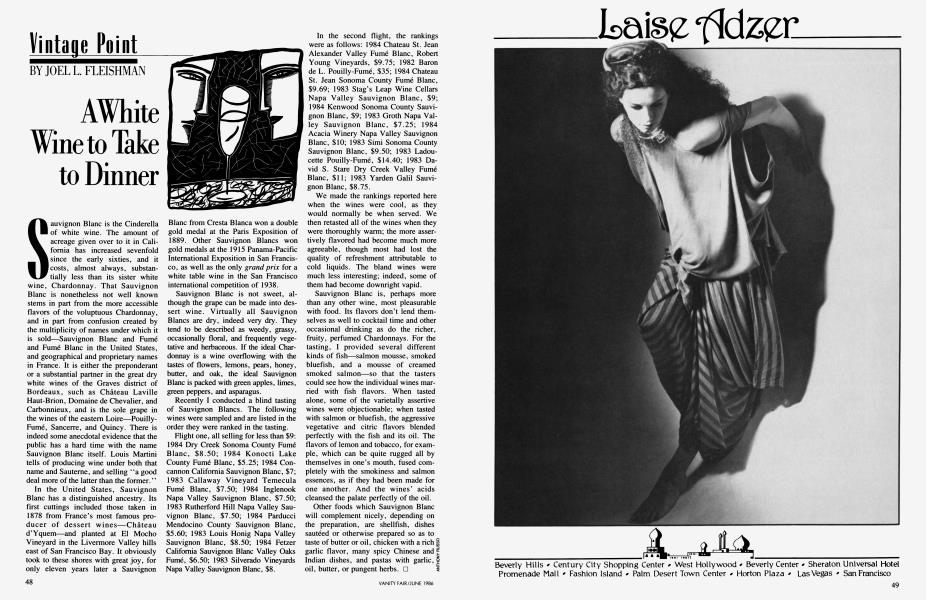
Sauvignon Blanc is the Cinderella of white wine. The amount of acreage given over to it in Califomia has increased sevenfold since the early sixties, and it Bcosts, almost always, substantially less than its sister white wine, Chardonnay. That Sauvignon Blanc is nonetheless not well known stems in part from the more accessible flavors of the voluptuous Chardonnay, and in part from confusion created by the multiplicity of names under which it is sold—Sauvignon Blanc and Fume and Fume Blanc in the United States, and geographical and proprietary names in France. It is either the preponderant or a substantial partner in the great dry white wines of the Graves district of Bordeaux, such as Chateau Laville Haut-Brion, Domaine de Chevalier, and Carbonnieux, and is the sole grape in the wines of the eastern Loire—PouillyFume, Sancerre, and Quincy. There is indeed some anecdotal evidence that the public has a hard time with the name Sauvignon Blanc itself. Louis Martini tells of producing wine under both that name and Sauteme, and selling "a good deal more of the latter than the former. " In the United States, Sauvignon Blanc has a distinguished ancestry. Its first cuttings included those taken in 1878 from France's most famous producer of dessert wines—Chateau d'Yquem—and planted at El Mocho Vineyard in the Livermore Valley hills east of San Francisco Bay. It obviously took to these shores with great joy, for only eleven years later a Sauvignon Blanc from Cresta Blanca won a double gold medal at the Paris Exposition of 1889. Other Sauvignon Blancs won gold medals at the 1915 Panama-Pacific International Exposition in San Francisco, as well as the only grand prix for a white table wine in the San Francisco international competition of 1938.
Sauvignon Blanc is not sweet, although the grape can be made into dessert wine. Virtually all Sauvignon Blancs are dry, indeed very dry. They tend to be described as weedy, grassy, occasionally floral, and frequently vegetative and herbaceous. If the ideal Chardonnay is a wine overflowing with the tastes of flowers, lemons, pears, honey, butter, and oak, the ideal Sauvignon Blanc is packed with green apples, limes, green peppers, and asparagus.
Recently I conducted a blind tasting of Sauvignon Blancs. The following wines were sampled and are listed in the order they were ranked in the tasting.
Flight one, all selling for less than $9: 1984 Dry Creek Sonoma County Fume Blanc, $8.50; 1984 Konocti Lake County Fume Blanc, $5.25; 1984 Concannon California Sauvignon Blanc, $7; 1983 Callaway Vineyard Temecula Fume Blanc, $7.50; 1984 Inglenook Napa Valley Sauvignon Blanc, $7.50; 1983 Rutherford Hill Napa Valley Sauvignon Blanc, $7.50; 1984 Parducci Mendocino County Sauvignon Blanc, $5.60; 1983 Louis Honig Napa Valley Sauvignon Blanc, $8.50; 1984 Fetzer California Sauvignon Blanc Valley Oaks Fume, $6.50; 1983 Silverado Vineyards Napa Valley Sauvignon Blanc, $8.
In the second flight, the rankings were as follows: 1984 Chateau St. Jean Alexander Valley Fume Blanc, Robert Young Vineyards, $9.75; 1982 Baron de L. Pouilly-Fume, $35; 1984 Chateau St. Jean Sonoma County Fume Blanc, $9.69; 1983 Stag's Leap Wine Cellars Napa Valley Sauvignon Blanc, $9; 1984 Kenwood Sonoma County Sauvignon Blanc, $9; 1983 Groth Napa Valley Sauvignon Blanc, $7.25; 1984 Acacia Winery Napa Valley Sauvignon Blanc, $10; 1983 Simi Sonoma County Sauvignon Blanc, $9.50; 1983 Ladoucette Pouilly-Fume, $14.40; 1983 David S. Stare Dry Creek Valley Fume Blanc, $11; 1983 Yarden Galil Sauvignon Blanc, $8.75.
We made the rankings reported here when the wines were cool, as they would normally be when served. We then retasted all of the wines when they were thoroughly warm; the more assertively flavored had become much more agreeable, though most had lost the quality of refreshment attributable to cold liquids. The bland wines were much less interesting; indeed, some of them had become downright vapid.
Sauvignon Blanc is, perhaps more than any other wine, most pleasurable with food. Its flavors don't lend themselves as well to cocktail time and other occasional drinking as do the richer, fruity, perfumed Chardonnays. For the tasting, I provided several different kinds of fish—salmon mousse, smoked bluefish, and a mousse of creamed smoked salmon—so that the tasters could see how the individual wines married with fish flavors. When tasted alone, some of the varietally assertive wines were objectionable; when tasted with salmon or bluefish, the aggressive vegetative and citric flavors blended perfectly with the fish and its oil. The flavors of lemon and tobacco, for example, which can be quite rugged all by themselves in one's mouth, fused completely with the smokiness and salmon essences, as if they had been made for one another. And the wines' acids cleansed the palate perfectly of the oil.
Other foods which Sauvignon Blanc will complement nicely, depending on the preparation, are shellfish, dishes sauteed or otherwise prepared so as to taste of butter or oil, chicken with a rich garlic flavor, many spicy Chinese and Indian dishes, and pastas with garlic, oil, butter, or pungent herbs. □
Subscribers have complete access to the archive.
Sign In Not a Subscriber?Join Now