Sign In to Your Account
Subscribers have complete access to the archive.
Sign In Not a Subscriber?Join NowHow Harvard Lost It
P. J. CORKERY laments his alma mater
Letter from the Ivy League
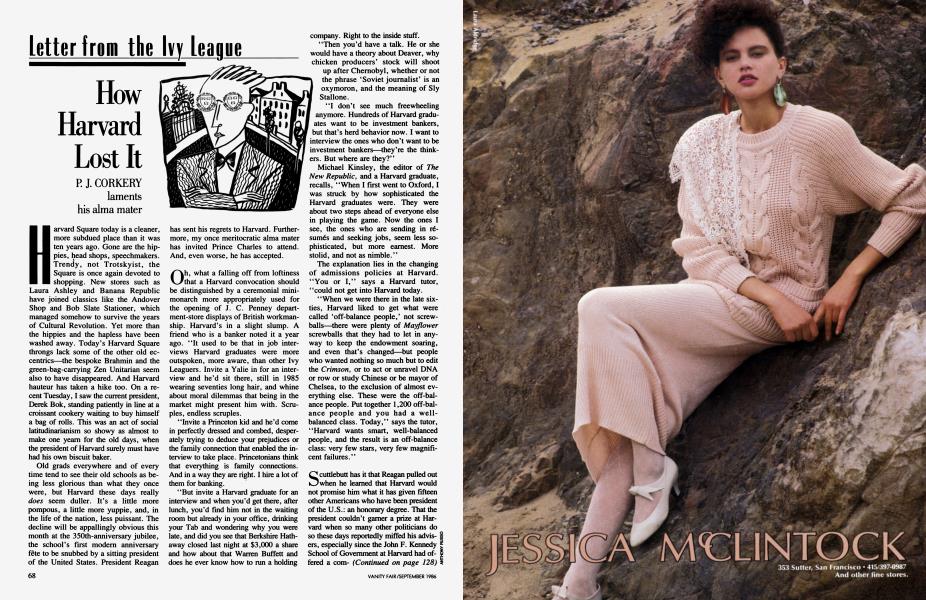
Harvard Square today is a cleaner, more subdued place than it was ten years ago. Gone are the hippies, head shops, speechmakers. Trendy, not Trotskyist, the Square is once again devoted to shopping. New stores such as Laura Ashley and Banana Republic have joined classics like the Andover Shop and Bob Slate Stationer, which managed somehow to survive the years of Cultural Revolution. Yet more than the hippies and the hapless have been washed away. Today's Harvard Square throngs lack some of the other old eccentrics—the bespoke Brahmin and the green-bag-carrying Zen Unitarian seem also to have disappeared. And Harvard hauteur has taken a hike too. On a recent Tuesday, I saw the current president, Derek Bok, standing patiently in line at a croissant cookery waiting to buy himself a bag of rolls. This was an act of social latitudinarianism so showy as almost to make one yearn for the old days, when the president of Harvard surely must have had his own biscuit baker.
Old grads everywhere and of every time tend to see their old schools as being less glorious than what they once were, but Harvard these days really does seem duller. It's a little more pompous, a little more yuppie, and, in the life of the nation, less puissant. The decline will be appallingly obvious this month at the 350th-anniversary jubilee, the school's first modem anniversary fete to be snubbed by a sitting president of the United States. President Reagan has sent his regrets to Harvard. Furthermore, my once meritocratic alma mater has invited Prince Charles to attend. And, even worse, he has accepted.
Oh, what a falling off from loftiness that a Harvard convocation should be distinguished by a ceremonial minimonarch more appropriately used for the opening of J. C. Penney department-store displays of British workmanship. Harvard's in a slight slump. A friend who is a banker noted it a year ago. "It used to be that in job interviews Harvard graduates were more outspoken, more aware, than other Ivy Leaguers. Invite a Yalie in for an interview and he'd sit there, still in 1985 wearing seventies long hair, and whine about moral dilemmas that being in the market might present him with. Semples, endless scruples.
"Invite a Princeton kid and he'd come in perfectly dressed and combed, desperately trying to deduce your prejudices or the family connection that enabled the interview to take place. Princetonians think that everything is family connections. And in a way they are right. I hire a lot of them for banking.
"But invite a Harvard graduate for an interview and when you'd get there, after lunch, you'd find him not in the waiting room but already in your office, drinking your Tab and wondering why you were late, and did you see that Berkshire Hathaway closed last night at $3,000 a share and how about that Warren Buffett and does he ever know how to run a holding company. Right to the inside stuff.
"Then you'd have a talk. He or she would have a theory about Deaver, why chicken producers' stock will shoot up after Chernobyl, whether or not the phrase 'Soviet journalist' is an oxymoron, and the meaning of Sly Stallone.
"I don't see much freewheeling anymore. Hundreds of Harvard graduates want to be investment bankers, but that's herd behavior now. I want to interview the ones who don't want to be investment bankers—they're the thinkers. But where are they?"
Michael Kinsley, the editor of The New Republic, and a Harvard graduate, recalls, "When I first went to Oxford, I was struck by how sophisticated the Harvard graduates were. They were about two steps ahead of everyone else in playing the game. Now the ones I see, the ones who are sending in resumes and seeking jobs, seem less sophisticated, but more earnest. More stolid, and not as nimble."
The explanation lies in the changing of admissions policies at Harvard. "You or I," says a Harvard tutor, "could not get into Harvard today.
"When we were there in the late sixties, Harvard liked to get what were called 'off-balance people,' not screwballs—there were plenty of Mayflower screwballs that they had to let in anyway to keep the endowment soaring, and even that's changed—but people who wanted nothing so much but to edit the Crimson, or to act or unravel DNA or row or study Chinese or be mayor of Chelsea, to the exclusion of almost everything else. These were the off-balance people. Put together 1,200 off-balance people and you had a wellbalanced class. Today," says the tutor, "Harvard wants smart, well-balanced people, and the result is an off-balance class: very few stars, very few magnificent failures."
Scuttlebutt has it that Reagan pulled out when he learned that Harvard would not promise him what it has given fifteen other Americans who have been president of the U.S.: an honorary degree. That the president couldn't gamer a prize at Harvard when so many other politicians do so these days reportedly miffed his advisj ers, especially since the John F. Kennedy i School of Government at Harvard had ofi fered a com mendation to Reagan's attorney general, Edwin Meese.
Continued on page 128
Continued from page 68
The Kennedy School, in fact, does function as a kind of cedar closet for otiose government types, sheltering them from the world when out of office, and it keeps relations with Washington cordial by constantly inviting and honoring government types still in office. The awarding of a merit certificate to Meese was too much, however, for some. One Harvard Law School professor decried "the marketing of Harvard's name by careerists." But it is a sign of the times that the award to Meese was not withdrawn, merely postponed.
Part of the difficulty, the unease one feels about Harvard at this particular moment, is created by the current enthusiasm for institutes leaning more to ladder climbing than to learning. "Harvard," says one historian tucked away in a library carrel while former chiefs of the common-carrier bureau scarf up hard-to-come-by secretarial help, student adulation, Harvard food and drink, and other university resources, "should not be a perpetual convention center for politicians and journalists eager to 'network,' but more and more it is that, at the expense of scholarship and independence. No wonder the kids all talk like TV-station editorials—meaningless argot is all they hear."
Harvard is still mighty—the endowment of $3 billion is the largest in the country, the libraries, with some 11 million volumes, the most complete, the research in the sciences unparalleled, and the policy of admission without regard to ability to pay tuition still remarkable. Nonetheless, watching the inners and outers from Washington use Harvard as a kind of summer camp and listening to undergraduates squeak earnestly but dully, one has the same sense that Richard Burton (the first Richard Burton—the Arabist and explorer) had when he enrolled at Oxford. He wrote to friends this desperate message after he met his fellow scholars and students: "Fallen among grocers." Fallen among politicians, and the self-regarding, one might say today. But, on a jubilee day, you can probably still discern grandeur among the grocers. Congratulations, alma mater. Beat Yale!
Subscribers have complete access to the archive.
Sign In Not a Subscriber?Join Now
