


Sign In to Your Account
Subscribers have complete access to the archive.
Sign In Not a Subscriber?Join NowLamb Without Garlic
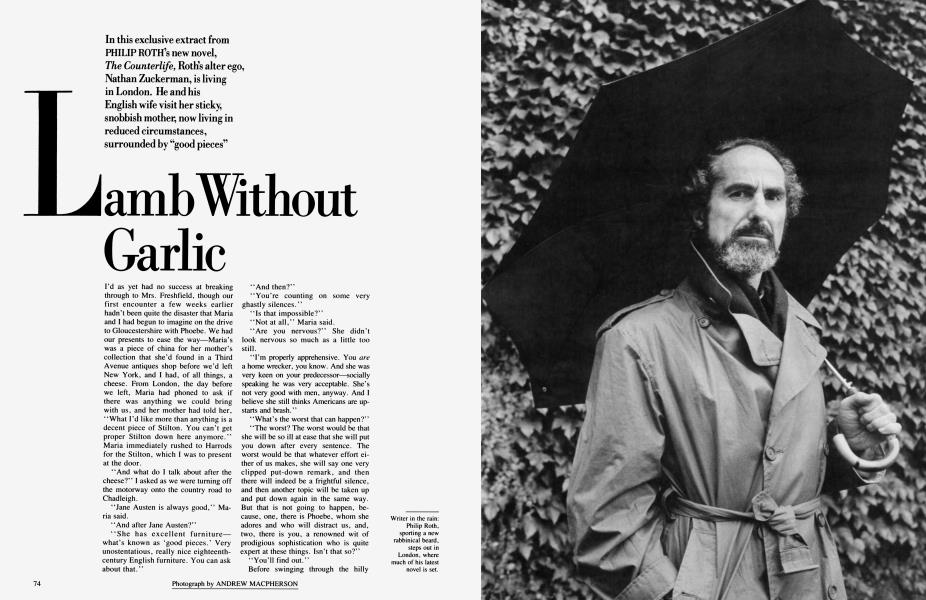
In this exclusive extract from PHILIP ROTH's new novel, The Counterlife, Roth's alter ego, Nathan Zuckerman, is living in London. He and his English wife visit her sticky, snobbish mother, now living in reduced circumstances, surrounded by "good pieces"
I'd as yet had no success at breaking through to Mrs. Freshfield, though our first encounter a few weeks earlier hadn't been quite the disaster that Maria and I had begun to imagine on the drive to Gloucestershire with Phoebe. We had our presents to ease the way—Maria's was a piece of china for her mother's collection that she'd found in a Third Avenue antiques shop before we'd left New York, and I had, of all things, a cheese. From London, the day before we left, Maria had phoned to ask if there was anything we could bring with us, and her mother had told her, "What I'd like more than anything is a decent piece of Stilton. You can't get proper Stilton down here anymore." Maria immediately rushed to Harrods for the Stilton, which I was to present at the door.
"And what do I talk about after the cheese?" I asked as we were turning off the motorway onto the country road to Chadleigh.
"Jane Austen is always good," Maria said.
"And after Jane Austen?"
"She has excellent furniture— what's known as 'good pieces.' Very unostentatious, really nice eighteenthcentury English furniture. You can ask about that."
"And then?"
"You're counting on some very ghastly silences. "
"Is that impossible?"
"Not at all," Maria said.
"Are you nervous?" She didn't look nervous so much as a little too still.
"I'm properly apprehensive. You are a home wrecker, you know. And she was very keen on your predecessor—socially speaking he was very acceptable. She's not very good with men, anyway. And I believe she still thinks Americans are upstarts and brash."
"What's the worst that can happen?"
"The worst? The worst would be that she will be so ill at ease that she will put you down after every sentence. The worst would be that whatever effort either of us makes, she will say one very clipped put-down remark, and then there will indeed be a frightful silence, and then another topic will be taken up and put down again in the same way. But that is not going to happen, because, one, there is Phoebe, whom she adores and who will distract us, and, two, there is you, a renowned wit of prodigious sophistication who is quite expert at these things. Isn't that so?"
"You'll find out."
Before swinging through the hilly country lanes to get to her mother's house in Chadleigh, we took a short detour in order for Maria to show me her school. As we passed the fields close by, Maria held Phoebe up so she could look at the horses—"Horses around here," she said to me, "as far as the eye can see."
The school was a long way from any human habitation, set in a vast, immaculately kept, old deer park shaded by large cedar trees. The playing fields and the tennis courts were empty when we arrived—the girls were in class and there was no one at all to be seen outside the grand Elizabethanlooking stone building where Maria had lived as a boarder until she went off to Oxford. "Looks to me like a palace," I said, rolling down the window to take in the view. "The joke was that the boys used to be brought up in laundry baskets at night," she said. "And were they?'' I asked. "Certainly not. No sex at all. Girls would get crushes on the hockey mistress, that sort of thing. We'd write our boyfriends pages of letters in various colored inks on pink paper sprayed with scent. But otherwise, as you see, a place of extreme innocence."
Chadleigh, less grand but more innocent-looking even than the school, was thirty minutes on, set halfway up a very steep, very lonely Gloucestershire valley. Years ago, before the wool industry moved off, it had been a village of poor weavers. "In the old days," said Maria as we turned into the narrow main road, "these were just hovels of tuberculosis—thirteen children and no TV." Now Chadleigh was a picturesque cluster of streets and lanes, situated dramatically across the valley from a hanging beech woods—a muddle of monochromatic stone houses, grayish and austere under the clouds, and a long triangular village green where some dogs were playing. Just beyond the houses and their kitchen gardens, the farms on the rising hillside were parceled off like New England fields with old dry stone walls, meticulously laid layers of tilelike rock the color of the houses. Maria said that the first sight of the stone walls and the irregular pattern of the fields was always very emotional for her if she hadn't been back for a while.
Holly Tree Cottage seemed from the road a sizable house, though nothing like as impressive, Maria told me, as
The Barton, where the family had lived before her father took flight. His family had been rich, but he was a second son and had got the family name with nothing to go with it. After university he'd been a banker in the City, only weekending with his family, but he hadn't much liked work and eventually skipped to Leicestershire with a very famous, horsey woman of the fifties, who had worn a top hat with a veil and ridden sidesaddle and had been known maliciously, for witty and (to me) obscure English reasons, as "Keep Death off the Road." To put himself beyond the financial edicts of the divorce court, he'd wound up only a few years later in Canada, married to a rich Vancouver girl and occupied mainly with sailing around the Sound and playing golf. The Barton proved to be too big and—after the support payments stopped coming in—beyond maintaining on Mrs. Freshfield's income. She had been left only her mother's modest capital and, thanks to the help of her stockbroker and some very stem economical management of her own, the small sum had proved to be just sufficient to get the girls through school. But this had meant selling The Barton, which lay in the open country, and renting Holly Tree Cottage, at the edge of Chadleigh village.
There was a log fire in the drawing room when we arrived and, after the presents were opened and admired and Phoebe had been allowed a wild run around the garden and given a glass of milk, we sat there having a drink before lunch. It was a pleasant room with worn Oriental carpets on the dark wood floors and on the walls a lot of family portraits along with several portraits of horses. Everything was a little worn and all in very discreet taste— chintz curtains with birds and flowers and lots of polished wood.
Following the advice garnered on the drive down, I said, "That's a very nice desk."
"Oh, it's just a copy of Sheraton," Mrs. Freshfield replied.
"And that's a beautiful bookcase."
"Oh, well, Charley Rhys-Mill was here the other day," she said, looking while she spoke at neither Maria nor me, "and he said he thought that it might well be a Chippendale design, but I'm certain it's a country piece. If you look there," she said, momentarily acknowledging my presence, "you can see the way the locks are put in, it's very rural. I think it's taken from the pattern book, but I don't think it's Chippendale."
The chiropodist father and the dentist brother seemed to havesummed me up instantly.
I decided that if she was going to belittle everything I admired, I had better stop here.
I said nothing more and just sipped my gin until Mrs. Freshfield took it upon herself to try to make me feel at home.
"Where are you from exactly, Mr. Zuckerman?"
"Newark. In New Jersey."
"I'm not very good at American geography."
"It's across the river from New York."
"I didn't know New York was on a river."
"Yes. Two."
"What was your father's profession?"
"He was a chiropodist."
There was a great silence while I drank, Maria drank, and Phoebe crayoned; we could hear Phoebe crayoning.
"Do you have brothers and sisters?"
"I have a younger brother," I said.
"What does he do?" "He's a dentist." Either these were all the wrong answers or else she knew by then all she needed to know, for the conversation about my background lasted all of half a minute. The chiropodist father and the dentist brother seemed to have summed me up instantly. I wondered if perhaps these were occupations that were simply too useful.
She had cooked the lunch herself—very English, perfectly nice, and rather bland. "There is no garlic in the lamb." She said this with what seemed to me a most ambiguous smile.
"Fine," I said amiably, but still uncertain as to whether there might not be lurking in her remark some dire ethnic implication. Perhaps this was as close as she would come to mentioning my strange religion. I couldn't imagine that was any less difficult for her than my being American. I clearly had everything going for me.
The vegetables were from the garden, Brussels sprouts, potatoes, and carrots. Maria asked about Mr. Blackett, a retired agricultural laborer who had supplemented his meager pension by working for them one day a week, mowing, hauling wood, and doing the vegetable garden. Was he still living? Yes, he was, but Ethel had recently died and he was alone in his council flat, where, said Mrs. Freshfield, she was afraid he existed just this side of hypothermia.
Maria said to me, "Ethel was Mrs. Blackett. Our cleaning lady. A very thorough cleaner. Always washed the doorstep on her knees. Terrible problems when we were teenage girls about giving Ethel a Christmas present. He'd get a bottle of whiskey from Mother, and Ethel invariably wound up with hankies from us. Mr. Blackett speaks a dialect that's almost incomprehensible. I wish you could hear it. He's a quite surprisingly nineteenth-century figure, isn't he, Mother?"
"It's going, that, the very strong rural accent," Mrs. Freshfield said, and then, Maria's effort to make the Blacketts of interest seemingly having fizzled out, we fell into a spell of doing nothing but cutting and chewing our food that I was afraid might last till we left for London.
"Maria says you're a great reader of Jane Austen," I said.
"Well, I've read her all my life. I began with Pride and Prejudice when I was thirteen and I've been reading her ever since."
"Why is that?"
This evinced a very wintry smile. "When did you last read Jane Austen, Mr. Zuckerman?"
"Not since college."
"Read her again and then you'll see why."
"I will, but what I was asking is what you get out of Jane Austen."
"She simply records life truthfully, and what she has to say about life is very profound. She amuses me so much. The characters are so very good. I'm very fond of Mr. Woodhouse in Emma. And Mr. Bennet, in Pride and Prejudice, I'm very fond of too. I'm very fond of Fanny Price, in Mansfield Park. When she goes back to Portsmouth after living down with the Bertrams in great style and grandeur, and she finds her own family and is so shocked by the squalor—people are very critical of her for that and say she's a snob, and maybe it's because I'm a snob myself (I suppose I am), but I find it very sympathetic. I think that's how one would behave, if one went back to a much lower standard of living."
(Continued on page 97)
(Continued from page 77)
Lamb Without Garlic
''Which book is your favorite?" I asked.
''Well, I suppose whichever I'm reading is my favorite at the time. I read them all every year. But in the end, it's Pride and Prejudice. Mr. Darcy is very attractive. And then I like Lydia. I think Lydia is so foolish and silly. She's beautifully portrayed. I know so many people like that, you see. And of course I do sympathize with Mr. and Mrs. Bennet, having all these daughters of my own to marry off.
I could not tell if this was intended as some kind of blow—whether the woman was dangerous or being perfectly benign.
"I'm sorry I haven't read your books," she said to me. "I don't read very much American literature. I find it very difficult to understand the people. I don't find them very attractive or very sympathetic, I'm afraid. I don't really like violence. There's so much violence in American books, I find. Of course not in Henry James, whom I do like very much. Though I suppose he hardly counts as an American. He really is an observer of the English scene, and I think he really is very good. But I prefer him on television, I think, now. The style is rather long-winded. When you see them on television, they get to the point so much more quickly. They've done The Spoils of Poynton recently, and of course I was particularly interested in that, with my interest in furniture. They did it awfully well, I thought. They did The Golden Bowl. I enjoyed that very much. It is a rather long book. Your books are published over here, are they?"
"Yes."
"Well, I don't know why Maria hasn't sent them to me."
"Oh, I don't think you'd like them, Mother," Maria said.
Here a decision was unanimously reached to be distracted by Phoebe, who in fact was harmlessly fiddling with the vegetables on her plate and being a perfect little girl. "Maria, she's dribbling, dear," said Mrs. Freshfield, "—see to her, will you?" and for the remainder of the meal everyone's remarks had to do with the child.
During coffee in the drawing room, I asked if I might see the rest of the rooms. Just as she had disparaged the furniture when I admired it, now she disparaged the house. "It's nothing very special," she said. "It was just a bailiff's house, you know. Of course they did themselves much better in those days." I understood from this that she was herself used to far better, and said no more on the subject. However, when the coffee was finished, I found I was to get the tour after all—Mrs. Freshfield rose, we followed, and this seemed to me such a good sign that I launched into a new line of inquiry that I thought might finally be appropriate.
"Maria tells me that your family has lived around here for a long time."
The reply came back at me like a hard little pellet. It could have struck my chest and gone out between my shoulder blades. "Three hundred years."
"What did they do here?"
"Sheep," like a second shot. "Everyone was in sheep then."
She pushed open the door to a large bedroom whose windows looked out to a field where some cows were grazing. "This was the nursery. Where Maria and her sisters grew up. Sarah was the oldest and she got to have a bedroom first, and Maria had to go on sleeping here with Georgina. This was a great source of bitterness. So was inheriting Sarah's clothes. When Sarah grew out of them, Maria was made to wear them, and by the time she was finished they weren't worth passing on to Georgina. So the oldest got new clothes and the youngest got new clothes, and Maria, in the middle, never did. Another source of bitterness. We were awfully hard up for a bit, you know. Maria never quite understood that, I don't think."
"But of course I did," Maria said.
"But you resented things, I think. Perfectly naturally, quite naturally. We couldn't afford ponies, and your friends could, and you seemed to think it was my fault. Which it wasn't."
And was recalling Maria's resentment meant to suggest something about her choosing me? I couldn't really tell from Mrs. Freshfield's tone. Maybe this was affectionate banter, even if it didn't sound that way to me. Maybe it was just straight historical reporting—fact, without implication or subtle significance. Maybe this was just how these people talked.
Out in the hallway I decided to make a last effort. Pointing to a bureau at the head of the stairs, I said lightly, as if to no one, "A lovely piece."
"That's from my husband's family. My mother-in-law bought that. She found it in Worcester one day. Yes, it's a very nice piece. The handles are right too."
Success. Stop there.
While Phoebe napped, Maria and I walked down the road to the little church where she'd been taken to worship as a child.
"Well," she said, after we had left the house, "that wasn't too bad, was it?"
"I have no idea. Was it? Wasn't it?"
"She made a real effort. She doesn't do treacle tart unless it's a special occasion. Because you're a man there was wine at lunch. She obviously thought about your coming for a week."
"That I didn't get, quite."
"She went to Mr. Tims, the butcher, and asked him for a specially nice joint. Mr. Tims made a real effort—the whole village made a real effort."
"Yes? Well, I made a real effort too. I felt as though I were crossing a minefield. I didn't have much luck with the furniture."
"You admired it too much." Maria laughed. "I must teach you never to praise someone's possessions to his face quite that way. But that's my mother, anyway. You praise it and, if it's hers, she runs it down. You made a hit with the Stilton. She cooed in ecstasies when we were alone in the kitchen."
"I can't see her in ecstasies."
"Over a Stilton, oh yes."
There was a dark patch of ancient yews outside the tiny church, a nice old building, surrounded by tombstones. "You do know the name of this tree," she said to me. "From Thomas Gray," I said, "yes, I do." "You had a very good education in Newark." "To prepare me for you, I had to." Maria opened the door to the church, whose earliest stones, she told me, had been laid by the Normans. "The smell," she said when we stepped inside, and sounded just a little stunned, as people do when their past comes wafting powerfully back, "—the smell of the damp in these places." We looked at the effigies of the noble dead and the wood carving on the bench ends until she couldn't stand the chill anymore. "There used to be six people in here for Evensong on a winter Sunday. The damp still gets right through to my knees. Come, I'll show you my lonely places.''
Lamb Without Garlic
We walked up the hill through the village again—Maria explaining who lived in each of the houses—and then got into the car and drove out to her old hideaways, the "lonely places" that she would always revisit, whenever she came home from school, to be sure they were still there. One was a beech woods where she used to go for walks—"very haunting," she called it—and the other lay beyond the village at the bottom of the valley, a ruined mill beside a stream so small you could hop across it. She'd come there with her horse, or, after her mother had decided that she was having a hard enough time paying for the children and their schools without ponies to be fed and looked after, she'd ride out on her bicycle. "This is where I'd have my visionary feelings of the world being one. Exactly what Wordsworth describes—the real nature mysticism, moments of extreme contentment. You know, looking at the sun setting and suddenly thinking that the universe all makes sense. For an adolescent there is no better place for these little visions than a ruined mill by a trickling stream."
From there we drove to The Barton, which was quite isolated, behind a high ivy-covered wall on a dirt road several miles outside of Chadleigh. It was getting dark and, as there were dogs, we hung back by the gate, looking to where the lights were burning throughout the house. It was built of the same grayishyellow stone as Holly Tree Cottage and most every other house we'd seen, though from its size and the impressive gables it couldn't have been mistaken for the home of a poor local weaver or even of a bailiff. There was a strip of garden beyond the wall leading to the French windows downstairs. Maria said that the house had no central heating when she was a child, and so there were log fires in all the rooms, burning from September through May; electricity they'd made themselves, using an old diesel engine that pumped away most of the time. At the back, she said, were the stables, the barn, and a walled kitchen garden with rose patches; beyond was a duck pond where they had fished and learned to skate, and beyond that a nut woods, another haunted place full of glades and birds, wildflowers and bracken, where she and her sisters used to run up and down the green paths frightening each other to death. Her earliest memories were all poetic and associated with that woods.
"Servants?"
"Just two," she said. "A nanny for the children and one maid, an old parlormaid left over from before the war. My grandmother's parlormaid, called by her surname, Burton, who did all the cooking and stayed with us until she was pensioned off at the end."
"So moving into the village," I said, "was a comedown."
"We were just children, not so much for us. But my mother never recovered. Her family hasn't given up an inch of land in Gloucestershire since the seventeenth century. But her brother has the estate of three thousand acres and she has nothing. Just the few stocks and shares inherited from her mother, the furniture you admired so, and those portraits of horses you failed to overpraise—kind of sub-Stubbs."
"It is all extremely foreign to me, Maria."
"I thought I sensed that at lunch."
Subscribers have complete access to the archive.
Sign In Not a Subscriber?Join Now


