

Sign In to Your Account
Subscribers have complete access to the archive.
Sign In Not a Subscriber?Join NowSPORTS-FAN PANDERING
The newest wrinkle in jockstrap worship is fan radio, ear exercise for blubbo couch buddies
JAMES WOLCOTT
Mixed Media
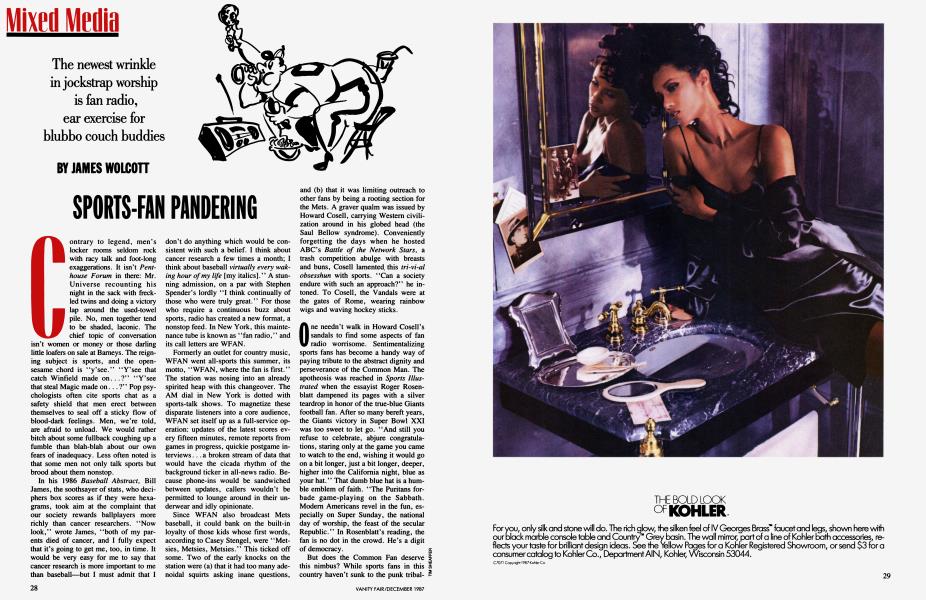
Contrary to legend, men's locker rooms seldom rock with racy talk and foot-long exaggerations. It isn't Penthouse Forum in there: Mr. Universe recounting his night in the sack with freckled twins and doing a victory lap around the used-towel pile. No, men together tend to be shaded, laconic. The chief topic of conversation isn't women or money or those darling little loafers on sale at Barneys. The reigning subject is sports, and the opensesame chord is "y'see." "Y'see that catch Winfield made on...?" "Y'see that steal Magic made on... ?" Pop psychologists often cite sports chat as a safety shield that men erect between themselves to seal off a sticky flow of blood-dark feelings. Men, we're told, are afraid to unload. We would rather bitch about some fullback coughing up a fumble than blah-blah about our own fears of inadequacy. Less often noted is that some men not only talk sports but brood about them nonstop.
In his 1986 Baseball Abstract, Bill James, the soothsayer of stats, who deciphers box scores as if they were hexagrams, took aim at the complaint that our society rewards ballplayers more richly than cancer researchers. "Now look," wrote James, "both of my parents died of cancer, and I fully expect that it's going to get me, too, in time. It would be very easy for me to say that cancer research is more important to me than baseball—but I must admit that I don't do anything which would be consistent with such a belief. I think about cancer research a few times a month; I think about baseball virtually every waking hour of my life [my italics]." A stunning admission, on a par with Stephen Spender's lordly "I think continually of those who were truly great." For those who require a continuous buzz about sports, radio has created a new format, a nonstop feed. In New York, this maintenance tube is known as "fan radio," and its call letters are WFAN.
Formerly an outlet for country music, WFAN went all-sports this summer, its motto, "WFAN, where the fan is first." The station was nosing into an already spirited heap with this changeover. The AM dial in New York is dotted with sports-talk shows. To magnetize these disparate listeners into a core audience, WFAN set itself up as a full-service operation: updates of the latest scores every fifteen minutes, remote reports from games in progress, quickie postgame interviews ... a broken stream of data that would have the cicada rhythm of the background ticker in all-news radio. Because phone-ins would be sandwiched between updates, callers wouldn't be permitted to lounge around in their underwear and idly opinionate.
Since WFAN also broadcast Mets baseball, it could bank on the built-in loyalty of those kids whose first words, according to Casey Stengel, were "Metsies, Metsies, Metsies." This ticked off some. Two of the early knocks on the station were (a) that it had too many adenoidal squirts asking inane questions, and (b) that it was limiting outreach to other fans by being a rooting section for the Mets. A graver qualm was issued by Howard Cosell, carrying Western civilization around in his globed head (the Saul Bellow syndrome). Conveniently forgetting the days when he hosted ABC's Battle of the Network Stars, a trash competition abulge with breasts and buns, Cosell lamented, this tri-vi-al obsesshun with sports. "Can a society endure with such an approach?" he intoned. To Cosell, the Vandals were at the gates of Rome, wearing rainbow wigs and waving hockey sticks.
One needn't walk in Howard Cosell's sandals to find some aspects of fan radio worrisome. Sentimentalizing sports fans has become a handy way of paying tribute to the abstract dignity and perseverance of the Common Man. The apotheosis was reached in Sports Illustrated when the essayist Roger Rosenblatt dampened its pages with a silver teardrop in honor of the true-blue Giants football fan. After so many bereft years, the Giants victory in Super Bowl XXI was too sweet to let go. "And still you refuse to celebrate, abjure congratulations, staring only at the game you came to watch to the end, wishing it would go on a bit longer, just a bit longer, deeper, higher into the California night, blue as your hat." That dumb blue hat is a humble emblem of faith. "The Puritans forbade game-playing on the Sabbath. Modem Americans revel in the fun, especially on Super Sunday, the national day of worship, the feast of the secular Republic." In Rosenblatt's reading, the fan is no dot in the crowd. He's a digit of democracy.
But does the Common Fan deserve this nimbus? While sports fans in this country haven't sunk to the punk tribalism of soccer fans in Europe and South America, there has been a thick foam forming at the bottom of the behavioral sink. When the Daily News sports writer Michael Katz took his daughter to her first baseball game, he found himself beamed to the planet of the apes. The smell of marijuana necklaced the stands, which were full of foul language and fisticuffs. "Maybe baseball games are no place to take a kid. Fans get upset because the players insist on acting human and refuse to be role models. Fans ought to take a look at themselves. And a listen. The language of the bleachers is nothing found in Little Golden Books." The fans are usually too busy trying to get on camera to consult a mirror. And as the camera pans the crowd, the contrast can be stark. There's Darryl Strawberry in the batter's box, muscular, lean, intense. And there are the Three Stooges in Section 36, loud, bombed, and blubbo.
A crude lampoon, perhaps, but sketched from life. For although athletes are becoming faster and stronger, armored with muscle and yet ropily flexible, Americans on the whole are acquiring an extra ring of flab. As an article in Forbes observed, "the truth is that we are not a nation of joggers, iron-pumpers and whisper-thin fashion models. Rather, we are, increasingly, a nation of broad bottoms and bulging middles." The yuppie stereotype may include skinny salads and Perrier, but those are the same yuppies refusing to feel guilty about their afternoon tryst with Frusen Gladje. Those less chic can dig into Dairy Queen's seven-hundred-calorie Blizzard, a dessert which consists of sixteen ounces of ice cream whipped in a blender with bits of crushed cookie or candy—a sort of suicide pact for your diet. Even mattress-makers, noted Forbes, are taking into account this added bulk. That bulk won't diminish in the coming generation. Studies show that school kids are worseningly out of shape, often unable to complete the simplest exercises. Mega-calorie desserts and TV are only part of the problem. Another factor is that gifted athletes are given the golden nod in school, while students who are average or below are tossed a ball in gym class and told to go play. After all, a school earns its status not by upgrading the median but by showcasing the superlative—boosting the future stud who may shine in college or even the pros. Ten kids who can do a hundred push-ups are deemed less valuable to the community than one phenom who can hit an outside jump shot. The phenom becomes a p.c. (privileged character) and the ten kids become... fans.
It's the red-meat spectator sports— baseball, football, basketball, hockey— that encourage fans to become glorified bystanders, fixing their hopes and fantasies (and bets) upon a fit elite. Jockstrap worship promotes personal passivity, which advertisers have learned to mine. Ads insist that the way a real fan roots for his team today is by funneling groceries down his gullet. The athlete expends, the fan consumes. On TV, for example, one commercial introduces us to the Coors "couching staff'—three couch potatoes jollily parked around a giant ice cooler and a pig trough of eats. On New York radio there's a commercial for a convenience store in which a fan helps the Yankees win by orgying on snacks: each time he takes a bite or a sip, the Yanks nudge closer to a comefrom-behind victory. When fans manage to climb to their logy feet, they learn to live by other cues. Beer commercials featuring George Wendt (Cheers) at a flower show or Paul Hogan (Crocodile Dundee) at an art opening function as object lessons in carriage and demeanor. They teach socialization—how to drink upscale and still be a regular guy. Not gal, guy.
Of course, there are millions of female sports fans and a scattering of female sports commentators. (WFAN has an excellent host in Ann Liguori.) But the broadcasting and advertising media prefer to segment an audience to pinpoint its demographics, and they really want those hearty men in search of hearty brew. This explains why the potatoes of the Coors "couching staff' are male; why in the Michelob commercial a spruce dude hesitates in front of a televised ball game as his miffed date steams on alone. Commercials drum home the message that men have a funky, primal, Fred Flintstone need to shuck off civilized duty and dig in in front of the flickering light. Like beer commercials, fan radio fosters an urban idyll of male bonding, a touch-football game of comradely spirit. (Touch football is as close as most men want to get to touchie-feelie.) Couch buddies have become one of the last, feeble vestiges of sexual separatism. ESPN is their biofeedback. CBS's John Madden is their shouting Buddha. Regardless of marital status, couch buddies are a bachelors' club (a man needn't be a bachelor to act like one), and sports radio is finally bachelor radio. It's aimed at men alone with their sports buzz—the solitary beer gut. But who am I to sound superior? I log a lot of useless hours with WFAN in the background, and I don't even have a couch. Or drink beer. My own susceptibility to WFAN makes me suspect that its formula will click.
Every new wrinkle in broadcasting begins as a novelty before it becomes a fad and then a staple. When New York's all-news station WINS began in the midsixties, one of its initial scoops involved the killing of a circus clown (the station's news manager proudly told The New Yorker, "[We had] the first interviews with the victim's fellow-clowns"). Today, however, nearly every major market has an all-news outlet. All-sports won't be as easy to clone, because few cities have the plethora of teams that New York has. But the spread of national sports consciousness—best reflected in the sports pages of USA Today—plus the overlapping of the baseball, football, basketball, and hockey seasons, helps make the format transplantable. The question is, how much input can even sports addicts take before it all becomes an indistinguishable drone? People winced and hooted when the announcer Tim McCarver compared Game Six of the Mets-Astros play-offs to Beowulf as an epic legend that would long endure. But if McCarver's prophecy proves false, it will be not because his comparison was kooky or inapt (although Game Six seemed more, duh, Homeric to me) but because the steady media wash of our time tends to subsume even peak events into an ongoing transmission. Our eyes become extensions of optic fibers. As sport becomes as intricately monitored as the weather or the stock market, it loses its special tang of time and place, its internal breath. Fan radio is just one more sign of how reluctant we are to be alone with our thoughts. How wired we are to distraction.
Subscribers have complete access to the archive.
Sign In Not a Subscriber?Join Now

