


Sign In to Your Account
Subscribers have complete access to the archive.
Sign In Not a Subscriber?Join NowTHE BEST OF THE BUNCH
An annual roundup of personal favorites, from the butch to the come-hither
MARK GINSBURG
Cars
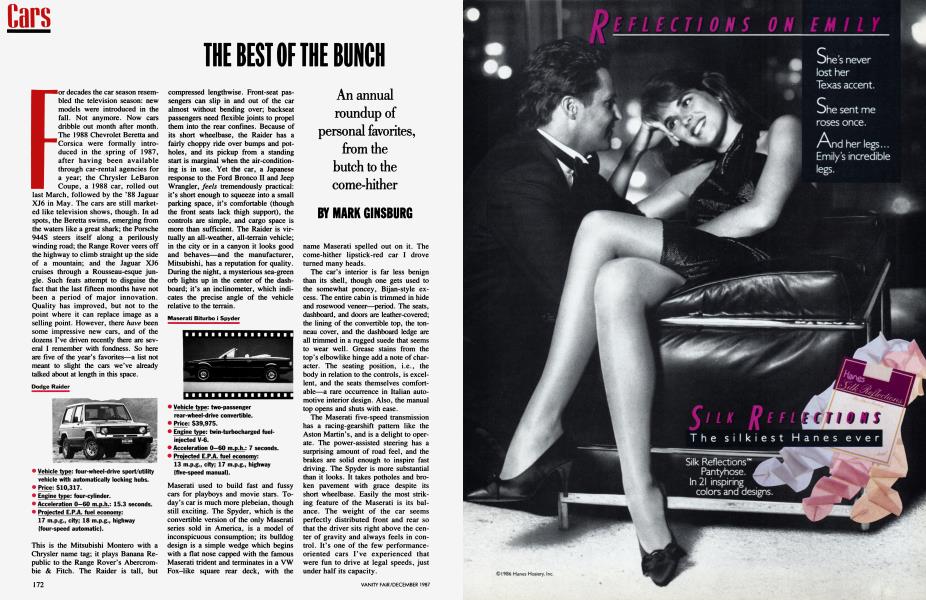
For decades the car season resembled the television season: new models were introduced in the fall. Not anymore. Now cars dribble out month after month. The 1988 Chevrolet Beretta and Corsica were formally introduced in the spring of 1987, after having been available through car-rental agencies for a year; the Chrysler LeBaron Coupe, a 1988 car, rolled out last March, followed by the '88 Jaguar XJ6 in May. The cars are still marketed like television shows, though. In ad spots, the Beretta swims, emerging from the waters like a great shark; the Porsche 944S steers itself along a perilously winding road; the Range Rover veers off the highway to climb straight up the side of a mountain; and the Jaguar XJ6 cruises through a Rousseau-esque jungle. Such feats attempt to disguise the fact that the last fifteen months have not been a period of major innovation. Quality has improved, but not to the point where it can replace image as a selling point. However, there have been some impressive new cars, and of the dozens I've driven recently there are several I remember with fondness. So here are five of the year's favorites—a list not meant to slight the cars we've already talked about at length in this space.
Dodge Raider
• Vehicle type: four-wheel-drive sport/utility vehicle with automatically locking hubs.
• Price: $10,317.
• Engine type: four-cylinder.
• Acceleration 0-60 m.p.h.: 15.3 seconds.
• Projected E.P.A. fuel economy:
17 m.p.g., city; 18 m.p.g., highway (four-speed automatic).
This is the Mitsubishi Montero with a Chrysler name tag; it plays Banana Republic to the Range Rover's Abercrombie & Fitch. The Raider is tall, but compressed lengthwise. Front-seat passengers can slip in and out of the car almost without bending over; backseat passengers need flexible joints to propel them into the rear confines. Because of its short wheelbase, the Raider has a fairly choppy ride over bumps and potholes, and its pickup from a standing start is marginal when the air-conditioning is in use. Yet the car, a Japanese response to the Ford Bronco II and Jeep Wrangler, feels tremendously practical: it's short enough to squeeze into a small parking space, it's comfortable (though the front seats lack thigh support), the controls are simple, and cargo space is more than sufficient. The Raider is virtually an all-weather, all-terrain vehicle; in the city or in a canyon it looks good and behaves—and the manufacturer, Mitsubishi, has a reputation for quality. During the night, a mysterious sea-green orb lights up in the center of the dashboard; it's an inclinometer, which indicates the precise angle of the vehicle relative to the terrain.
Maserati Biturbo i Spyder
• Vehicle type: two-passenger rear-wheel-drive convertible.
• Price: $39,975.
• Engine type: twin-turbocharged fuelinjected V-6.
• Acceleration 0—60 m.p.h.: 7 seconds.
• Projected E.P.A. fuel economy:
13 m.p.g., city; 17 m.p.g., highway (five-speed manual).
Maserati used to build fast and fussy cars for playboys and movie stars. Today's car is much more plebeian, though still exciting. The Spyder, which is the convertible version of the only Maserati series sold in America, is a model of inconspicuous consumption; its bulldog design is a simple wedge which begins with a flat nose capped with the famous Maserati trident and terminates in a VW Fox-like square rear deck, with the name Maserati spelled out on it. The come-hither lipstick-red car I drove turned many heads.
The car's interior is far less benign than its shell, though one gets used to the somewhat poncey, Bijan-style excess. The entire cabin is trimmed in hide and rosewood veneer—period. The seats, dashboard, and doors are leather-covered; the lining of the convertible top, the tonneau cover, and the dashboard ledge are all trimmed in a rugged suede that seems to wear well. Grease stains from the top's elbowlike hinge add a note of character. The seating position, i.e., the body in relation to the controls, is excellent, and the seats themselves comfortable—a rare occurrence in Italian automotive interior design. Also, the manual top opens and shuts with ease.
The Maserati five-speed transmission has a racing-gearshift pattern like the Aston Martin's, and is a delight to operate. The power-assisted steering has a surprising amount of road feel, and the brakes are solid enough to inspire fast driving. The Spyder is more substantial than it looks. It takes potholes and broken pavement with grace despite its short wheelbase. Easily the most striking feature of the Maserati is its balance. The weight of the car seems perfectly distributed front and rear so that the driver sits right above the center of gravity and always feels in control. It's one of the few performanceoriented cars I've experienced that were fun to drive at legal speeds, just under half its capacity.
Volvo 740 Turbo Wagon
• Vehicle type: rear-wheel-drive five-door wagon.
• Price: $23,310.
• Engine type: turbocharged four-cylinder.
• Acceleration 0—60 m.p.h.: 7.9 seconds.
• Projected E.P.A. fuel economy:
20 m.p.g., city; 25 m.p.g., highway (four-speed manual with overdrive).
The fire-engine-red wagon I drove looked hot and was hot. It felt like a sports car, providing instant response and smart braking. Inside, the blackand-white-checked cloth upholstery, trimmed with black leather bolsters, was tasteful and sporty, and the front seats offered enough support to keep passengers in their places during heavy cornering, when this longish car leans a bit, since it's rather softly sprung. The rear seats, also comfortable, fold down, forming a large cargo bed that's easy to load. The wagon's control panel is a model of simplicity without being barebones. Even fully loaded, the wagon was fun to drive, and, thanks to the turbo, one could charge past much sportier vehicles with aplomb—regardless of the weight the Volvo was hauling. The 740 Turbo Wagon is an example of utilitarian technology that's both warm and chic.
Nissan Pathfinder XE
• Vehicle type: four-wheel-drive sport/utility vehicle.
•Price: $15,714.
• Engine type: fuel-injected V-6.
• Acceleration 0—60 m.p.h.: 12.7 seconds.
• Projected E.P.A. fuel economy:
15 m.p.g., city; 17 m.p.g., highway (three-speed automatic).
The burgeoning sport/utility market is loaded with four-wheel-drive vehicles with butch names, but only this one has all its bulges, iron bracing, and spare tires in the right places for durable sex appeal. The car derives its look from a collaboration between Tokyo (Nissan Motor Co. Ltd.) and San Diego (Nissan Design International). Despite the bizarre geometric center side windows placed at odd angles, there's a harmony to the design that's androgynously appealing. (Women buy 40 percent of the vehicles in the Pathfinder XE's market segment.) Built to conquer the most rugged terrain, the car feels at home in the big urban sprawl. Poised on four huge tires and looking very Blade Runner in traffic, the Pathfinder XE coddles up to five occupants with comfortable seats, plush upholstery and carpeting, a sunroof, and numerous optional power accessories. The engine is quiet and responsive, and the car's aerodynamic silhouette cuts down on wind noise— which is usually the curse of boxy utility vehicles. The Pathfinder XE shares its only significant shortcoming with the Raider: rear-seat access. Once passengers are in, there's plenty of legroom, but getting there is a chore. Unlike the Raider, the car has a fairly smooth ride. The Pathfinder XE is very much late-eighties transportation— slick, substantial, and cool.
Mercedes-Benz 300E
• Vehicle type: front-engine rear-wheel-drive four-door sedan.
• Price: $42,570.
• Engine type: three-liter fuel-injected in-line-6.
• Acceleration 0—60 m.p.h.: 7.7 seconds.
• Projected E.P.A. fuel economy: 18 m.p.g., city; 22 m.p.g., highway (four-speed automatic).
This is the most popular Mercedes in America. It's also the besf car I've ever driven. The 300E is the perfect example of quiet high technology at work. The car's cabin is minimal, yes, but it's not austere, and the comfortable simplicity (no video-like readouts on the dashboard, for instance) creates an atmosphere conducive to concentration on driving. That's a major safety factor. So are anti-lock brakes, an air bag, excellent mirrors, headlamp washers, and a windshield-wiper blade so powerful it rocks one and a half tons of car at a stoplight. The four-speed automatic transmission just seems like one long gear. Shifts are barely noticeable. The car is very, very fast, yet quiet as a stone.
I experienced two annoying problems with the car. The controls of the expensive Becker radio-cassette player were awkward to use. The system itself produced only fair-quality sound, and the unit isn't removable by the owner, which is a pity because thieves target Mercedes-Benzes for their radios. The climate-control mechanism inconveniently offers temperature readings in centigrade only, and is slow to react to changes in settings. The vent system is also dotted with symbols that don't readily suggest their function, and the vent fan is noisy on its lowest speed. BMW's variable-speed fan would be much more practical. But the 300E excels in road manners, and, more than any other sedan, it makes possible a clear, unfettered channel from the driver's mind to the road. The majority of international race-car drivers don't drive Mercedes-Benzes for nothing.
Over the next twelve months, a staggering number of new cars will be unveiled. Radical moves from Ford and G.M. include the all-new, trimmer Lincoln Continental and the $30,000 Buick Reatta sports car. G.M. plans also to import its Opel Senator from Germany to compete with the Scorpio, Sterling, Saab, et al. I drove the English version, the Vauxhall Senator, and the car is worth waiting for. Also in the $20,000-plus sedan category, the Audi 80/90 series will replace the aging 4000 here. The car has won numerous accolades from the European press. One notch below, in terms of price, will be the new Pininfarina-designed Peugeot 405 four-door sedan—again, a winner in Europe. In a similar price range, $15,000 to $22,000, there is the new Mazda 929, which will compete with the boring Toyota Cressida and the very competent redesigned Mitsubishi Galant Sigma. From the defunct American Motors Corporation, Chrysler inherits the new Giugiaro-styled Eagle Premier. A revisionist Chevy Impala, this spacious Canadianbuilt family car should conquer Middle America if its price can be held down to the $13,000 range. Sports-car lovers who may not be placated by the new Mazda RX7 convertible will have to wait until at least 1989 for the Porsche 944 Cabriolet, and possibly the Porsche Speedster shown at this year's Frankfurt Auto Show. In the interim, Renault might just have tossed over a beautiful fiberglass snowball called the Alpine V6 Turbo, which is the car of my year.
Subscribers have complete access to the archive.
Sign In Not a Subscriber?Join Now
