
Sign In to Your Account
Subscribers have complete access to the archive.
Sign In Not a Subscriber?Join NowCADDY CHIC
Jeanne Moreau tries out Detroit's answer to the Mercedes 560SL— the new Cadillac Allanté
MARK GINSBURG
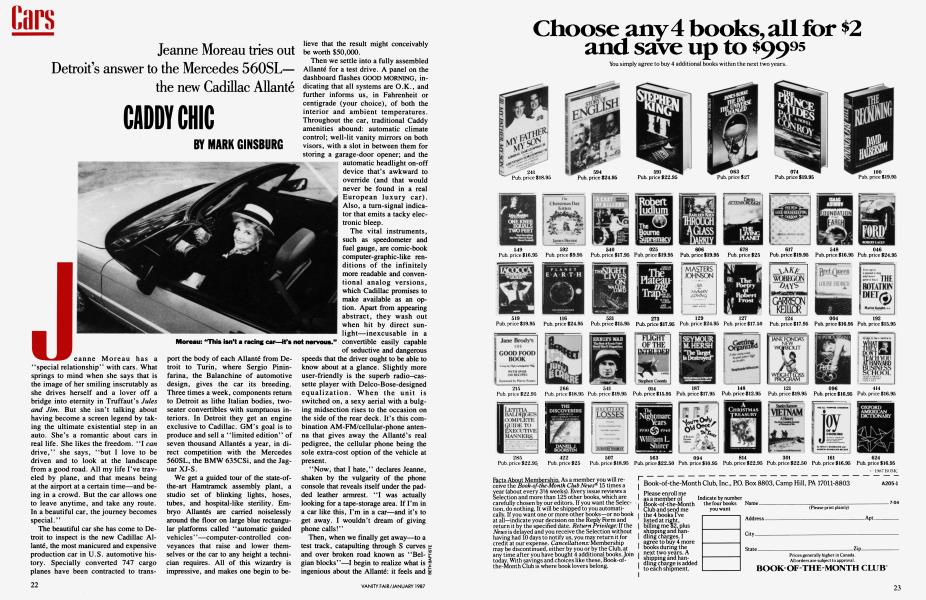
Jeanne Moreau has a "special relationship" with cars. What springs to mind when she says that is the image of her smiling inscrutably as she drives herself and a lover off a bridge into eternity in Truffaut's Jules and Jim. But she isn't talking about having become a screen legend by taking the ultimate existential step in an auto. She's a romantic about cars in real life. She likes the freedom. "I can drive," she says, "but I love to be driven and to look at the landscape from a good road. All my life I've traveled by plane, and that means being at the airport at a certain time—and being in a crowd. But the car allows one to leave anytime, and take any route. In a beautiful car, the journey becomes special."
The beautiful car she has come to Detroit to inspect is the new Cadillac Allante, the most manicured and expensive production car in U.S. automotive history. Specially converted 747 cargo planes have been contracted to transport the body of each Allante from Detroit to Turin, where Sergio Pininfarina, the Balanchine of automotive design, gives the car its breeding. Three times a week, components return to Detroit as lithe Italian bodies, twoseater convertibles with sumptuous interiors. In Detroit they get an engine exclusive to Cadillac. GM's goal is to produce and sell a "limited edition" of seven thousand Allantes a year, in direct competition with the Mercedes 560SL, the BMW 635CSi, and the Jaguar XJ-S.
We get a guided tour of the state-ofthe-art Hamtramck assembly plant, a studio set of blinking lights, hoses, tubes, and hospital-like sterility. Embryo Allantes are carried noiselessly around the floor on large blue rectangular platforms called "automatic guided vehicles ' '—computer-controlled conveyances that raise and lower themselves or the car to any height a technician requires. All of this wizardry is impressive, and makes one begin to believe that the result might conceivably be worth $50,000.
Then we settle into a fully assembled Allante for a test drive. A panel on the dashboard flashes GOOD MORNING, indicating that all systems are O.K., and further informs us, in Fahrenheit or centigrade (your choice), of both the interior and ambient temperatures. Throughout the car, traditional Caddy amenities abound: automatic climate control; well-lit vanity mirrors on both visors, with a slot in between them for storing a garage-door opener; and the automatic headlight on-off device that's awkward to override (and that would never be found in a real European luxury car). Also, a turn-signal indicator that emits a tacky electronic bleep.
The vital instruments, such as speedometer and fuel gauge, are comic-book computer-graphic-like renditions of the infinitely more readable and conventional analog versions, which Cadillac promises to make available as an option. Apart from appearing abstract, they wash out when hit by direct sunlight—inexcusable in a convertible easily capable of seductive and dangerous speeds that the driver ought to be able to know about at a glance. Slightly more user-friendly is the superb radio-cassette player with Delco-Bose-designed equalization. When the unit is switched on, a sexy aerial with a bulging midsection rises to the occasion on the side of the rear deck. It's this combination AM-FM/cellular-phone antenna that gives away the Allante's real pedigree, the cellular phone being the sole extra-cost option of the vehicle at present.
"Now, that I hate," declares Jeanne, shaken by the vulgarity of the phone console that reveals itself under the padded leather armrest. "I was actually looking for a tape-storage area. If I'm in a car like this, I'm in a car—and it's to get away. I wouldn't dream of giving phone calls!"
Then, when we finally get away—to a test track, catapulting through S curves and over broken road known as "Belgian blocks"—I begin to realize what is ingenious about the Allante: it feels and drives like a much bigger car, a Cadillac, for instance, which is uncanny for a roadster.
"But, Jeanne, don't you miss that throaty roar of real sports cars?" I inquire, uninspired by the vaguely feline purr.
"No, if I wanted the roar I would be in a Ferrari," she replies. "Besides, this isn't a racing car—it's not nervous; it's an elegant sports car. The roar is macho Italian style, and I find it disturbing."
What the Allante lacks in distinctive accelerative noises, it makes up for in brakes—very tight, supersecure anti-lock braking that we experience firsthand from 70 m.p.h. on wet pavement. During the side-to-side motion of the S curves, the car handles capably, without thrills or excessive body lean, all of which indicate that a lady's cigarette and boater will likely be left intact under vigorous driving. In fact, on all the surfaces we test, the Allante treats us with grace.
As for the cockpit, the car's interior is predictably nouveau riche in a Concorde sort of way: marginally elegant, nonaggressively hightech, but not really cozy. The comfortable bucket seats are infinitely adjustable, allowing a shorter person to sit tall and still reach the controls. The headrests, however, badly obscure rear vision for any size driver, and Pininfarina knows they require remodeling. (They were designed, as was the car's entire body, in his mammoth wind tunnel. The Allante is first and foremost a convertible; to keep the cockpit absolutely wind-free at speeds up to 60 m.p.h. was a Cadillac prerequisite.) Though the car employs generous amounts of hide, the creamy, clubby, leathery aroma of a Rolls or Jaguar is absent. The Allante is wide, significantly wider than the 560SL, and airy, even though we drove with the removable hard top in place.
"Usually in sports cars you don't have space," Jeanne notes, electrically adjusting the lumbar support of the seat back. "They're like being in economy class on the plane. You're in a car that costs an enormous amount of money and you're squeezed."
"The view from a car is also very important to me," she adds, peering through the glass as if it were a lens. "This view, I don't know whether you've noticed, is well carried out. You can see 260 degrees—even the door pillars don't upset it. And the trunk is lovely, very well finished. I could put at least two of my suitcases in it. For once I could travel with one big one and also a small bag."
But does the Allante have character and style—or is it too bland, too middle-class for the money that could have been invested in a Mercedes-Benz? "Lots of people have MercedesBenzes," Jeanne counters, "and to me the 560SL is bourgeois, not the Allante. The design of the Cadillac is so much more impertinent and amusing. It's not an Italian car, but a great American car with an Italian design. And it's not a copy; it's a blend of Cadillac—and it's a classic."
So what is an "allante"? It is not a word in Jeanne's multilingual vocabulary. "It's an imaginary word that means with spirit, with flair," a Cadillac P.R. person says. Someone else volunteers that the word is a blend of "elan" and "avanti." What they are suggesting is that the Allante is a car about feeling, not driving per se. It's not a driver's car, nor is it directed at that kind of buyer. A BMW or Porsche will have a plethora of professional drivers, teams, and racing circuits behind it from prototype through production. The Allante, since 1982, has had phalanxes of market researchers "clinicking" Mercedes, Jaguar, and Cadillac owners about how they'd cotton to various versions of a baby Caddy roadster, should one appear in the marketplace.
"It's an elegant sports car," Jeanne reiterates as we reluctantly give up the keys. "Like elegant sportswear made by Calvin Klein or Yves Saint Laurent, rather than Benetton. Just imagine me driving down the Champs-Elysees in that car! The first one that comes to Paris, you tell me."
The Cadillac Allante made its world debut at the 72e Salon de l'Automobile, in Paris, in October. It will become available for sale in the United States early this year.
Manufacturer's Specifications
Vehicle type: front-engine, front-wheel-drive, two-passenger, two-door hardand soft-top convertible. Price: $50,000 (estimated).
Options: cellular phone.
Engine type: fuel-injected V-8. Transmission: four-speed automatic. Acceleration 0—60 m.p.h.: 10.0 seconds.
Top speed: 125 m.p.h. Projected E.P.A. fuel economy: 22.5 m.p.g., city/highway.
Subscribers have complete access to the archive.
Sign In Not a Subscriber?Join Now
