

Sign In to Your Account
Subscribers have complete access to the archive.
Sign In Not a Subscriber?Join NowTHE READY-TO-WEAR ALFA
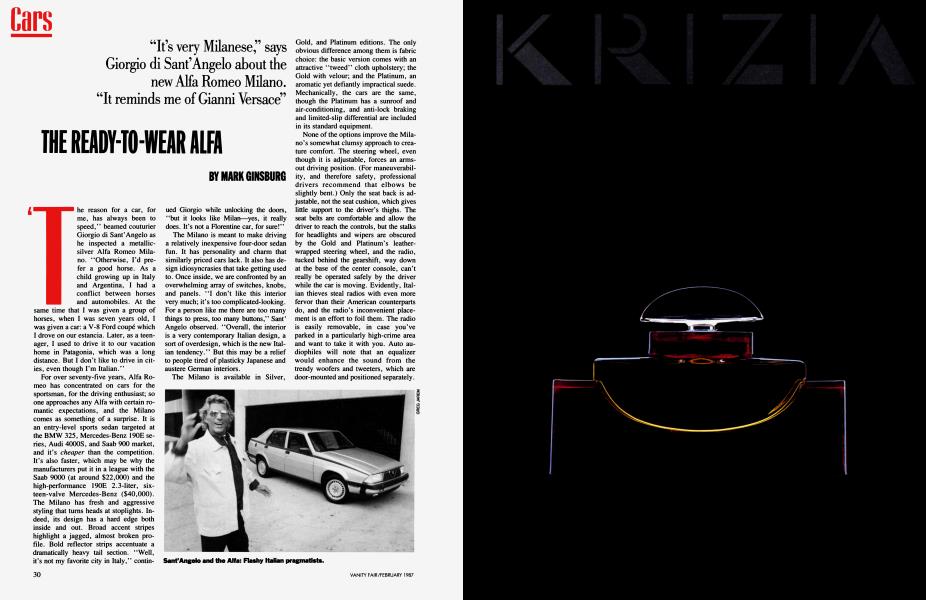
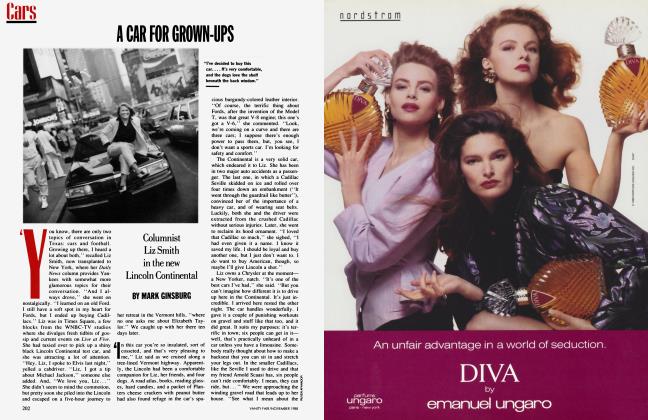
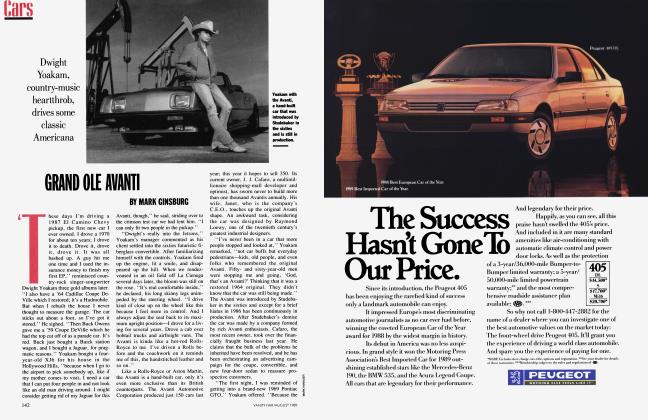
"It's very Milanese," says Giorgio di Sant'Angelo about the new Alfa Romeo Milano. "It reminds me of Gianni Versace"
MARK GINSBURG
Cars
The reason for a car, for me, has always been to speed," beamed couturier Giorgio di Sant'Angelo as he inspected a metallicsilver Alfa Romeo Milano. "Otherwise, I'd prefer a good horse. As a child growing up in Italy and Argentina, I had a conflict between horses and automobiles. At the same time that I was given a group of horses, when I was seven years old, I was given a car: a V-8 Ford coupe which I drove on our estancia. Later, as a teenager, I used to drive it to our vacation home in Patagonia, which was a long distance. But I don't like to drive in cities, even though I'm Italian."
For over seventy-five years, Alfa Romeo has concentrated on cars for the sportsman, for the driving enthusiast; so one approaches any Alfa with certain romantic expectations, and the Milano comes as something of a surprise. It is an entry-level sports sedan targeted at the BMW 325, Mercedes-Benz 190E series, Audi 4000S, and Saab 900 market, and it's cheaper than the competition. It's also faster, which may be why the manufacturers put it in a league with the Saab 9000 (at around $22,000) and the high-performance 190E 2.3-liter, sixteen-valve Mercedes-Benz ($40,000). The Milano has fresh and aggressive styling that turns heads at stoplights. Indeed, its design has a hard edge both inside and out. Broad accent stripes highlight a jagged, almost broken profile. Bold reflector strips accentuate a dramatically heavy tail section. "Well, it's not my favorite city in Italy," continued Giorgio while unlocking the doors, "but it looks like Milan—yes, it really does. It's not a Florentine car, for sure!"
The Milano is meant to make driving a relatively inexpensive four-door sedan fun. It has personality and charm that similarly priced cars lack. It also has design idiosyncrasies that take getting used to. Once inside, we are confronted by an overwhelming array of switches, knobs, and panels. "I don't like this interior very much; it's too complicated-looking. For a person like me there are too many things to press, too many buttons," Sant' Angelo observed. "Overall, the interior is a very contemporary Italian design, a sort of overdesign, which is the new Italian tendency." But this may be a relief to people tired of plasticky Japanese and austere German interiors.
The Milano is available in Silver, Gold, and Platinum editions. The only obvious difference among them is fabric choice: the basic version comes with an attractive "tweed" cloth upholstery; the Gold with velour; and the Platinum, an aromatic yet defiantly impractical suede. Mechanically, the cars are the same, though the Platinum has a sunroof and air-conditioning, and anti-lock braking and limited-slip differential are included in its standard equipment.
None of the options improve the Milano's somewhat clumsy approach to creature comfort. The steering wheel, even though it is adjustable, forces an armsout driving position. (For maneuverability, and therefore safety, professional drivers recommend that elbows be slightly bent.) Only the seat back is adjustable, not the seat cushion, which gives little support to the driver's thighs. The seat belts are comfortable and allow the driver to reach the controls, but the stalks for headlights and wipers are obscured by the Gold and Platinum's leatherwrapped steering wheel, and the radio, tucked behind the gearshift, way down at the base of the center console, can't really be operated safely by the driver while the car is moving. Evidently, Italian thieves steal radios with even more fervor than their American counterparts do, and the radio's inconvenient placement is an effort to foil them. The radio is easily removable, in case you've parked in a particularly high-crime area and want to take it with you. Auto audiophiles will note that an equalizer would enhance the sound from the trendy woofers and tweeters, which are door-mounted and positioned separately.
This brings us to the finish of the car. Outside: paint looks good, body panels fit tight, doors close as they should and seal out the wind; things appear happily symmetrical. Inside, there are a few minor problems, at least in the models we drove. The carpets didn't snap in properly, and tended to buckle and shift. The plastic gearshift knob had a ridge on its top surface that hurt my hand after a day's drive; and at night the instrument-panel lights reflected off their black housing unit directly into the windshield, leaving a bright strip in the driver's line of vision (a common design fault in cars that cost even twice as much as the Milano). Of course the panel lights can be dimmed out, but then you won't see how fast you are going. And it should be noted that it is very easy to outdrive the Milano's headlights even when they are on high beam.
The Behr air-conditioning system from Germany has a good reputation, though the weather did not allow us to adequately test it. One last point about the interior: sophisticated Milanese lighting is much in evidence. The Milano has map lights that swivel, courtesy lights, two brake-system lights, doorajar lights; it even has a bright-green light off to the side that tells you that the headlights are on—which is redundant, because the instrument panel is already lit up in this circumstance.
'Y cause ou can of tell the it's engine not a sound; cheap it's car bethe sound of a strong, powerful car, and it drives beautifully—it drives very Italian," mused Giorgio as we shifted into fifth gear and accelerated to 120 m.p.h. "It has an attitude, and a fast reaction^ yet you have control over it. I feel very secure in the Milano, even though I know it's light. It feels like a heavy car."
Indeed, on the road the Milano is an absolute joy. Whether on creviced urban boulevards or rural highways, it is very quick and fully responsive to a driver's whim. None of the three Milanos we drove rattled or squeaked even on washboard roads. The car's unusual equal front and rear weight distribution gives an uncanny weightless sensation to the front end, but one adapts to it readily. The five-speed gearbox can be a bit tricky in the lower gears—though at
MANUFACTURER'S SPECIFICATIONS • Vehicle type: front-engine, rearwheel-drive, four-door sedan. • Price: $12,980 (Silver); $14,700 (Gold); $18,995 (Platinum). • Options: automatic transmission (all models); sunroof (Gold); airconditioning, metallic paint, Clarion stereo system (Silver and Gold). • Engine type: all-aluminum singleoverhead-camshaft V-6 with fuel injection; electronic ignition. • Transmission: five-speed manual. • Acceleration 0—60 m.p.h.: 8.2 seconds. • Top speed: 130 m.p.h. • Projected E.PJt. fuel economy: 18 m.p.g., city; 24 m.p.g., highway. high speeds the meshing seems more fluid and satisfying. The steering is precise, and the brakes feel secure.
"Unfortunately, cars like this suffer in America," lamented Sant'Angelo, "because you cannot speed them. And this car needs speeding." All Alfa Romeos need to be driven to be maintained. The problem in the U.S. in the past has been that most of the driving was to the repair shop and back. Yet one feels that the Milano has benefited from the new European automotive technology, and that it will hold up mechanically and structurally, if not ornamentally. (It should also benefit from the recent takeover by Fiat, which has vowed to inject much-needed cash into the company.) It has a V-6 engine (the equivalent Mercedes, Audi, and Saab have fourcylinder engines) large enough to withstand extended periods of fast driving. Frequency of repair is very often related to inadequate preparation at the dealer's and poor-quality service, so many lowvolume-import-car buyers prefer to have their car serviced by an independent mechanic. Alfa Romeo recently increased the number of its dealerships, and offers a three-year/36,000-mile limited warranty on the Milano. It would behoove any prospective buyer to call the national Alfa Romeo Owners Club (619-747-5240) for a referral to a local club that can provide the name of a reputable dealer and a reliable independent mechanic. The latter will be invaluable for the niggly adjustments the warranty may not cover, and will be your ally once it has expired.
Inasmuch as the Milano is a wonderful highway cruiser, it is also a perfectly good town car, one in which Giorgio felt his clients could be comfortably and elegantly shuttled around, sitting in back or in front. Which is to say that this Alfa is as suitable a conveyance for Mick Jagger, Faye Dunaway, and Catherine Oxenberg as it is for Lena Home, Princess Elizabeth of Yugoslavia, and Doris Duke. "It's very Milanese," Giorgio said again. "It's just perfectly named; it reminds me of Gianni Versace—people who have to get up very early in the morning and drive out of Milan to factories. It really looks like a kind of fish," he added. "It drives well, it's fast, it's an efficient car, and it's the right size. And it has the look of a contemporary person of achievement." □
Subscribers have complete access to the archive.
Sign In Not a Subscriber?Join Now
