

Sign In to Your Account
Subscribers have complete access to the archive.
Sign In Not a Subscriber?Join NowA Slice of Bacon
Few painters have been rasher than eighty-year-old Francis Bacon, who is accorded a major retrospective at the Hirshhorn Museum in Washington, D.C., this month. JOHN RICHARDSON, a friend from the old London days, writes about the relationship between Bacon's powerful work and his outrageous behavior
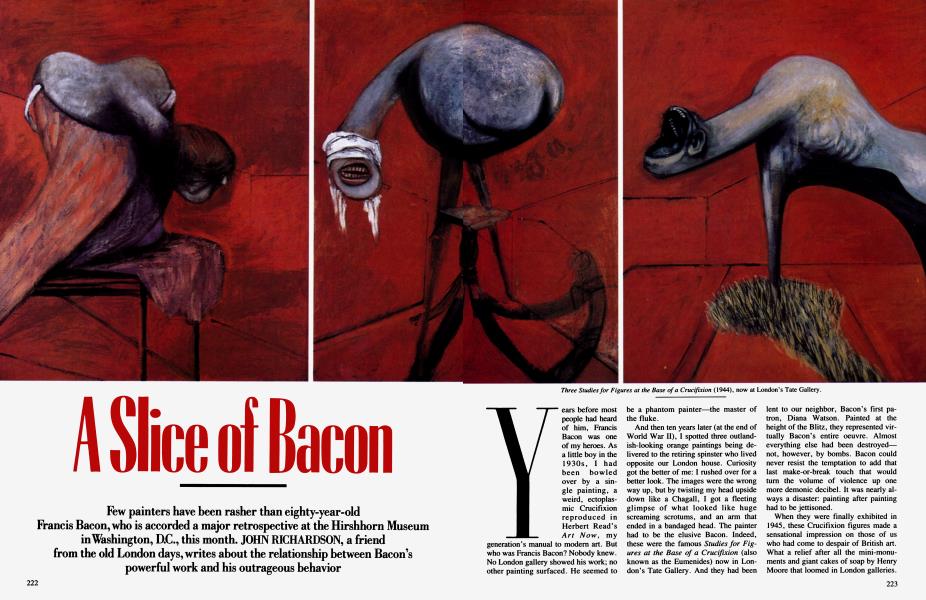
Years before most people had heard of him, Francis Bacon was one of my heroes. As a little boy in the 1930s, I had been bowled over by a single painting, a weird, ectoplasmic Crucifixion reproduced in Herbert Read's Art Now, my generation's manual to modem art. But who was Francis Bacon? Nobody knew. No London gallery showed his work; no other painting surfaced. He seemed to be a phantom painter—the master of the fluke.
And then ten years later (at the end of World War II), I spotted three outlandish-looking orange paintings being delivered to the retiring spinster who lived opposite our London house. Curiosity got the better of me: I rushed over for a better look. The images were the wrong way up, but by twisting my head upside down like a Chagall, I got a fleeting glimpse of what looked like huge screaming scrotums, and an arm that ended in a bandaged head. The painter had to be the elusive Bacon. Indeed, these were the famous Studies for Figures at the Base of a Crucifixion (also known as the Eumenides) now in London's Tate Gallery. And they had been lent to our neighbor, Bacon's first patron, Diana Watson. Painted at the height of the Blitz, they represented virtually Bacon's entire oeuvre. Almost everything else had been destroyed— not, however, by bombs. Bacon could never resist the temptation to add that last make-or-break touch that would turn the volume of violence up one more demonic decibel. It was nearly always a disaster: painting after painting had to be jettisoned.
When they were finally exhibited in 1945, these Crucifixion figures made a sensational impression on those of us who had come to despair of British art. What a relief after all the mini-monuments and giant cakes of soap by Henry Moore that loomed in London galleries. At last a flash of hope. Bacon looked like being our most imaginative manipulator of paint since Turner. But public recognition was years away. At first the principal benefactor of Bacon's debut seemed to be Graham Sutherland, England's star painter of the postwar period. With a jump-start from this new arrival, Sutherland soon got his engine going again. Parodying Cezanne's complaint about Gauguin's exploitation of his "little sensation," Bacon (who often uses feminine instead of masculine pronouns) issued a mocking warning: "She's welcome to my petite sensation, but it just might do her in."
Francis was every bit as startling, perverse, and charismatic as I had been led to expect.
His muse's name is Chaos, and he requires a modicum of mess and moil in which to paint.
As a painter, but in no other respect, Bacon was a late starter. After his Irish horse trainer of a father caught him trying on his mother's underclothes at the age of sixteen, he ran away to Berlin and spent the next few years wallowing in the Sturm und Drang and kink of the city's gay life. Later he moved to Paris, where exposure to Picasso's biomorphic bathers inspired him to become a painter. Before he could realize his dream, he was obliged to work at a number of ignominious jobs: cook, stenographer, telephone operator (at London's stuffy Bath Club), and finally modernist-furniture designer. Although his chairs and desk in chrome and battleship gray had a certain grim chic (R. A. Butler, the Cabinet minister, commissioned Bacon to do his dining room), the artist dismisses these artifacts—in my view rightly—as "hideous." (Traces of his designing past are to be detected in the chrome podiums that rail off some of the figures in his triptychs.) It wasn't until war broke out and the army turned him down because of chronic asthma that Bacon became a full-time painter, occasionally subsidizing himself by gambling and stints as a croupier.
When I finally met Francis, in the late 1940s, he was every bit as startling, perverse, and charismatic as I had been led to expect. I was less ready for his High Camp authoritativeness. He turned out to be one of the most articulate and disconcerting analysts of art I had ever encountered. And drunk or sober, he was very funny. (At a luncheon in New York, I told him that a fellow guest was Jackson Pollock's nephew. Loud and clear came his reply: "You mean the niece of the old lacemaker?") In his poor days Francis lived in a huge billiard room in a bombed house opposite South Kensington Station that was far grander than the cruddy studio he has now that he's rich. Sir John Millais, the celebrated academician, had formerly lived there, and the place still had a fustian Edwardian grandeur leavened with a touch of Baconian raunch. Paintings, I seem to remember, were conspicuous by their absence. Something shadowy in a dark comer turned out to be Francis's blind old nanny, who knitted away, oblivious to her wild charge's ferocious battles with his work and no less ferocious battles with the rough trade that came and went but sometimes stayed for years on end.
I'll never forget a party in this huge, dim, ominous room to celebrate the marriage of two English painters, Anne Dunn and Michael Wishart. Francis, whose muse's name is Chaos, still requires a modicum of mess and moil in which to paint, and this party generated more than the usual degree of it. In memory the festivities went on for days. As alcohol and heaven knows what other stimulants took hold, those of the guests who had "sat" for Francis seemed transformed into their portraits. Features would implode and squash into one another as if subjected to an excess of gravitational pull. "She's going to rupture with rapture," someone said of a Soho crony whom Bacon had set spinning in one of his canvases, like a child's top inside a satin dress.
To my mind, these early portraits of Bacon's are his most miraculous feats of painting—miraculous in that pigment has been transmogrified into some of the most palpable flesh in modem art. Miraculous too in that the execution seems so fresh and casual, although its freshness is usually the consequence of countless attempts to achieve perfection with the first strokes of his brush—just as the English dandy Beau Brummell would toss aside dozens of cravats before tying one with the requisite casualness. To save canvas after canvas from destruction, Bacon sometimes rehearsed these effects on his own perennially boyish face. Great swooshes of Max Factor pancake would be smeared onto a few days' growth of stubble. This duplicated the effect of a paint-clogged brush dragged across the unprimed nap of a canvas—the surface Bacon always preferred to work on.
In his later years Bacon has given up painting screams and death rattles, but he still knows how to probe our nervous systems with a loaded brush, still knows how to hurl a handful of paint onto canvas with sensational ejaculatory effect. If anything, he has become a little too adept. One is no longer conscious of the gambler staking his fortune on zero, or the flying trapezist risking his life on a flick of his wrist, a twirl of his torso. At the age of eighty, however, Bacon still prefers to live dangerously. One evening a few weeks ago, he drank even more than his huge habitual ration of champagne, stumbled, fell, and gashed his head. After spending the night unconscious in a pool of blood, he was found and taken to a hospital. Stitches were out of the question. A day or two later he was back at his Soho haunts. Back, above all, at his easel.
Subscribers have complete access to the archive.
Sign In Not a Subscriber?Join Now


