Sign In to Your Account
Subscribers have complete access to the archive.
Sign In Not a Subscriber?Join NowLONE STAR ARISTOCRATS
JOHN DAVIDSON
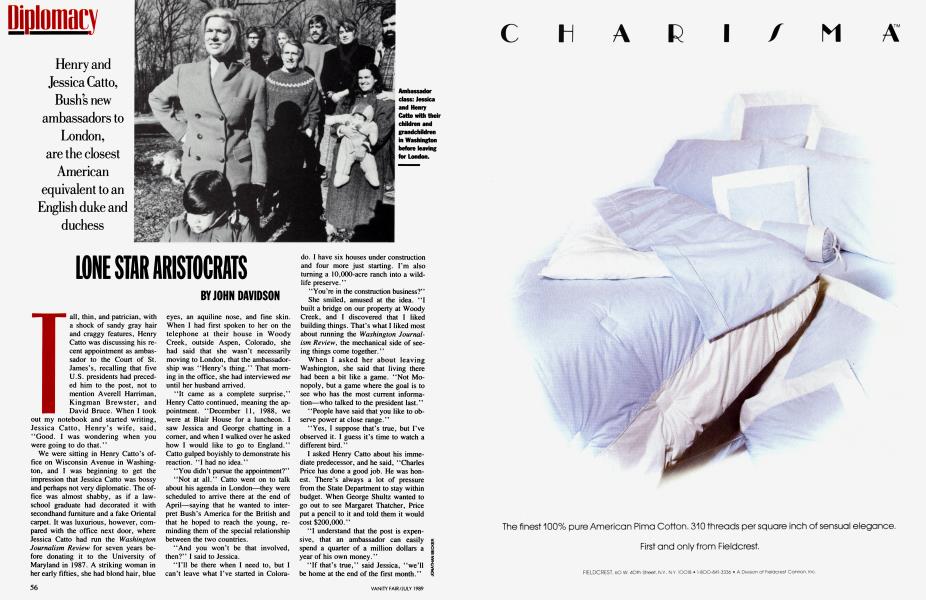
Henry and Jessica Catto, Bush's new ambassadors to London, are the closest American equivalent to an English duke and duchess
Diplomacy
Tall, thin, and patrician, with a shock of sandy gray hair and craggy features, Henry Catto was discussing his recent appointment as ambassador to the Court of St. James's, recalling that five U.S. presidents had preceded him to the post, not to mention Averell Harriman, Kingman Brewster, and David Bruce. When I took out my notebook and started writing, Jessica Catto, Henry's wife, said, "Good. I was wondering when you were going to do that."
We were sitting in Henry Catto's office on Wisconsin Avenue in Washington, and I was beginning to get the impression that Jessica Catto was bossy and perhaps not very diplomatic. The office was almost shabby, as if a lawschool graduate had decorated it with secondhand furniture and a fake Oriental carpet. It was luxurious, however, compared with the office next door, where Jessica Catto had run the Washington Journalism Review for seven years before donating it to the University of Maryland in 1987. A striking woman in her early fifties, she had blond hair, blue eyes, an aquiline nose, and fine skin. When I had first spoken to her on the telephone at their house in Woody Creek, outside Aspen, Colorado, she had said that she wasn't necessarily moving to London, that the ambassadorship was "Henry's thing." That morning in the office, she had interviewed me until her husband arrived.
"It came as a complete surprise," Henry Catto continued, meaning the appointment. "December 11, 1988, we were at Blair House for a luncheon. I saw Jessica and George chatting in a comer, and when I walked over he asked how I would like to go to England." Catto gulped boyishly to demonstrate his reaction. "I had no idea."
"You didn't pursue the appointment?"
"Not at all." Catto went on to talk about his agenda in London—they were scheduled to arrive there at the end of April—saying that he wanted to interpret Bush's America for the British and that he hoped to reach the young, reminding them of the special relationship between the two countries.
"And you won't be that involved, then?" I said to Jessica.
"I'll be there when I need to, but I can't leave what I've started in Colorado. I have six houses under construction and four more just starting. I'm also turning a 10,000-acre ranch into a wildlife preserve."
"You're in the construction business?"
She smiled, amused at the idea. "I built a bridge on our property at Woody Creek, and I discovered that I liked building things. That's what I liked most about running the Washington Journalism Review, the mechanical side of seeing things come together. ' '
When I asked her about leaving Washington, she said that living there had been a bit like a game. "Not Monopoly, but a game where the goal is to see who has the most current information—who talked to the president last."
"People have said that you like to observe power at close range."
"Yes, I suppose that's true, but I've observed it. I guess it's time to watch a different bird."
I asked Henry Catto about his immediate predecessor, and he said, "Charles Price has done a good job. He was honest. There's always a lot of pressure from the State Department to stay within budget. When George Shultz wanted to go out to see Margaret Thatcher, Price put a pencil to it and told them it would cost $200,000."
"I understand that the post is expensive, that an ambassador can easily spend a quarter of a million dollars a year of his own money. "
"If that's true," said Jessica, "we'll be home at the end of the first month."
'Iabsolutely loathe the expression 'American aristocrat,' but that's what the Cattos are," said Susan Mary Alsop in her charming aristocratic voice. We were sitting in her Georgetown drawing room, where she had identified the child in the John Singer Sargent above the mantel as her father, who had been the ambassador to Argentina. Her great-great-grandfather John Jay was the first chief justice of the United States. A noted author herself, she had been married to the columnist Joseph Alsop. Seventy-one years old, tall, and stick-thin, she was wearing a short skirt and brown boots, and she was a lot of fun. "Myself, I'm a wino," she had said when she asked what I would drink. "You know, you must use what Kay Evans told you about Jessica: 'barefoot contessa.' That's good. Today at lunch, Kay and I went to the mat with Jessica and convinced her that she had to stop giving the impression that she wasn't going to London. Of course she'll go. She's very proud of Henry, and the English will love her. She's a great equestrian, you know, and she's the closest thing we have to an English duchess."
Earlier in the day, Mrs. Alsop had lunched with Jessica Catto, Kay Evans, Susan Brinkley, and Irena Kirkland— the regular group. Kay Evans was the editor of the Washington Journalism Review while Jessica was its owner and publisher. In an interview that morning, she had told me that she and her husband, Rowland Evans, the syndicated columnist, met Jessica and Henry at a party given for the Cattos by George Bush when he was a congressman. The Evanses belong to the Woody Creek Poker Club, which is made up of the Cattos, David and Susan Brinkley, and Lane and Irena Kirkland. The Cattos are what Susan Mary Alsop calls "permanent people." Their friendships cross party lines and include people as diverse as Caspar Weinberger and Lane Kirkland, who is president of the A.F.L.-C.I.O.
When Kay Evans went to work for the Washington Journalism Review, it was published sporadically out of a mouseinfested apartment above a shop on M Street. Her desk was the kitchen table. A freelance writer who was doing stories for the journal at the time recalled that there was an air of "let's be journalists, of women—social friends—who wanted to get back into doing something. You got a distinct feeling of noblesse oblige from the Cattos, but it was well-done noblesse oblige, and W.J.R. would do hard stories."
Jessica and Kay Evans put the journal out regularly ten times a year and established the Best in the Business Awards, which brought prestige if not profits to the publication. In the office, Kay had the reputation of being tense, a stickler for rules, whereas on pretty days Jessica would walk down the hall announcing that the staff had to go outside and enjoy themselves.
"My opponent had been indicted twice for murder," said Henry Catto, "but such was my charm that I lost the election."
Kay Evans told me that when she was recently asked by an English journalist if Jessica Catto was a social climber, she replied that if Jessica was climbing, she was climbing down. She mentioned the time Jessica asked David Kidd, the art director of W.J.R., to drive her to a lunch in Georgetown to welcome Nancy Reagan to Washington. Kidd assumed they would go in Jessica's car, but she insisted that they take his. Stretch limousines lined the block as Jessica Catto arrived in a 1968 Valiant with a white roof, a blue body, one red fender, and one yellow and three black wheels. According to Carol Moses, a neighbor in McLean, Virginia, Jessica's idea of doing her hair for a party is to wash it, then hang her head out the window of the car to let it dry on the drive over.
In Texas, some of Jessica's friends say that "she protests too much," that her quirkiness isn't entirely sincere. But in Washington it is admired, and people consider her democratic, with a small d, a champion of the underdog and a pushover for a hard-luck story. When David Kidd married, she had the wedding at her house, and at parties there her Salvadoran housekeeper's three children wander in and out freely. They live in the Catto children's old bedrooms.
If anyone can interpret—or, rather, embody—Bush's America for the British, it is Henry Catto. And if any couple epitomizes the rise of the Republican Party in Texas, it is Henry and Jessica Catto.
Henry Catto grew up in a small, old part of San Antonio where everyone knew one another. As Stevie Tucker, Jessica's best friend there, said recently,
"It isn't that we aren't interested in new people. You just don't meet people you don't know." Henry Catto's father and uncle moved there from Dallas in the 1930s. His uncle married Roxanna Gage, whose family owns the Gage Ranch in West Texas, and the two brothers started an insurance company, Catto & Catto. Henry attended the Texas Military Institute in San Antonio, then Williams College in Massachusetts. After graduating, he returned to San Antonio, joined the family business, and got involved in civic affairs. One of the organizations that interested him most was the Order of the Alamo, a social club that presented girls to San Antonio society each spring. The presentation was staged as a royal court, with a queen, prime minister, prince, and so forth. In 1957, Jessica Hobby was invited to be a "visiting duchess" from Houston. Her escort, Robert Tobin, was an old family friend of hers as well as of Henry Catto's. Tobin, an art collector and philanthropist, recalls that on the night of the coronation he was stricken with appendicitis and turned a "distinct chartreuse green." He asked Henry to take over as Jessica's escort, an act which he refers to as his "only effort at playing Cupid." According to Jessica, her father, Will Hobby, "practically proposed" to Henry a year later, and according to Henry's friends in San Antonio, his marriage into one of the most powerful families in Texas opened up a whole new realm of possibilities for him.
Will Hobby, a newspaperman from East Texas, had been elected governor of the state in 1918, and in 1931, whfcn he was fifty-two and president of The Houston Post, he married Oveta Culp, a state legislator's daughter, who was twenty-six. The Hobbys later bought the Post, as well as a Houston radio station, and made a great financial success of them. They had two children, William (Bill Hobby, who has been the lieutenant governor of Texas since 1973) and Jessica.
Oveta Culp Hobby was a small, rather beautiful woman with blue eyes and blond hair. During World War II, she went to Washington to run the Women's Army Corps. After the war, she and her husband bought a twenty-seven-room mansion in Shady Side, Houston's most exclusive neighborhood, and in 1950 she persuaded her husband to buy KPRC, Houston's first television station. She was instrumental in helping the Republicans carry Texas for Eisenhower, who appointed her the first secretary of health, education, and welfare. When her photograph appeared on the cover of Time in 1953, she was considered one of the most powerful women in the United States.
"This is the best appointment since David Bruce, the most admired ambassador since World War II," said Susan MaryAlsop.
"Oveta was simply gone when Jessica was growing up," said Stevie Tucker. "She was raised by nannies and the governor, who was more of a grandfather and whom the children called Nini. Jessica adored her father, but she didn't have what you would call a standard motherly influence. I always think of her as a girl running barefoot down marble halls. You know the joke about 'Your mother wears combat boots'? Well, Jessica always says, 'My mother did wear combat boots.' "
When Jessica married Henry Catto, they settled in San Antonio and had four children. In 1960, Henry entered politics. "When I called my father and told him that Henry was running for the state legislature," Jessica recalled, "he said how proud he was. But when I told him that Henry was running as a Republican, there was dead silence at his end of the line. Then he said, 'I always thought you had married a sensible man.' "
At that time, the Republican Party was virtually nonexistent in Texas, so small that it held its state convention in Brownsville without taxing the available hotel space. Henry Catto's opponent was Red Berry, a colorful San Antonio character who ran a large and completely illegal gambling house on the edge of town. The only plank in his platform was a promise to "bring back the ponies," meaning pari-mutuel horse racing, and he dubbed Henry, who came across as young and stuffy, "Fat Cat Catto." Berry told the press, "We don't ever send anyone but crooks to the state legislature. I'm just one who admits it."
"My opponent had been indicted twice for murder," said Henry Catto, "but such was my charm that I lost the election." He did, however, win 42 percent of the vote—unprecedented for a Republican—and that is said to have galvanized the party in Texas. He ran again unsuccessfully for the state senate in a 1961 special election, then worked on John Tower's winning campaign for the U.S. Senate. In 1962, Catto said, he was considering running for county chairman of the Republican Party when he heard of "an attractive man named George Bush who was doing the same thing in Houston." He called Bush up, and that was the beginning of their friendship. The two men were alike in many ways. They were both young, handsome, and wealthy—essentially eastern in style and disposition. According to friends who grew up with Catto in San Antonio, he was shaped more by Williams College and by his family than by Texas. His grandfather in Dallas retained his British citizenship to the end of his life, and was an adviser to Churchill during the war. Like Bush, Henry Catto did not have an agenda so much as a desire to be there.
Two small worlds in Texas—the world of the very rich and the world of aspiring Republicans—had suddenly overlapped. Henry Catto did not run for elective office again, but chose to work in the background of the Republican Party, which was actually more in keeping with the Hobby style of wielding power. According to Texas Monthly, in 1978 Oveta Culp Hobby was regarded in Houston "much like an English regent," and her son, Bill, as state lieutenant governor, was said to have "exercised power quietly, almost invisibly— a style patterned after his mother's."
Henry Catto, however, didn't find his ultimate direction in public life until. 1967, when President Johnson asked Jessica to manage the Latin-American ambassadors' visit to HemisFair in San Antonio. Johnson had known Jessica's father, who had died in 1964, and was a friend of Oveta Culp Hobby's. According to friends, it was during the LatinAmerican ambassadors' visit that Henry Catto decided what he wanted to do in life and decided, too, that the Court of St. James's was his ultimate goal.
A self-disciplined man who memorizes a poem a week and who, like Bush, is known for always writing thank-you notes, Henry Catto started teaching himself Spanish. He served as the national finance director for Nixon's 1968 presidential campaign, and in 1969 he was made deputy U.S. representative to the Organization of American States. In 1971, Nixon appointed him ambassador to El Salvador, where he served for two years, and when he returned, it was to Washington rather than to San Antonio. The Cattos bought a graceful threestory house above the Potomac in McLean, and Henry became the chief of protocol under Gerald Ford. One of his duties was to stand behind the president at state functions and tell him who it was he was about to greet; Catto prepared by keeping photographs of the foreign dignitaries taped to his dressing-room mirror.
During the Ford administration, Catto made his only bid for the ambassadorship to the Court of St. James's by asking influential friends to call the White House and recommend him. When Anne Armstrong, the wife of South Texas rancher Tobin Armstrong, Robert Tobin's cousin, called to retail Catto's virtues, it occurred to whomever she was speaking with that she should get the job for which she was recommending her friend. And she did. Henry Catto says that he has heard the story, but that he's not sure it's true.
Although Catto did not get the Court of St. James's, he was appointed ambassador to the United Nations in Geneva and later served as spokesman for the Department of Defense under Reagan. Between diplomatic posts, he has been involved with H&C Communications (H&C standing for Hobby and Catto), which in 1983—in what appears to have been an act of prescience, considering the downturn of the Houston economy— sold The Houston Post for $100 million and acquired two more television stations, bringing the total to six. In 1987, Forbes estimated the family fortune at $800 million, but, despite its size, H&C Communications remains something of a mystery to financial analysts; no one is sure who calls the shots. According to Jessica, Oveta Culp Hobby, now eightyfour and living quietly in Houston, "has gone in,'' a southern expression meaning that she has withdrawn from all public life.
Jessica Catto laughed when she told me that a former resident of Winfield House, the ambassadorial residence in London, had given her a list of things she should be prepared to provide herself, and that one item on the list was twenty-four silver candelabra. From other sources I learned that the Cattos had asked Ralph Lauren to help them decorate Winfield House.
"Henry is so modest," Susan Mary Alsop told me. "I'm sure he hasn't told you how well prepared he is for this post. He knows his way around the State Department, and that's very important. This is the best appointment since David Bruce, who was perhaps the most admired American ambassador since World War II.
"In the last few years, we've sent these businessmen out there absolutely green. Annenberg was a joke. At his first presentation to the queen, she asked how he felt about Winfield House. He said it needed a great deal of refurbishment. Refurbishment! The English press really jumped on that. But the Annenbergs were very generous. They spent a great deal of money, and in the end the English were fond of them.
"No, the Cattos will fit right in>. I can't think of another couple who will be more easily accepted."
Subscribers have complete access to the archive.
Sign In Not a Subscriber?Join Now


