





Sign In to Your Account
Subscribers have complete access to the archive.
Sign In Not a Subscriber?Join NowPolke's Progress
Finally the contemporary German master Sigmar Polke is getting a U.S. retrospective. The eccentric and brilliant painter has always shunned the Sturm und Drang of the art world—he's never even had a dealer—but here he grants a rare audience to GABRIELLA DE FERRARI at his Cologne studio
Americans have always responded slowly to contemporary European artists, but in Sigmar Polke's case the delay is partially his own doing: he is notoriously elusive and evasive, even compared with other elusive and evasive artists, such as Polke's fellow German Anselm Kiefer and the priestly American Jasper Johns. Polke's cryptic art is as complicated as his own carefully calculated persona; for instance, he enjoys recounting how he was once introduced at a museum gathering as Paul Klee. Polke might simply be amused by the similarity in the sound of his and the Swiss artist's names, but the story could also be Polke's oblique way of telling us that he agrees with those who say that he and Klee share a sensibility and historical position. How Polke wants the vignette to be interpreted is left up for grabs. The same can be said of his enigmatic canvases. As Michael Brenson, art critic for The New York Times, recently said, "In the work of Sigmar Polke, there is a touch of a mad scientist, a touch of a malignant god, a touch of the Wizard of Oz, and a touch of a monk in prayer. No postwar work has a laugh that is more derisive and reassuring."
Polke's iconoclastic art, first exhibited in 1963, has long been recognized by the international art community as one of the most influential bodies of work extant. Important and widely discussed Polke exhibitions have been seen in Europe, but his first American museum show is only now opening at the San Francisco Museum of Modem Art. The retrospective, organized by curator John Caldwell, will travel to New York, Chicago, and Washington. Although New York's Museum of Modem Art wanted to mount the show, Polke, in a typically individualistic move, chose instead to give it to the Brooklyn Museum.
Polke lives in Cologne, as bleak a city as can be found in the Federal Republic, a sort of 1950s city planner's nightmare. Perhaps because of a need to compensate for its ugliness, perhaps because of its liberal pre-war traditions, the city has become one of the most important centers for contemporary art in Europe. Here, art, the life of art, and the gossip of art are the stuff of daily life. There are more galleries per square foot than in any other city in the world.
When Polke emerged in the sixties, he was part of a band of young German painters (many of whom were disciples of Joseph Beuys's) that included the now successful Kiefer, Georg Baselitz, Jorg Immendorf, Markus Liipertz, A. R. Penck, and Gerhard Richter. Friendships among artists in Cologne are legendary for the intensity with which they are made and broken; Polke and Richter were once so close that they collaborated on exhibitions and posed for a photograph in bed together. Now they do not speak to each other, and the reason for the falling-out has been the subject of much speculation.
Polke was very much a part of the scene during the 1960s, around the same time that art dealer Michael Werner (who later married and has since separated from Mary Boone) was bringing world attention to postwar German art. Polke's career developed in the petri dish of the Cologne scene, but despite Werner's efforts the artist would never join his close-knit stable, which then, as now, included Baselitz, Liipertz, Penck, and Immendorf. (Among Werner's artists there is an unspoken but widely acknowledged hierarchy that this list reflects. For Polke it must have been unimaginable to be a part of any group or on any list.)
(Continued on page 250)
(Continued from page 186)
As he became more established, Polke distanced himself from other artists and the art crowd in general. Today, when in Cologne, he surrounds himself with a small circle of friends—people outside of the circuit, with whom he likes to play and drink—and family. When not in town, he is teaching in Hamburg or "disappearing" in the Far East.
Unlike nearly every painter of his stature, Polke has never had a primary dealer; he chooses to make his work available by rules all his own, often relying on the advice of his agent and confidante, Helen van der Meij, an eminence grise of the European contemporary-art world. Collecting Polke's work requires a great deal of ingenuity; when Dr. Reiner Speck shows off his vast collection (which includes not only contemporary art but also the largest holdings of Proust memorabilia in Germany), he stops with particular pride to point out the Polke he acquired serendipitously. After other channels proved futile, he bicycled past Polke's studio on the off chance that he might gain entry and talk Polke into parting with one of his works. None of the artist's business eccentricities have gotten in the way of commercial success, however; his canvases sell for well into the six figures, and one of his major works, Paganini, formerly owned by the Saatchi Collection, is reputed to have changed hands recently for more than a million dollars.
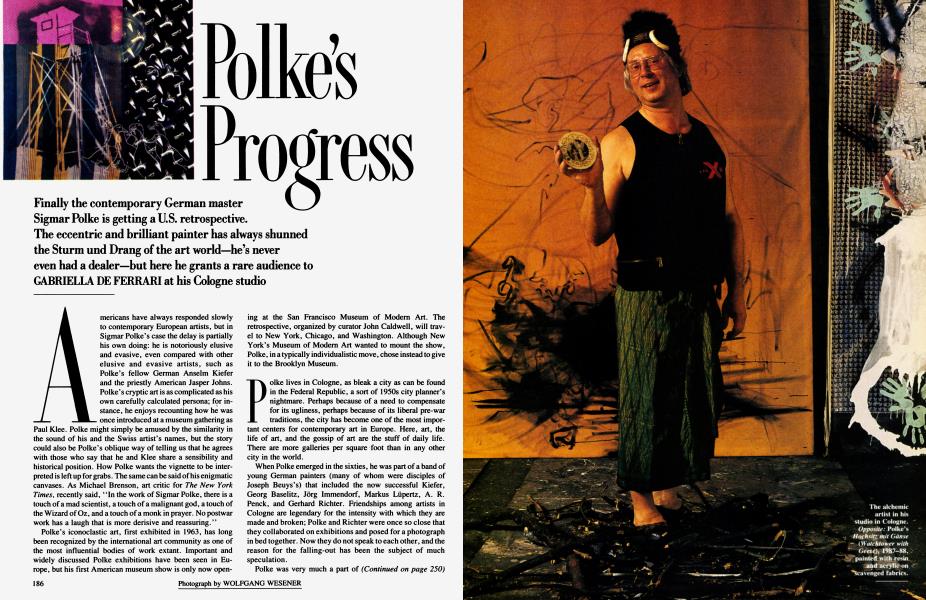
When dressed in a white linen suit, as he is when we meet for dinner, Sigmar Polke resembles a German bourgeois on his night out. In his studio, though, he seems far more comfortable dressed in a black sleeveless T-shirt and a black-andwhite patterned cloth wrapped sarongstyle around his waist, in the manner of the natives of Bali, where he has spent much time. Polke works in a spacious, slightly dilapidated stable in what must once have been the countryside near Cologne. As the growing city encompassed the stable, it came to house a variety of new tenants: a furniture manufacturer, a coal distributor, and a large immigrant family from Yugoslavia. Polke's studio is made up of three large, unconnected rooms; the one he uses most frequently is filled with a jumble of objects and works in progress.
Polke, who, unusually for this day and age, works without assistants, is a connoisseur of his own chaos. He stops to scrutinize the materials at hand: a pile of stretchers covered with inexpensive tablecloths made for the Turkish community in Germany; chemicals such as silver nitrate and a variety of lacquers which he often uses instead of traditional paints; a light table covered with boxes of slides that he himself has taken. He holds up a slide of a hunting tower, an image he has used many times for its double meaning (the tower can be read as a concentration-camp lookout or as a simple hunting tower used on weekends), and begins to manipulate other slides on the light table. The sublime is juxtaposed with the ridiculous: a detail of a Diirer next to an advertisement for "bi-elastic" rubber hose (Polke makes the obvious sexual association). Later, he projects the slides onto immense canvases and paints the outlines of images using the projections as his guide.
Downstairs in a large, almost empty studio, Polke works on his "transparencies," pieces where the artist applies layers of paint, lacquer, and unexpected chemicals to translucent polyester stretched across a frame. To some of these seductive works he has given a stainedglass quality ("I was trained to work in stained glass," he says revealingly), while others resemble alabaster—"like good, old honey." The process of drying and adjusting to the humidity and temperature makes the works ever changing. "My breath makes the color, my perspiration changes the painting," Polke says.
In the midst of the confusion and the rawness of the studio stands an object of incredible delicacy. On an elegant, old wooden easel, a white canvas is covered with translucent, earth-colored abstractions. A string is tied around the canvas, transforming it into an exquisite package. Polke explains that it was sent blank by his favorite aunt as an invitation to paint a self-portrait. He has transformed this gift into what he calls Ein Pdckchen von Driiben (A Package from Over There), an ironic reference to the care packages that affluent West Germans used to send to East Germany.
Polke himself came from what was to become East Germany, where he was bom in 1941 into a large family. When he was twelve, they moved to West Berlin and then to Diisseldorf, where he studied at the Academy of Art. In the early days of his career, he lived in extreme poverty and supported his wife and two children by working as a craftsman, including restoring the stained-glass windows of the Cologne Cathedral. (He and his wife are now separated.) Michael Werner recalls going to Polke's house to buy work and having to haul the paintings out from under the bed. In spite of his dire circumstances, Polke was stubborn: he tried to insist that his paintings be shown without stretchers, over Werner's protests that they would be unsalable. Werner won, and Polke, he says, wouldn't speak to him for several years afterward.
From the outset, Polke used a variety of styles simultaneously in order to destroy the "myth" of a personal style. Indeed, it is often difficult to identify a painting as his. In 1963, Polke, together with Richter and Konrad Fischer (an artist who went on to become a well-known dealer), held a now legendary exhibition in a furniture store in Diisseldorf. Called "A Demonstration for Capitalist Realism," the show consisted of works that responded to American Pop art, which at that time was better understood and more widely collected in Germany than in the United States.
However, Polke's objectives were the antithesis of Pop. While American Pop artists used images of consumer goods— Coke bottles, Brillo boxes—in their work and turned them into cultural icons, Polke incorporated images of those consumer goods with the flotsam of a war-tom and newly materialistic Europe. For the Pop artists, the objects became symbols; for Polke, they were simply used in what Sanford Schwartz calls Polke's "melancholy and nasty meditation on life."
Though Polke continues to use the deliberately trite images of his early paintings, his more recent work combines abstraction with references to the German Romanticism of the nineteenth century. The paintings he exhibited at the 1986 Venice Biennale (where he won the Golden Lion award) are some of his most extraordinary, imbued with hints of the mysteries of German history and myth.
After a long day of clowning for the camera in a myriad of outfits, Polke the actor turns serious. He is slightly apprehensive on the eve of his American retrospective. In front of the Cologne Cathedral, sipping his beer, the artist who earlier on had claimed not to be interested in the critical reception of his work admits to being especially "concerned that a lack of understanding might lead to a critically superficial comparison to some of my American contemporaries." (David Salle is only one of several American artists who owe a debt to Polke.) But even if Americans are late in giving Polke his due, those in the know have long been in agreement with the critic Ingrid Sischy: "Polke was always the most chimeric one. He wasn't going to let the Americans eat him up, pin him down, or wear his work thin. His art is as untamable as he is. He uses materials as if he's mixing up a potion, not just paint and photography, but matches and alchemy, and his spell still holds in the nineties."
Subscribers have complete access to the archive.
Sign In Not a Subscriber?Join Now


