

Sign In to Your Account
Subscribers have complete access to the archive.
Sign In Not a Subscriber?Join NowDEADLY CONNECTION
When an assistant D.A. was accused of accidentally exposing his informant, they both became victims
TRIP GABRIEL
justice
When Collier Vale didn't show up for work that morning, his boss phoned his home and got the machine. "Hey, Collier, if you're around, give me a call," he said. A moment later it dawned on Mike Bartram, the district attorney of Monterey County, California, that Vale would never just blow off work. He was the kind of prosecutor who called his boss at home on weekends with the smallest updates on cases. He would have phoned in if he were running late. It was only nine A.M., but Bartram had a black premonition.
He got Russ Dubree, his chief investigator, on the line and told him to go over and check out Vale's house. Dubree was in the middle of a meeting with a couple of lawyers, but he heard the little dagger of fear in the D.A.'s voice; he grabbed his coat and went at once, leaving behind the astonished attorneys.
As he drove over on that morning last October, Dubree thought about Collier Vale and the case of the two Sonya Johnsons. The two Sonya Johnsons! Why, it was like a plot device out of a movie, the kind of thing Hitchcock would have gone for, the setup for a lushly stylized thriller. It featured a gruesome case of mistaken identity and the drama of a man's psychological disintegration. Except that this wasn't out of a thriller. This one was for real.
More than a year earlier, two lowlifes had been shot to death in a drug dealers' feud over turf. A young woman named Sonjii Yvette Johnson had rolled over, telling the cops she had heard two acquaintances talking about the killings. A few days later, Vale, who was the deputy prosecutor assigned to the case, had called Sonjii (pronounced "Sonya") on the phone. Although a detective had dialed the number for him, it was Vale
who stumbled into the horribly improbable coincidence that had haunted him ever since:
"Is this Sonjii?" he asked.
The woman said it was.
Vale wanted to remind his witness that she could be in grave danger from the men she'd informed on. He asked her for the names of out-of-town family members she could be sent to for protection. The woman gave him several names and then said she had to step away from the phone to attend to her baby. It occurred to Vale that his witness didn't have any children. He must be talking to the wrong person, he realized, and hung up. "That's real weird," Vale said to the detective. "Two people with the same name in the same town." He thought no more about it.
But Songia Petite Johnson, the woman on the other end of the line, did. She had heard enough to figure out that Sonjii Yvette Johnson, who lived nearby and whom she knew slightly, was cooperating with the law. As she later admitted in court, she put the word on
the street that Sonjii Johnson was a snitch.
Collier Vale had inadvertently compromised the identity of his witness. Just two weeks later, on August 6, 1989, as Sonjii pulled into her driveway, a gunman in a hooded sweatshirt stepped from the shadows and fired six shots into her through the car window.
hen the full story came to light, the cold-blooded execution of the D.A.'s witness set off an uproar over Vale's conduct. He found himself trapped in a prosecutor's most dreaded nightmare: a woman he had helped to bring in from the cold, a skittish acquaintance of crack dealers who had put her trust in the legal system, had been let down by that system. Vale's office defended him, claiming that at least twice he had offered protection to Sonjii Johnson, and pointing out other ways her identity could have been compromised. But to the people of Monterey County, where the story became a screaming page-one scandal, and to local attorneys and politicians, it certainly seemed that a deputy D.A. had gotten a witness killed.
As an attorney for the people, Vale pledged to right the wrongs done to victims—and never to create additional victims or place witnesses in harm's way. As a prosecutor, he could compel hostile witnesses to face the court, where he posed the questions and controlled the thrust of testimony. Only by some perverse twist would a prosecutor find himself the accused, forced to submit to the hostile inquiry of others.
And yet this is what happened to Vale: his world was freakishly inverted. A witness had become a victim, and now an accuser became the accused. In the year after Sonjii Johnson's murder, Vale was alternately enraged, humiliated, plunged into despondency. Even when most of the official questions the case raised had been answered, he was unable to let it go. Anxiety washed over him in waves. It was not always visible to his friends and colleagues, however, because he was an intense, extremely proud man whose job demanded brute stamina.
The D.A.'s office is the emergency room of law. Young prosecutors typically work for three or four years, make their bones, and then get out, taking their trial experience to better-paying jobs in private firms. Of those who do stay, many bum out watching the constant parade of the guilty, the lying witnesses and defendants, society's layer of human sludge. Vale, who went to work for the Monterey D.A. in 1979, neither left nor burned out.
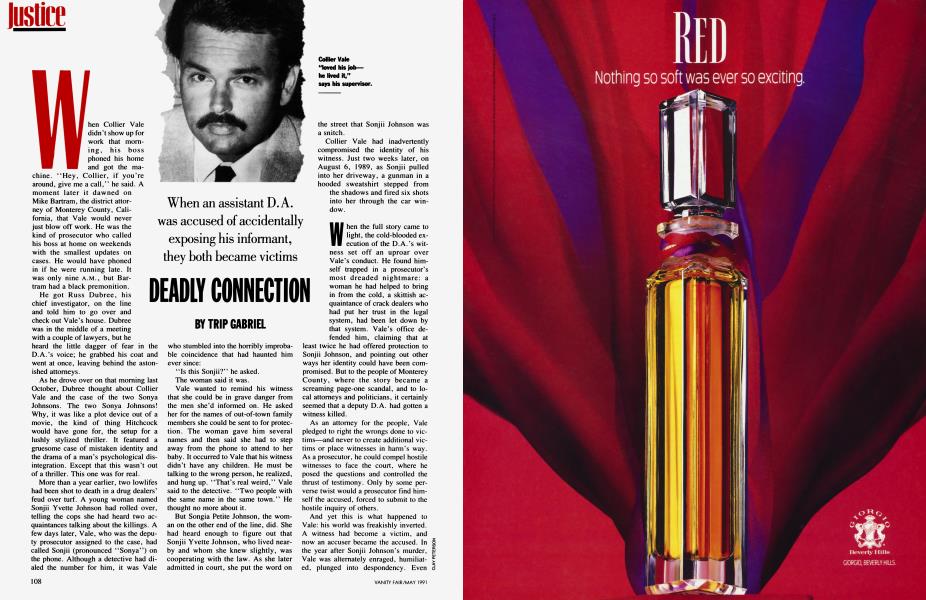
"He loved his job—he lived it,'' says Assistant D.A. Jon Yudin, his supervisor. Vale was enthralled by the trial process. He liked the gravity of what was at stake—years in the life of a defendant—and the competitive duel with the defense. He put in sixtyto eighty-hour weeks on the county's biggest homicide and corruption cases. He carried trial preparation to an extreme, typing out his voir dire questions to prospective jurors word for word, then doing the same for his opening and closing arguments. Maybe he was too hardworking: early in his career, a fellow deputy quit a car pool they shared, because of Vale's intensity. "I couldn't stand hearing about his case work every day," she says. "It was the most important thing in the world to him, and he'd replay it for hours on end."
Vale tried private practice briefly in 1986. Friends say the move was made under pressure from his wife at the time, who aspired to a finer life than was possible on a prosecutor's salary. She wanted to own a horse ranch in the Carmel Valley and urged Vale to go into debt to start moving up in the world. But Vale, the son of a janitor, was queasy about financial risk, and, more important, he was bored in private practice. After seven months he returned to the D.A.'s office, and a short while later the marriage ended bitterly.
Divorce cleaned Vale out financially. He asked his colleague Russ Dubree if he could move in temporarily, and he spent five months sleeping on Dubree's gym-room floor, using a rolled-up towel as a pillow. Vale had never associated with cops and investigators much, but Dubree was not your typical law officer. His talk was a combination of street tough and West Coast human-potential movement. He'd worked as an investigator for the Monterey D.A. for twentythree years, and he gave Vale the benefit of a blunt, unsentimental wisdom that recognized the vulnerabilities of people in jobs like theirs.
"This office is like a funeral parlor," Dubree would say. "There isn't any good news in here. We don't deal with good news. We deal with death and dying." Once, Dubree told Vale that each case took a little piece out of you as a human being. "When the day comes you can't regenerate that lost piece,
Vale's world was freakishly inverted. A witness had become a victim, and now an accuser became the accused.
when you can't pull yourself back up to come to work on Monday, that's the day the cop starts eating his gun."
Iooking back, Collier Vale's and Sonjii Johnson's paths seem almost destined to have crossed. She came to him from the place where he found most of his violent-crime cases, the town of Seaside, just out the back door but a world away from the resorty Monterey Peninsula. In contrast to upscale Monterey, with the emerald golf courses of Pebble Beach and the pristine village of Carmel, Seaside is a mixed black, Hispanic, and white working-class town with pockets of genuine ghetto, housing projects, and wannabee gangs. And, especially since the arrival of crack in the mid-eighties, the highest rate of violent crime in Monterey County. "Most of the peninsula, the majority of which is upper-middle-class and a lot of retireds, don't give a shit what goes on in Seaside," says an investigator who works there. Vale, who'd briefly and unhappily strived for a tonier life-style while he was married and in private practice, was aware of the indifference, if not contempt, with which affluent Monterey viewed his work. After one court victory, he told the local newspaper, "I have prosecuted rape and child molestation cases where the victim was physically and emotionally scarred forever, and the only people who cared were me and the police officers."
In the summer of 1988, a deadly feud erupted between rival crack dealers in Seaside. Within twelve months, five young black men were murdered, a startling statistic for a town of 26,000 people. They were hyperviolent, mindless killings, payback in a war over turf. The chief of police said all hell was breaking loose. The mayor cried that the town had become the O.K. Corral. Vale was assigned to make cases in the killings, but in July of 1989 he was still getting nowhere—wounded victims refused to cooperate, and eyewitnesses were too terrified to speak. Then Sonjii Johnson came forward and handed the Seaside police department its big break.
Johnson was a shy, pretty kindergarten aide who, at twenty-three, still lived with her parents. She did not smoke or drink and had been to her first movie, A Nightmare on Elm Street, only two years earlier. But lately her sheltered life had careened perilously out of control—she was sleeping with two men on opposite sides of the Seaside drug war.
On July 16, one of her boyfriends, Victor Austin, and another man had been shot to death in a wild car chase across town. Sonjii told the police she had later heard two men, Anthony Jacobs and Bradley Hardison, talking about the killings while she was spending the night with Hardison. Based on her account, police arrested Jacobs and began searching for Hardison, who was known on the streets as Shorty.
Hardison packed an AK-47 assault rifle in his car and carried a handgun. But after talking to the cops, Sonjii had no sense of the great danger she might be in. Collier Vale met with her the day she gave her statement and told her that she could go underground and become a protected witness. But it all sounded so complicated to Sonjii, who felt safe right at home, where she'd always lived. She didn't even mention the D.A.'s offer to her parents.
There was no way, of course, she could have known that Vale made the ill-fated follow-up call a couple of days later; he never got around to dialing the right number, and neither he nor the police thought to mention the mistaken call to her. And so, for two weeks, Sonjii went routinely about her business, making trips to the post office, to fast-food outlets on Fremont Boulevard, never suspecting that she was in mortal danger. She wasn't thinking her identity had been compromised when she and her brother Bobby left the house in a 1972 Thunderbird to run errands on the first Sunday in August. They stopped at two Laundromats, but Sonjii didn't go into either one. When Bobby asked why, she laughed and said she'd do the wash tomorrow. She was in a carefree mood.
She drove home, pulled into the driveway, and shut off the engine. Suddenly a man ran around from behind the car and fired at Sonjii, killing her instantly. Another bullet wounded Bobby in the hip. For a second his eyes locked on the gunman's. He saw that it was five-foot-four-inch Shorty Hardison.
At the time, it simply didn't occur to Collier Vale that he could be linked in any way to the murder of his witness. But six months later, in February 1990, when a D.A.'s investigator was interviewing Songia Petite Johnson on a separate matter, she blurted out that she had told "all my friends" that Sonjii Yvette Johnson was an informant.
Vale was taken aback. Mindful of the legal ethics involved, he wrote a report to be sent to lawyers for the defendants in the murder cases. He phoned one defense attorney, Thomas Worthington, to alert him to what was coming.
"What's wrong?" Worthington recalls asking, hearing the unhinged note in Vale's voice.
"Some reports are coming to you— they're accusing me of causing a witness's death as a result of a phone call I made."
Worthington thought it must be some kind of joke. He'd clashed often with Vale in court, but respected him highly as a professional. In fact, Vale was known especially for the empathy he showed witnesses and victims. He'd keep their snapshots on his desk for months to remind him that real fleshand-blood people were behind his cases. According to investigator Dubree, "He believed that to give the best representation of a case you had to become the family of the murdered victim, you had to become the rape victim. You had to put yourself into that and feel the loss and grief. ' '
It was the worst sort of irony that Vale was being accused of endangering a witness. But in a short time he'd be taken off the Seaside murder cases he'd worked on day and night for months. There was misery and a hint of fear in his voice.
"Collier, you're serious about this," Worthington said.
"Oh yeah. It's not pretty."
A few days later the story broke in the local paper, The Herald, and Vale was thrust into the eye of a tempest. In quiet Monterey County, it was the biggest crime story in years.
There was no evidence that the phone call had been anything more than a tragic accident, an error precipitating a ghastly, almost unbelievable chain of events. But the saturation coverage of Vale's "horrifying mistake," as one headline put it, left the impression that the D.A.'s office had committed an act of negligence. The family of Sonjii Johnson moved to sue the county for wrongful death. Defense attorneys for Hardison, who had been arrested, en-
tered a court motion to have the state attorney general take over the case from the D.A.'s office, a blow that humiliated Vale before his colleagues. Each development brought another front-page story. "It was unmerciful," says Jon Yudin, the assistant D.A. "It was day in and day out. It kept referring to his blunder, the blunder, the blunder. You can only take so much."
The case contained subtleties and ambiguities: Was the witness to blame for not accepting Vale's early offer of protection? And then, Vale himself hadn't actually placed the call—a cop had dialed the number and handed the phone to him. On top of that, Sonjii's statement to the police had been filed with the county clerk at least six days prior to her murder. Since it was a public record, that statement could have exposed Sonjii, assuming members of Seaside's crack community knew how to locate it. It was also possible that Sonjii herself had indiscreetly told friends she had gone to the cops. "Maybe I'm real naive," says Yudin, "but this phone call was a non-event. It had absolutely no significance."
Nonetheless, in newspaper accounts and in the public's mind, the ambiguities faded and the story acquired a reality all its own, larger and simpler than the facts. It was always the D.A.'s office that was to blame, never the police and never the victim. In the following months, as the story's repercussions spread, it was always Vale's reputation that took the biggest pounding. By May, at the height of a campaign to elect a new district attorney, Vale began hearing that the challenger, Dean Flippo, was promising voters, "When I am D.A., no one is going to get killed."
In June, Flippo won by a landslide. Vale briefly entertained the hope that the matter would now be allowed to drop. But opening the San Francisco Daily Journal, a legal newspaper, one morning in August, he saw a profile of Flippo that led with the tale of Sonjii Johnson's death. "That was the case that put me over the edge," Flippo was quoted as saying. "If I had thought the D.A.'s office was effectively representing the people, I would not have entered the race." Vale was whipped into a state of high anxiety. "He got everyone in the office to read it," says a colleague. "He was very worked up. He saw it as a personal attack."
Vale began to fret seriously about his future. He felt it was imperative that he talk to Flippo and make him see that Sonjii Johnson's death was not his fault. He called his soon-to-be new boss, but Flippo was out. Vale became increasingly frantic as the two traded messages for several days. When they finally connected, Vale urged Flippo to listen to his side of the story, including "things that have not been reported in the press." Flippo was not sympathetic. A former military prosecutor, he gave a strict, legalistic reply. He told Vale he was not a party to any of the cases before the court related to the matter, nor was he yet district attorney. "That being the case, I don't feel it's appropriate to talk about it at this time," he said, adding, "I'd be more than happy to hear you out when I come in January."
Vale now felt sure Flippo was hanging him out to dry. "He's going to fire me," he told Jon Yudin.
"He can't fire you," Yudin replied. "Shit, you're one of the top deputies in the office."
"Yeah, he might not fire me, but he'll move me into juvenile or consumer fraud"—jobs that would be a crushing comedown for a homicide prosecutor, meant to force his resignation.
To Vale's closest friends, he was a man with an outward toughness, a wisecracking machismo that comes from dealing regularly with felons, but he was also a man who, underneath, desperately craved approval. He thrived on the competitive clash of the courtroom—but afterward he never just walked away from it; he took the clashes personally. He felt small and belittled by the talk of Sonjii Johnson constantly floating through the courthouse. "So many people in the legal community battled so hard against him, he thought we didn't like him," says a defense attorney. "He thought we were holding him responsible for what happened. It wasn't correct, but I think that's the way he thought—that everybody out there was against him."
Especially since his divorce, Vale's job had been his entire identity and his life. His new girlfriend, Melinda Young, was a court reporter. When he thought of his future he had always pictured himself as a judge, the crowning glory of a career in public service. But now all his plans seemed to crumble around him. He despaired that the blot on his record would preclude an appointment to the bench. A return to private practice seemed equally impossible—Vale, his perceptions now becoming distorted under the pressure, convinced himself no local law firm would ever trust him. "He felt so helpless, so terribly vulnerable," Young would later tell the San Jose Mercury News.
His routine was the same as always, but something hidden inside Collier Vale broke. He would leave his ramshackle house, in an unfashionable neighborhood between Monterey and Seaside, to arrive by seven or so at the courthouse in Salinas, and enter his institutionally drab office, with its brown carpeting and gray metal desk. Above his doorway, a plastic sign read, FILING DEPUTY, his current job. Vale now had the administrative task of deciding which cases the D.A. would prosecute. He'd comb through mounds of police reports, everything from spitting on the sidewalk to murder, and appear in arraignment court at 1:30 each afternoon.
Waiting to enter court, he would still spend a customary few minutes chatting
"He thought we didn't like him," says an attorney. "He thought we were holding him responsible for what happened "
with Judge Wendy Duffy, but she noticed a changed in Vale. "We'd talk about what he was doing for the weekend," she remembers, "but he just didn't have the vitality he normally had." Around the courthouse Vale would run into Thomas Worthington, who found him distant and preoccupied, almost perversely obsessed with the Sonjii Johnson case. "His friends and adversaries were willing to let it go, but Collier didn't seem able to. Every time I saw him he would raise it again. It was eating away at him."
In late September the tabloid TV show A Current Affair aired a segment about the death of Sonjii Johnson. Vale was so anxious about the broadcast he asked Mike Bartram, the D.A., to come to his home to watch it with him. Despite pounding music and a histrionic tone, the segment, called "Sorry, Wrong Number," was a superficial treatment that did not come down hard on Vale. Afterward, he seemed relieved.
He knew, however, that there would be another round of publicity in the month of October, when the case against Hardison came to trial. Vale would likely be called as a witness, an odious prospect. And he was scheduled to face a hostile deposition in the Johnson family's negligence suit.
One day Russ Dubree dropped by Vale's office to find him staring vacantly out the window. "Collier, it's not as bad as you're making it out to be," Dubree insisted. "That phone call in and of itself didn't cause Sonjii Johnson's death. You were just doing your job." But Dubree could tell his words were hardly penetrating. Vale was still asking himself the same questions: Was there anything more he could have done? Was the death of the witness his fault after all? Was his career over? He did not feel guilt for what had happened to Sonjii Johnson as much as he pitied himself for the way events had been used against him. He was awash in despair, fear for his future, and a black anger. "Sometimes I feel like 1 want to put a gun in my mouth and blow my head off," he said.
Dubree took it for an off-the-wall crack. A few years earlier the two had worked a case in which they'd examined dozens of autopsy pictures, and the images had so repulsed Vale he'd made Dubree promise no coroner would ever get to cut him up. It had been a dark joke between them ever since. "Oh yeah?" Dubree said now. "That's the best way I know to get your autopsy."
The first Wednesday in October, Vale and Melinda Young dined out. Vale became severely agitated over the Sonjii Johnson matter; self-doubts were leading him into moments of the purest paranoia. The next day, October 4, he opened his datebook at the office and compiled a list. In a neat purple script, he listed ten "Options" for future employment, mainly with other California D.A.'s:
1.Santa Cruz
2.ACS
3.Local firms
4.U.S. atty.
5.Bakersfield
6.Ron's business
7.Stay
8.Pursue judgeship
9.Teach tennis
10.San Diego, Orange County, Santa Barbara
He went to lunch with some colleagues to celebrate a female prosecutor's victory in a tough rape case. Walking back to the courthouse, he waxed philosophical, telling Bartram, "Mike, you can't control the wind, but you can control the trim of the sail." That evening Vale packed his Toyota Tercel for a weekend trip he and Young were planning to Yosemite. He set the coffee-maker timer for early the next morning, then settled down with a glass of brandy.
Soon he had consumed four or five. From a drawer he removed the handgun he'd requested for protection when he began prosecuting the Seaside drug murders. He placed the holster on top of a bookcase and set down his drink. Sometime shortly after that, Collier Vale put the gun in his mouth and squeezed the trigger.
Russ Dubree pulled up to the house and saw Vale's Toyota parked out front. The drapes were drawn tightly all around. Like the district attorney before him, Dubree had an awful premonition. "I can feel it," he said aloud. "Somebody's just killed himself." He opened the front door and found the body lying face up on the living-room floor. Jesus Christ. He couldn't believe Vale had really done it.
He stumbled through the motions of an investigation. Vale's dog was nowhere to be found; he knew the careful, meticulous prosecutor would have taken care of the animal. He looked in the big garbage can to see if Vale had killed the dog first. (It was later found to be at Young's.)
Dubree was upset, but he was also angry at Vale. In the case where they'd looked at all the autopsy pictures together, there had been a suicide who had done it with a shotgun, and the victim was so disfigured they'd named him Gumbyhead. Now Vale was a Gumbyhead himself. Jesus H. Christ. How could he do it? If he had given any thought to the fact that one of his closest friends would probably find his body, Vale had left no signal.
There was no note, no will. Dubree knew of only one final wish of Vale's, a special consideration he might have expected as one of the guys inside the system. When the coroner arrived, Dubree took him aside. "I made a promise to Collier that I would do whatever I could to stop an autopsy," he said. "Sorry," the coroner told him, "there isn't anything I can do."
Dubree had known all along what the answer would be. In the end Vale's status as a prosecutor had not protected him from any of the horrors experienced by other victims. The streets of Seaside had claimed one more fatality.
"I know," said Dubree. "You're going to do whatever you're going to do." And he watched while the coroner collected the remains.
Subscribers have complete access to the archive.
Sign In Not a Subscriber?Join Now


