Sign In to Your Account
Subscribers have complete access to the archive.
Sign In Not a Subscriber?Join NowAnnie's EYE
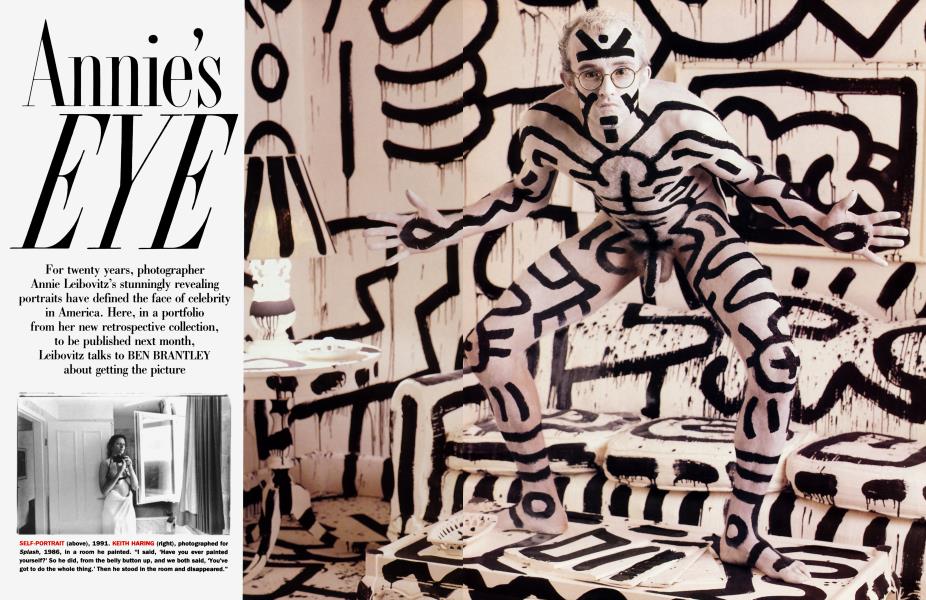
For twenty years, photographer Annie Leibovitz's stunningly revealing portraits have defined the face of celebrity in America. Here, in a portfolio from her new retrospective collection, to be published next month, Leibovitz talks to BEN BRANTLEY about getting the picture
BEN BRANTLEY
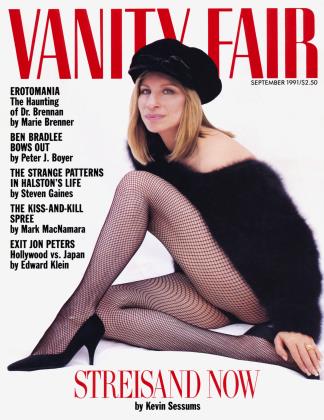
'I could not have taken those pictures if they weren't those people, if they didn't already understand themselves really well." Annie Leibovitz is thinking about two photographs, shot over a decade apart, which more than any others have fueled the legend that she can make a subject do absolutely anything: one, a 1981 cover of Rolling Stone, showed a naked John Lennon coiled fetuslike against the body of his wife, Yoko Ono; the other, on last month's cover of Vanity Fair, showed another nude, Demi Moore, cupping her breast and a stomach swollen with pregnancy. "What I asked John to do was not any different from what he was doing his whole life," says Leibovitz. "He was always in bed with Yoko Ono, he was always posing nude. As for Moore, "Im there, and she was so proud of the way she looked at this moment in her life, and definitely felt beautiful, more beautiful than she's ever felt. And I'm obliged to take the picture."
For more than twenty years, the most observed people in the world have stripped down and dressed up for Annie Leibovitz, somehow always baring souls, if not bodies, in the process. And Leibovitz has again and again been obliged to take the picture—the product, she insists, not of directorial Svengali-ism but of a conscious complicity between the portraitist and the sitter. The results of this dialogue are on display in the book Photographs: Annie Leibovitz 1970-1990 (HarperCollins), and the distance they cover is vast. We move from her earliest days as a photojoumalist who found the telling detail on the periphery of the main event, "photographing just what you see in front of you," to "the point where photographs can be produced almost as much as a small movie." Leibovitz herself sees a certain loss of innocence in this odyssey, but she continues to bring a veteran journalist's eye for the inside story to her work, and even her most stylized pictures—the ones that play most blatantly on a star's perceived image—suggest the face behind the mask and the unfathomable isolation imposed by celebrity. "I'm not a hundred percent comfortable with traditional glamour," she says. Accordingly, her work is seldom just glamorous; there's always a touch of grit amid the stardust.
"People always talk about the soul of.the sitter, but the photographer has a soul, too.
And I almost lost it."
Subscribers have complete access to the archive.
Sign In Not a Subscriber?Join Now


