







Sign In to Your Account
Subscribers have complete access to the archive.
Sign In Not a Subscriber?Join NowDON'T CRY FOR ME, INDONESIA
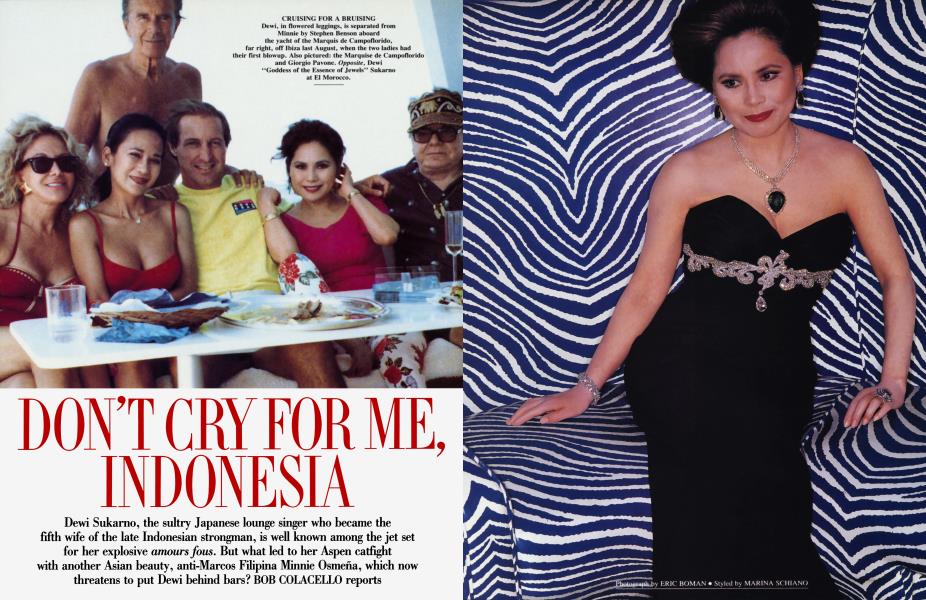
Dewi Sukarno, the sultry Japanese lounge singer who became the fifth wife of the late Indonesian strongman, is well known among the jet set for her explosiveamours fous.But what led to her Aspen catfight with another Asian beauty, anti-Marcos Filipina Minnie Osmeña, which now threatens to put Dewi behind bars? BOB COLACELLO reports
BOB COLACELLO
"She's a woman for men, repaid the Duke de Sabran. That's why, perhaps, she sees other women as competition."
It's not quite clear, from the press reports, who called whom a whore just seconds before a champagne glass held by Dewi Sukarno, a former First Lady of Indonesia, smashed into the face of Minnie Osmena, a granddaughter of a president of the Philippines, at a jetset party in Aspen last January. Nor is it clear in what language that and other alleged insults were hurled. A busboy who witnessed the bloody incident in the Primavera restaurant at the Aspen Club Lodge told police that Dewi Sukarno was "cursing in either Spanish or Italian." The Austrian host, Prince Heinrich HanauSchaumburg, was quoted as saying he thought the two women were "shouting at each other" in Tagalog, the native Philippine tongue. In her statement to the police, Dewi Sukarno insisted that Minnie Osmena had called her a whore, in plain English, but Minnie Osmena has denied this. Minnie "called Dewi 'a miniscule little snail from nowhere,' " the London Sunday Times reported. "Dewi snapped back, 'You are a geisha girl from a Japanese brothel.' "
Contrary to a number of reports, Barbra Streisand and George Hamilton were not at the party. Billionaire oilman David Koch, supermodel Elle Macpherson, Cornelia Guest, Joanna Carson, and Jane Holzer, with her son Rusty, were. Ivana Trump was on her way out when the ambulance arrived to take Minnie Osmena to the Aspen Valley Hospital. Cuts on her forehead, eyelid, and cheek required thirty-seven stitches.
After being questioned by the police in an office at the Aspen Club Lodge, Dewi Sukarno "made the spontaneous statement," as one cop's report put it, "that she should be able to go back to the party." Instead, Madame Sukarno, as she is called, was informed that she was under arrest for second-degree assault and was read her Miranda rights. Wearing a full-length sable coat and dangling diamond earrings, she was taken in a patrol car to the Pitkin County Jail, where she was fingerprinted, photographed, and given a voluntary breath test which showed she was not legally intoxicated. She was then released on $5,000 bail.
The ravishing beauty, who was once married to one of the most powerful dictators in Asia, now faces up to sixteen years in a Colorado state prison and a $500,000 fine, as well as a $10 million civil suit brought against her by Minnie Osmena. Madame Sukarno's lawyer, Barry Slotnick, whose clients have included John Gotti, General Manuel Noriega, and subway gunman Bernhard Goetz, has filed a countersuit "for more than $10 million," charging Osmena with "slander, assault, and outrageous conduct."
"She's trying to make it look like a catfight. It's not a catfight," says Minnie Osmena, whose sultry beauty matches Dewi Sukarno's. As Osmena told a Philippine newspaper, "It's an assault case. It is a crime. And it really irritates me that she wants to drag me down to her level. ' '
"It is a catfight," counters Madame Sukarno's longtime confidante and staunchest supporter, New York Post gossip columnist Cindy Adams. "We're talking two lionesses. Two gorgeous, Asian, social lionesses. Well, make that one lioness. And a tabby."
Though they have known each other for more than fifteen years, and have apartments in the same building in both New York and Paris, the two ladies now play down any friendship they may have had. "I've only seen this woman ten times in my life," Minnie Osmena, who is reportedly forty-three, told me. "She has never been of interest to me," Dewi Sukarno, reportedly fifty-two, told me. That is not what I heard from numerous American, European, and Asian social, political, and media sources. They chronicled a long mutual history which deteriorated from instant rapport to seething hostility, and which flared into a fiery verbal confrontation—over a third Asian political beauty, Imelda Marcos—on a yacht off Ibiza last summer.
Some say that Minnie Osmena had developed an apparent obsession with Dewi Sukarno and that she seemed particularly envious of her international fame. Others say that it was Dewi Sukarno who seemed envious of Minnie Osmena's recent multimillion-dollar divorce settlement from her third husband, Carnation-milk heir Dwight Stuart. But even those who take Dewi Sukarno's side admit that Minnie Osmena was not the only woman she clashed with in public. A Parisian hostess from a prominent Arab family notes, "Aspen, alas, was not her first scandale."
In Paris, where Madame Sukarno lived in exile for fifteen years after her husband was toppled in a 1966 coup, various socialites recall several outbursts in nightclubs involving champagne glasses or ice buckets and a scene outside the Duchess de La Rochefoucauld's house involving a gun, though none of these incidents resulted in serious injury or criminal charges. Her highly publicized 1977 dispute with Regine led to a lawsuit: "The Queen of the Night" claimed that "the Pearl of the Orient," as the French press had dubbed Madame Sukarno, had slapped another patron, and banned her from her nightclub; Madame Sukarno told me that Regine "was furious" because she had hosted a party at a rival club. After a three-year publicity tempest, a Paris judge found that Regine had no right to ban her from what was ruled a public place, and awarded Madame Sukarno one franc.
Most of these previous contretemps had something to do with a man. And the battle of Aspen? Minnie Osmena suggests that the ill will may have had its roots in an extramarital romance between President Sukarno and a beauteous Filipina who was a relation of the Osmenas, back in the days when both families were at the height of their power in their neighboring Asian island nations.
When the Japanesebom Dewi Sukarno met the Indonesian strongman in 1959, he had already been "President for Life" for a decade, and was a noisy player on the world stage as one of the leaders of the Non-Aligned Nations, along with Nasser, Nehru, and Tito. Among his many other titles were "Mouthpiece of the People" and "Father of the Nation," the latter in recognition of his more than twenty-year struggle, interrupted by the Japanese occupation during World War II, to eject the Dutch colonialists from oil-rich Indonesia, the fifthmost-populous country in the world. A Muslim, he had two former wives, Utari and Inggit, and two current wives, Fatmawati and Hartini, when he met Dewi, and he would go on to take two more wives, Harjati and Yurike, while married to her, for a total of seven. "Sukarno also engaged in a lifelong series of liaisons with Dutch, Russian, American, Chinese, Japanese, Filipino, and Mexican women, among many others," according to an Encyclopaedia Britannica entry. As "the Rampant Lion of Asia" himself once said, "Yes, yes, yes, I love women."
(Continued on page 132)
(Continued from page 127)
"For me, he was like a god, and I was like a maiden in a shrine or a temple," Madame Sukarno explained when I interviewed her this spring in New York. She was sitting on a plum sofa in the green living room of her one-bedroom pied-aterre on an upper floor of the Ritz Tower. She was wearing a black-and-white silk suit by Japanese designer Yuki Yao and chic purple pumps. In one corner were two chrome-and-glass bookcases filled with framed photographs of the late president of Indonesia and Madame Sukarno receiving such dignitaries as Prince Norodom Sihanouk and Princess Monique of Cambodia at the presidential palace in Djakarta. There were also more recent snapshots, including one of Madame Sukarno in Islamabad with Prime Minister Benazir Bhutto of Pakistan shortly before she left office, and another of Madame Sukarno, Madame Marcos, and former queen Farah Diba of Iran, three exiled widows from the East dining in an East Side restaurant.
"It did not matter if he was married before, if he still had other wives," Madame Sukarno continued. "If I would compare his lifework, his state work, with building a monument, I would be very happy to be just one of the stones in the foundation. I would say that he deserved more women than he ever had, he was such a great man. I wouldn't be jealous."
According to Madame Sukarno, they were formally introduced at a tea party in the Imperial Hotel in Tokyo on June 16, 1959, but she reportedly had caught his eye the night before, when she sang his favorite Indonesian folk song at the highpriced Copacabana nightclub. She was about nineteen at the time, a struggling actress/model/artist/singer/bar hostess who worked part-time at the Copacabana to support her impoverished mother and younger brother and to pay for her acting classes at the drama school run by the renowned actor Sessue Hayakawa, according to her 1978 autobiography, The Flame of the Hibiscus. Her Japanese name was Naoko Nemoto. Later, in Indonesia, it was changed to Ratna Sari Dewi, which means Goddess of the Essence of Jewels.
"Some hostesses at the Copacabana, which was one of only three internationalstandard nightclubs in Tokyo at that time, were available to take out after the club closed," a knowledgeable Tokyo source says. "But in her book Madame Sukarno insists that she never did this. She wrote that she served drinks and snacks and sometimes she sang when asked."
President Sukarno, then fifty-eight, had been brought to the Copacabana by a Japanese businessman named Masao Kubo, the late president-director of Tonichi Trading Company, which chartered ships to take Indonesian Muslims to Mecca, among other businesses. Masao Kubo's right-hand man, who is mysteriously referred to by a code name in The Flame of the Hibiscus, was a close friend of young Dewi, or Naoko; he had arranged for her to sing for Sukarno at the Copacabana, and he conveyed the presidential invitation to tea the next day at the Imperial Hotel. Two months later, he delivered a letter from Sukarno, inviting Naoko for a two-week visit to Indonesia. Madame Sukarno showed me that letter, one of hundreds he eventually wrote her, which she keeps in a safe in a New York bank.
Kubo's right-hand man accompanied Naoko on this trip, her first outside Japan. According to the Indonesian newsweekly Tempo, before Naoko Nemoto left for Djakarta, Masao Kubo offered her five million yen in cash (about $14,000), a house in Tokyo's prime Setagaya district worth another five million yen, and a 200,000-yen-a-month allowance in exchange for "looking for opportunities for Tonichi Trading Company in Indonesia.''
A year earlier, the rival Kinoshita Trading Company had introduced President Sukarno to another attractive young Japanese woman, Sakiko Kanase, and had installed her in Indonesia as his mistress— and its agent. Sakiko Kanase had previously been a hostess at another swanky Tokyo nightclub, Benibasha, where Naoko Nemoto had also worked before moving on to the Copacabana. Apparently, Naoko and Sakiko were as competitive as the trading companies behind diem.
At the end of Naoko's planned stay in Indonesia, Sukarno took her to his palace in Bali. As they watched the sun set over the Indian Ocean, he asked her, "Would you be my inspiration? Would you be my strength? Would you please be the joy of my life?" She accepted.
A few days later, Sakiko Kanase killed herself, by slashing her legs with a razor blade. Exactly one month after her death, on November 3, 1959, President Sukarno and Naoko Nemoto, renamed Ratna Sari Dewi, "promised to be husband and wife" in a small, unofficial ceremony in the Djakarta palace. Not long after that, Tonichi Trading Company was awarded contracts to take part in the construction of the Hotel Indonesia in Djakarta and the Ambarrukumo Palace hotel in Jogjakarta, which were financed from the $223 million in war reparations that the Japanese government had agreed in 1958 to pay for development projects in Indonesia.
But Dewi's struggles were far from over. On February 4, 1962, her mother, Masako, who had never approved of Dewi's Islamic-style "temporary marriage," died in Tokyo. "I still have a guilty conscience about my mother's death," Madame Sukarno told me. "She was very old-school Japanese, and it was very hard for her to accept the idea of her daughter going to live in a foreign country and marrying a foreigner." Two days later, on February 6, her brother, Yasoo, a student at Waseda University, gassed himself to death in his Tokyo apartment. "That was my twenty-second birthday," she wrote in her autobiography. On her twenty-third birthday, Sukarno gave her a mansion of her own in Djakarta's nicest suburb, which she filled with Oriental bric-a-brac and crystal chandeliers and named the House of Yasoo, in honor of her brother. On March 3, 1963, Sukarno officially married Dewi.
Still she struggled and chafed. For one thing, her marriage was not made public for some time. "She was being kept a deep, dark secret. He didn't want people to know he had a foreign wife," says Cindy Adams, who was in Indonesia then, writing Sukarno: An Autobiography, As Told to Cindy Adams. For another, there was the "harem" to contend with. Fatmawati lived in another suburb and considered herself the First Lady, even though the president didn't visit her much anymore. Dewi's greatest rival was Hartini, who lived in Bogor, a mountain resort, where the president joined her on weekends. Haijati, whom Sukarno married in 1964, was about the same age as Dewi, and was kept in Bali. Nobody seems to know where the teenage Yurike, whom Sukarno married in 1965, was quartered. Nor is it certain which wife he divorced in order to respect the Islamic limit of only four wives at one time.
"There was an enormous jealousy," Cindy Adams says. "There's this idea that it's easy for a Muslim man to have four wives. It's not. And Dewi, clearly being the most beautiful of them all, the most international of them all, cut a very wide swath. When she walked into a room, the whispering would start. She was an anomaly.... But he adored her. He was crazed about her."
"I really have been spoiled by my husband's love," Madame Sukarno told me. "He was a man who reminded me every day, every hour, every second, that he loved me. Even at a Cabinet meeting, he would pull a rose from the vase on the table and tear a piece of memo paper and write, 'I'm with all the ministers, but my heart is with you.' In the morning, when I was combing my hair, he would say, 'My love is longer than your hair.' "
The fifth Mrs. Sukarno began to act like a real First Lady about a year after her official marriage. She stood beside the president when he received Chinese premier Zhou Enlai, and she accompanied him on state visits to Brazil, Italy, and France, where she was said to have enchanted General de Gaulle almost as much as Jacqueline Kennedy had. But her power period was brief.
General Suharto deposed President Sukarno as effective ruler of Indonesia on March 11, 1966, following an attempted Communist coup, a military countercoup, and six months of violent turmoil—at least 300,000 people were killed—during which time Dewi worked hard to charm the two tough men into a power-sharing compromise. She played golf with General Suharto, she played bridge with the American ambassador, she persuaded Sukarno to invite Suharto for dinner, but to no avail. Sukarno was allowed to keep the title of president for two more years, but his regime was finished.
In November 1966, Dewi Sukarno, five months pregnant, flew to Tokyo, where her only child was bom on March 7, 1967. She named her Kartika Sari—it means Essence of Stars—and asked the Count de Beaumont (the father of Jacqueline de Ribes) and Cindy Adams to be the godparents. In September 1967, after articles in the Japanese press accusing Sukarno of corruption led to a demonstration by sword-bearing rightists outside her house, she left Tokyo for Paris. A few months earlier, Sukarno had been placed under house arrest in Djakarta, and communication with him became increasingly difficult. Dewi hadn't heard from him in months, she said, when an A.P. reporter called her in Paris, in June 1970, and told her he was close to death.
Against all advice, she flew to Djakarta with her three-year-old daughter and her Japanese nanny. In Singapore, where she changed planes, an attach^ from the Indonesian Embassy warned her that her security could not be guaranteed in Djakarta. But she was also handed a message in Singapore, from "a Japanese friend," she said, which gave her courage. It read, "Please never forget under any circumstances that you are a Japanese lady."
"That became my bible of how to behave in Indonesia," she told me. "I said, 'O.K., if I'm going to be killed, I will be killed very proudly, with dignity. And, God help me, if I am to be killed, give me a few seconds to kill my daughter.' I couldn't think that my daughter would survive in their hands."
Sukarno was in a coma when she arrived at the military hospital in the middle of the night, and the next morning, when she returned, he was dead. "This is when I saw his other wife for the first time in my life," she said softly, adding in a near whisper, "Hartini." The fallen leader's funeral was attended by more than half a million people, including his former wife Inggit, then eighty-three, Fatmawati, Hartini, Dewi, and their eight children.
"She was a woman who had every door in Paris open to her when she first arrived," says an important Rive Gauche hostess, Sao Schlumberger. "Because the French love an exotic beauty. And she was very beautiful, very soignee—she had great style. But she couldn't handle it."
Shortly after she moved to Paris from Tokyo in late 1967, Madame Sukarno took a five-room apartment on fashionable Avenue Montaigne, in the same building in which Marlene Dietrich and the Qatari ambassador lived. There were rumors that Sukarno had stashed away several million dollars in a Swiss bank account for her, but she denied this, telling journalists that she had left Indonesia with "six maternity dresses and two pairs of false eyelashes." In Japan, she explained, her husband's supporters had taken up a collection for her, and she was living off the interest.
She was feted by President Georges Pompidou, the Aga Khan, Baron Guy and Baroness Marie-H61&ne de Rothschild, Baron Edmond and Baroness Nadine de Rothschild, the Princess de Polignac, and the Viscountess de Ribes. She was dressed in haute couture by Pierre Cardin, Marc Bohan of Dior, and Valentino in Rome. She became a favorite of Paris Match and French Vogue, and was photographed at all the right parties and in all the right resorts—Capri, Saint-Tropez, Gstaad, Baden-Baden—often on the arm of a Mr. Right, such as Lord Patrick Lichfield or Prince Vittorio Massimo. She was also said to be seeing Pakistani prime minister Zulfikar Ali Bhutto, Benazir's father, when he visited Paris.
For a stretch in the early seventies, she was engaged to a handsome young Spaniard, Francisco Paesa, and lived with him in a lakefront house near Geneva. They started a private bank together, registered in Lugano. She also worked on her autobiography and wrote a column "on the difference between the Occidental and Oriental mentalities, in love, in marriage, in customs," for a Japanese women's magazine. But her relationship with Paesa "didn't work out," she told me. "I lost the house, and I lost the bank."
She was soon back on the Paris-London-Rome social circuit with a succession of glamorous swains and escorts, including Guy Burgos, John Bentley, Juan March, Fabio Testi, Patrice Calmettes, and assorted young Saudi princes.
"As I met one, there was another one on the horizon," Cindy Adams says. "One time in her Paris apartment, we were going through the list of the many men and wondering which one she should marry. One had a great title, but he was aged. Another had no title, but he was young. Another was young, had a title, but also had a wife. We were ticking them off, and we decided that there weren't that many Onassises around."
She seemed to be searching for a handsome Onassis. And she was developing a reputation for her jealousy fits. Baroness Helene de Ludinghausen vividly remembers a night about twenty years ago at Le Prive, the discotheque owned by French tennis star Jean-Noel Grinda. She was sitting with Manuel de Miranda, a young coffee king from El Salvador whom Madame Sukarno dated for a while. "First she threw a bucket of ice all over us. Then she scratched his face, until she drew blood. It was totally ridiculous. He was someone I'd known all my life, and there was nothing going on between us."
Manuel de Miranda, reached at his El Salvador coffee plantation, corroborated this story. He said that he had "broken up" with Madame Sukarno the night before, and that after she doused them with ice and champagne "Hel&ne and I got up to dance, and everyone clapped for us, because we were so 'brave.' Then Dewi scratched me at the door as we were leaving. She had very long nails, and I was bleeding. I went to a doctor immediately. Fortunately, it didn't leave scars."
A titled Scandinavian told me about another night at Le Prive in the mid-seventies. "Dewi went across the dance floor to where the Duke de Sabran was sitting with another woman, and she dumped a bucket of ice over his head." A social South American described another scene with the Duke de Sabran, around 1980, at Castel's. "He was sitting at the table next to me with Beatrice Barclay, one of the eight wives of Eddie Barclay—I think the third or fourth. And suddenly Dewi Sukarno arrived, and she took a bucket or a bottle—it all happened very quickly, but I know it was definitely bigger than a glass—and she threw it all over them."
Duke Elzear de Sabran-Ponteves was the grand amour of Dewi Sukarno's Paris years. He had all the prerequisites on the list she'd made with Cindy Adams. Youth —he was thirty-five when they met in 1972. A title—one of the oldest and most important in Provence. No wife—though his sister was married to the Duke d'Orleans, the son of the Count of Paris, pretender to the French throne.
A prominent Paris woman sums up their relationship: "He's nice, good-looking, good in bed; he has a very good name. So women think he's a very good catch. He's not. He's a womanizer.... Her hope, her dream, was to marry him, to be the Princess de Sabran. That's the one thing he couldn't do to his family. His mother would have died. And he adores his mother. ' '
The Dewi Sukarno story that Paris wits love to tell is about the time the Duke de Sabran took her home to meet his mother, a distinguished Catholic lady who wore her gray hair in a bun and absolutely no makeup. As they toured the family's thousand-year-old Chateau de Ansouis, near Aix-en-Provence, Dewi sounded off about how she would rearrange the heirloom furniture and rehang the ancestral portraits. At the end of the tour the old duchess, having listened in silence, is said to have uttered three words: "I'm still here. ' '
"It's not right to say that my family did not like Dewi," the Duke de Sabran said, sitting in the Boulevard Haussmann apartment from which he runs his latest business, marketing vacuum-packed gourmet meals under the brand name France Gastronomic. "My family, even my mother, was amused by her. I don't think they wanted me to marry her, but they found her interesting as my friend. " In any case, the duke said, he wasn't ready to marry then, and at fifty-five he's still not. "I would like to have children, but every year I think, Another year of freedom."
When I'd called for an appointment, I'd asked him if he had been surprised by the news from Aspen. "No, because when she was with me she was a very violent woman—which is charming. She has a short temper, but a big heart. She's a woman for men. That's why, perhaps, she sees other women as competition." In his office, I asked him to elaborate. "I like this short temper," he said. "Other women say things behind the back, but she says it to the face. In society, however, you must be more of a hypocrite, and, unfortunately, she is not a hypocrite.
... The smallest compromise makes her hysteric. .. . She is like a cat, a tiger. You'll never be bored with her.... I have beautiful memories of Dewi. I respect her. I like her violence. I can be violent, too."
What exactly did he mean by "violence"?
"You know, I was in love, she was in love. When you have this passion, you can hurt each other.... If you hurt her, for her you deserve to die."
"She fought with every woman in Paris because of Sabran," a man-about-Europe says, citing Princess Ira von Furstenberg, the Duchess de La Rochefoucauld, the Duchess of Bedford, and Lynn Wyatt. "But the truth is, he is a man who cannot say no to any woman. Even a poor woman. He's a real Casanova."
One night in the mid-seventies, the Duchess de La Rochefoucauld gave a dinner party at her apartment on the Avenue Montaigne, just down the street from Madame Sukarno's place. She invited the Duke de Sabran but not Madame Sukarno. Princess de Polignac, who left the party around midnight, was stunned to find Dewi "waiting in the lobby, looking miserable. She asked me, 'Is Elzear still there? Is he flirting with Ira von Furstenberg?' "
'For me, Sukarno was like a god, and I was like a maiden in a shrine."
A chauffeur who was waiting outside the building that night witnessed this scene: "Madame Sukarno was hiding behind a Citroen truck, just near the Duchess de La Rochefoucauld's door. She was wearing an evening gown, a very light color. She was standing with a gun in her hand, a 6.35-mm. revolver—it's very small, a woman's revolver—looking straight at the door. And then a guest, a man, came down and saw her and said, 'What are you doing here?' She was discovered, and she left. She was screaming, almost to herself, 'Son of a bitch!' ''
"My grandfather President Sergio Osmena landed with General MacArthur,'' Victoria Maria Osmena, known as Minnie, was telling me on the telephone. "My father, Senator Sergio Osmena Jr., ran for president against Marcos in 1969, and after this martial law was declared. My father contested the results, and was hand-grenaded at a political rally and left an invalid for the rest of his life. My brother, Sergio Osmena III, was put in jail together with a lot of members of my family, as political prisoners. They went on a hunger strike, and / negotiated with the Marcos regime. Then I went to the U.S. on a political mission—my father was already in exile there—and when I didn't come back, Marcos kept my children as political hostages for eighteen months.... I was married to a prominent political figure. The first wedding gown Yves Saint Laurent did after he left the House of Dior was my wedding gown.''
A few days later, Minnie Osmena flew from her Ritz Tower apartment in New York to her Avenue Montaigne apartment in Paris, on her way to a "Bop Till You Drop" bash in Gstaad. We met for tea in the busy lobby of the Plaza Athenee hotel. She wore a moss-green jacket and matching leggings, under a Dior sable coat with a diamond-eyed gold owl pinned on the lapel. Seven weeks after her face had been cut in Aspen, there was a faint little scar just above her left eyebrow, an infinitesimal one on the edge of her left eyelid, perilously close to the eye itself, and a one-inch-square Band-Aid on her left cheek covering the largest wound.
She picked up her autobiographical monologue where she'd left off: "In the 1986 election, there were three major tickets for president and vice president: Marcos-Tolentino, Aquino-Salonga, and Laurel-Osmena. / was the Osmena. Cory Aquino didn't have much chance of winning with her party, so we convinced her to join our party. And Laurel stepped down to vice president on her ticket, and I stepped down to campaign manager of Cebu Province.... I started in politics when I was twelve years old, campaigning with my father, because my mother hated politics. So / used to crown the little princesses in the barrios' fiestas."
Minnie Osmena's mother was bom into the de la Rama shipping family. Several sources in the Philippines say that Amelia de la Rama, a socialite and actress who had been married to a cousin of Minnie's mother, was a paramour of President Sukarno's. Minnie Osmena told me, "My father introduced Amelia to Sukarno. Sukarno used to be our guest in the Philippines. He asked my father to give her $200,000, and then he repaid my father." I asked Osmena if she was suggesting that this may have been what set Dewi Sukarno against her in Aspen. She nodded yes.
Madame Sukarno claims that she never had any reason to be jealous of Amelia de la Rama. "When I came to America in 1967, I passed Hawaii, and she was the first person to welcome me in Honolulu. Amelia also helped Minnie in Hawaii, when she left the Philippines.... And Minnie had a falling-out with Amelia."
Amelia de la Rama, reached at her house in Baguio, the Philippines, told me, "I introduced President Sukarno to Minnie's father, not the other way around." She added, "If the president is going to make a present, it's not going to be a mere $200,000. I don't know anything about that." She confirmed that she had received both Dewi and Minnie in Honolulu, but said that she no longer sees Minnie. "Minnie was always calling me wherever she was, and then she married that Carnation heir, and she stopped calling me.... You know, some people, no matter how much money or fame or glory they have, don't have peace of mind. Minnie seems that way. I don't know why."
Minnie Osmena entered Dewi Sukarno's life in Paris in 1974, when the former First Lady was seeing less of the Marie-Helene de Rothschild set and more of another exotic exile who hadn't played her social cards quite right, Soraya, the ex-wife of the Shah of Iran. Minnie Osmena and Dewi Sukarno were introduced by Kumiko Terakita, a Japanese woman who lived in the same building as Dewi and who was a close friend of Minnie's first father-in-law.
Minnie Osmena had been married twice in the Philippines: to steel heir Joselito Jacinto, in a 1964 wedding attended by 3,500 guests, and then to mining heir Jess Cabarrus. Both marriages were annulled, because there is no divorce in the Philippines. She has two children from her first marriage, now both in their mid-twenties: Paolo, a Princeton graduate, and Stephanie, a graduate student at New York University. Osmena left the Philippines in the early seventies and turned up on the Manhattan-Fire Island disco scene, sometimes with Egon von Furstenberg, more often with decorator Pierre Scapula. She took a one-year "mid-career" program at Harvard's Kennedy School of Government, earning a master's degree in public administration. In 1978 she worked at Citibank in New York as a financial-futures broker. She also worked at Conti Commodities, a subsidiary of Continental Grain.
In about 1983 she married her third husband, evaporated-milk scion Dwight Stuart, who was more than twenty years older than she and had been divorced three times. He lived in Beverly Hills and had a private jet. In 1984, while undergoing alcohol-detoxification treatment, he decided to sell his shares of the family business, Carnation Company, precipitating a $3 billion buyout by Nestle. According to the Forbes Four Hundred list, the Stuart family is worth about $800 million. During their nine-year marriage, Stuart gave Minnie the Ritz Tower apartment, a second Park Avenue apartment ("for entertaining," says a friend), and the Paris apartment, as well as jewelry, art, and annual payments reportedly totaling about $11 million in cash. When they divorced last year, she told me, she "sold" him their Beverly Hills house and her half-interest in their Palm Springs house. According to friends, she also received another $8 million in cash. She refused to confirm this figure, and noted that she gets "no alimony."
"She was definitely on a capital-assets acquisition program," says one of the friends with whom she shared her marital and financial secrets. These friends say that Minnie Osmeha has a saying when it comes to men. "She calls it 'The two Bs.' One is the body, and the other is the bankroll. She says, 'They either have one or the other; anything else doesn't matter.' "
"She talks about her money all the time," another chum says. "I don't know why, but she has this thirst, this get-outof-my-way attitude. She has to be first. She doesn't like any competition. It's sad, is what it is."
When Minnie Osmena met Dewi Sukarno back in 1974, however, "money she had not," according to Cindy Adams, who is backed up by other, less partial sources. "Dewi took her under her wing. She seems to remember loaning Minnie some couture clothes for parties."
Osmena angrily denies that she borrowed clothes from Sukarno. "She says that we're the same size. We're not. I'm five foot five, and she's five foot one!" Sukarno says, "I'm five foot two, close to three. I thought she was shorter than me"
Osmena also rejects the widespread perception that she is basking in her sudden fame, despite the fact that she has given interviews to several New York and Manila columnists and posed in her bandages for People magazine. She denies the allegation that she offered $30,000 to the Paris-based jet-set glossy The Best in the World to put her on the cover. "She called Cindy Adams," Osmeha hisses about you-know-who. "She hired a P.R. firm, not me. She spread all these statements saying I'm a social climber.... I never felt I had to prove anything to anybody. Except now I feel I have to prove my credibility, because she is making it look like a brawl, which taints me."
Osmeha insists that she and Madame Sukarno have never been anything more than passing acquaintances. She points out that she didn't get her Paris apartment until three years after Sukarno rented hers out and moved back to Indonesia in 1982, and that Sukarno didn't buy her Ritz Tower apartment until last year—for $280,000. "The only time I had dinner alone with her in my life was last June," Osmeha says. "She wanted to talk to me about the Ritz Tower, so we went to the Japanese restaurant downstairs. She had already put a deposit on another apartment in another building, and I told her that the Ritz Tower was the best if you're only using it sometime."
Dewi Sukarno has spent most of the last ten years in Indonesia, running a consulting company called P. T. Imcor, which she says represents major American, Japanese, and European construction companies. Shortly after her return, the press reported that she was suing her former secretary, whom she accused of having absconded with property that she had temporarily signed over to her when she left the country, including antiques, a marble company, and the local Toyota dealership. Indonesian sources say that at one point Madame Sukarno was very close to General Suharto's influential half-brother. Three years ago, she moved into a palatial house, where she has given poolside parties for Julio Iglesias and Zubin Mehta.
All during this period, she made several trips a year to New York and Paris. Social sources in both cities say that Dewi Sukarno and Minnie Osmeha saw much more of each other than either woman may now care to remember.
A New York pal of Osmena's: "I think the resentment is between two very prominent, wealthy Asians on the scene. They used to be very friendly, going to the same parties, calling each other up." What happened? "Minnie seems to have this streak of envy. I used to tell her, 'Minnie, you should be so happy—stop being envious. You're smart, you're good-looking, you're witty, you're from a good family.'...Even people who want to be friends with her wonder, Hey, what did I do wrong?"
A Paris friend of both women: "They've been good friends for a long time, and then suddenly, when Dewi decided to live in New York, Minnie became jealous, I think. They're tough cookies. No pity, either one of them. If what happened to Minnie had happened to Dewi, she would do the same thing that Minnie is doing to her. She's like an atomic bomb—well, they're both like atomic bombs; when you go out in the evening, you don't know when the bomb will go off. Which doesn't mean they're unpleasant. It's a good match: two champions of the night, two socialite heavyweights."
Everyone—even Dewi Sukarno and Minnie Osmeha—agrees that things took a turn for the worse last August on the Spanish island of Ibiza. A mutual friend, Massimo Gargia, the publisher of The Best, was promoting a development of luxury villas and had invited several celebrities, including actress Linda Christian, starlet Francesca Dellera, and Dewi Sukarno. According to Gargia, Minnie Osmeha called* and told him that Dewi had suggested she join them, but when he checked with Dewi, she said she'd leave if Minnie came, and he had to persuade her to stay. "From the first night Minnie arrived," he said, "there were problems. She wanted to go to dinner in the same car as Dewi. She said, 'Why is her car bigger?' She wanted to be in the same house as Dewi, because it was more luxurious. ... She always had to be at the same table as Dewi, only to attack her. Whatever Dewi said, she said the contrary. She went around saying that Dewi was sixty and was completely remade.... She said Sukarno never married Dewi, that she was a whore.... One night she said to Dewi, 'Why are you overdressed? To make the rest of us look poor?' It was terrible. She hates Dewi, and at the same time she follows her wherever she goes. I think she wants to be like Dewi, because she never arrived at the celebrity of Dewi.... They look alike, they dress alike, they could be sisters-After two days Dewi left, because she couldn't take it anymore.... Minnie asked me where she was going. She was going to Saint-Tropez on the private plane of a rich Italian industrialist, and she told him not to bring Minnie."
Two days before Dewi Sukarno's departure, several Ibiza sources recounted, she and Minnie Osmeha had a fight on the yacht of the Marquis de Campoflorido. Madame Sukarno told me that she had been sitting alone with Minnie Osmeha in the main cabin when they got into a discussion about Imelda Marcos—a friend of Sukarno's, but not, understandably, Osmena's favorite Filipina. Madame Sukarno said, "She insisted that Mrs. Marcos would be killed if she returned to the Philippines, and I asked her, 'How can you be so certain? Have you financed the assassins? How can you talk about such matters without knowing anything about them? What is your background in politics, your experience?' She told me that she was going to run for vice president in the Philippines. I said, 'How frightening for the world that a little girl like you could do such a thing.' She became very upset and said terrible things to me, so I left the cabin. And she followed me out to the deck and started screaming at me in front of everyone."
"La Osmeha started it all," said the Marquise de Campoflorido. "She called Senora Sukarno a waitress and said she was working in a cafeteria, a bar, when she met President Sukarno. It was very disagreeable."
"She belittled me," Minnie Osmena countered. "We had an argument because she started discussing Philippine politics, which she doesn't know very much about. She became very personal. She made a public confrontation out of it. I don't like public confrontations, so the way I dealt with it was to avoid her ever since. I stopped talking to her, that's all I did. I snubbed her."
"Mrs. Sukarno put on her lipstick, powdered her face. . . picked up her wineglass, and walked over to where Minnie was," said a woman who was at the Aspen Club Lodge and saw what the Sukarno side calls "the accident" and the Osmena side calls "the attack."
Tension had been building all through the holiday week in America's most socially overheated ski resort as Dewi Sukarno and Minnie Osmena found themselves at the same parties night after night—at the Caribou Club, at David Koch's on New Year's Eve, at the $150,000 champagne-and-beluga bash Adnan Khashoggi threw on New Year's Day.
At each of those parties, according to Dewi Sukarno, Minnie Osmena was talking about her. "It was constant. I felt so humiliated. Even if I didn't hear the words, I could see the face of the people she was whispering to, and their little smiles as they looked at me."
"During our various social outings, Mrs. Osmena steered away discreetly," an Osmena friend, Kalliope Karelia, told the Aspen police. "At Adnan Khashoggi's dinner, when there was a possibility of sharing a table with Mrs. Sukarno due to lack of dining space, Mrs. Osmena clearly expressed the desire not to do so."
The following night, at the Aspen Club Lodge, Minnie Osmena exchanged words with Dewi Sukarno's friend Victoria Seteny, and Dewi Sukarno exchanged words with Minnie Osmena's friend Lee Keating. And then it happened.
"I felt a tug on my right arm, so I turned my face," Osmena told me. "And when I looked at Dewi, I already saw her hand coming down at me toward my face. I think she broke the glass on my face, because she left a two-inch shard of glass in my face. There was so much blood all over my eye and face and cheek that one of my friends fainted."
"Madame Sukarno's position is that it was an accident," a supporter of hers said. "She says that Minnie Osmena grabbed her by the wrist as she was holding the champagne glass. Madame Sukarno tried to pull away, and Minnie Osmena pulled her in the other direction. They went back and forth, and evidently somebody lost their grip, and the glass flew back into Minnie Osmena's cheek, resulting in a very serious gash. Madame Sukarno says that nobody saw the actual incident. They were in a dark comer, just the two of them."
Dewi Sukarno is pleading not guilty to second-degree assault, which carries a mandatory minimum sentence of five years if she is convicted as charged. The prosecution has at least six witnesses, including a German prince and a nephew of a former Colombian president, prepared to repeat what they told the Aspen police the night of or the morning after the alleged crime: that they saw Dewi Sukarno "attack," "hit," or "smash" Minnie Osmena's face with a glass.
Sukarno has one of the strongest defense lawyers in America working for her, and Barry Slotnick, true to form, promises "a big surprise" at the trial, which is scheduled to last at least two weeks, starting August 12. But Minnie Osmena has also hired a tough attorney to pursue her $10 million civil suit, Buddy Monasch, who has litigated on behalf of Saul Steinberg, David Merrick, and Stan Getz.
In March, Slotnick filed Sukarno's $ 10million-plus countersuit, and in April, Pitkin County prosecutors charged Sukarno's private investigators, Beau Dietl and Associates, with harassing witnesses in Aspen and having a photographer tail Minnie Osmena in New York. Judge J. E. DeVilbiss refused the requests for a restraining order. "Yes, we did take photographs," Slotnick told me, "which she voluntarily posed for." Minnie Osmena told me that she became paranoid after the thirtieth or fortieth shot. I also spoke to a New York photographer, David McGough, who had been contacted by Madame Sukarno. "She wanted us to follow a small, well-dressed, affluent-looking Asian woman who lived in the Ritz Tower, so I sent an associate, and he saw this rich-looking Asian woman getting into a limousine outside the Ritz Tower. He followed her to Le Cirque and took some pictures. But when we sent them to Madame Sukarno, she refused to pay us, because they were pictures of her."
Over tea at the Mayfair hotel late this spring, Madame Sukarno, accompanied by her publicist, Bob Brody, Barry Slotnick, and his partner, Mark Baker, told me she was planning to spend July in Aspen, "white-river rafting, horseback riding, camping out, trout fishing, hiking, and playing golf. And I'm helping the Aspen Music Festival. I'm bringing Balinese dancers. ... I love Aspen." She said she wasn't worried about the outcome of the trial. "Not even for one second. Because my conscience is very good. I didn't do it."
I asked one of her closest friends if she was less confident in private, if the tensions of her conflict with Minnie Osmena had ever driven her to tears.
His answer was "Dewi doesn't cry."
Subscribers have complete access to the archive.
Sign In Not a Subscriber?Join Now


