
Sign In to Your Account
Subscribers have complete access to the archive.
Sign In Not a Subscriber?Join NowTHE MAN WHO INVENTED CELEBRITY
For almost 40 years, Walter Winchell could make or break you. A new biography evokes the man who ruled the world from his table at the Stork Club
Flashback
LIZ SMITH
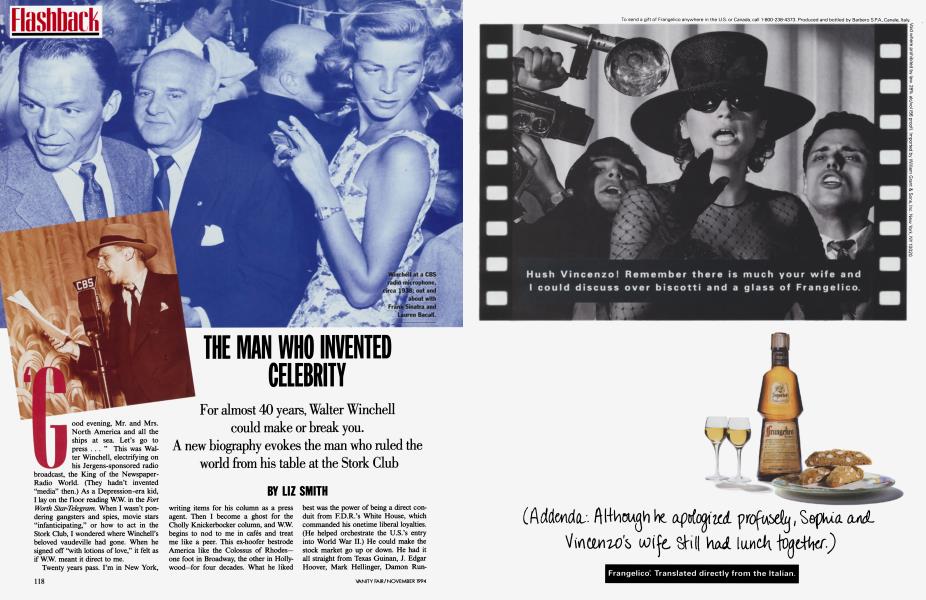
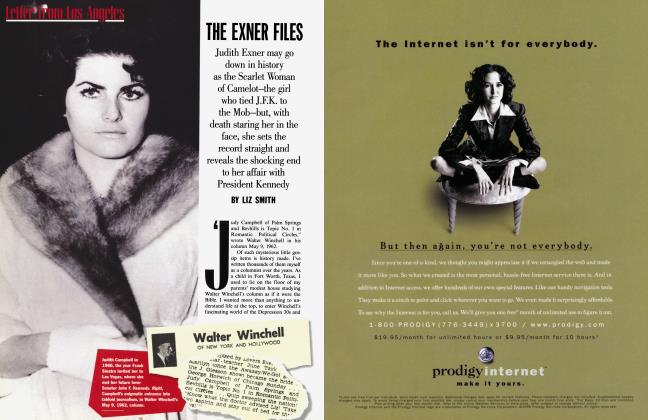
'Good evening, Mr. and Mrs. North America and all the ships at sea. Let's go to press ..." This was Walter Winchell, electrifying on his Jergens-sponsored radio broadcast, the King of the NewspaperRadio World. (They hadn't invented "media" then.) As a Depression-era kid, I lay on the floor reading W.W. in the Fort Worth Star-Telegram. When I wasn't pondering gangsters and spies, movie stars "infanticipating," or how to act in the Stork Club, I wondered where Winchell's beloved vaudeville had gone. When he signed off "with lotions of love," it felt as if W.W. meant it direct to me.
Twenty years pass. I'm in New York, writing items for his column as a press agent. Then I become a ghost for the Cholly Knickerbocker column, and W.W. begins to nod to me in cafes and treat me like a peer. This ex-hoofer bestrode America like the Colossus of Rhodes— one foot in Broadway, the other in Hollywood—for four decades. What he liked best was the power of being a direct conduit from F.D.R.'s White House, which commanded his onetime liberal loyalties. (He helped orchestrate the U.S.'s entry into World War II.) He could make the stock market go up or down. He had it all straight from Texas Guinan, J. Edgar Hoover, Mark Hellinger, Damon Runyon, et al. But in the mid-60s, after he'd lost his New York outlet, I remember W.W. roaming El Morocco at night, showing his copy to celebs who could no longer read him in their own city. He was a toothless tiger, having made all the wrong friends and enemies. By then he was a rabid conservative; he lined up against Josephine Baker, the N.A.A.C.P., Ed Sullivan, and the New York Post, and put himself on the line for Red-baiters such as Joe McCarthy and Roy Cohn.
He could make the stock market go up or down. He had it all straight from Texas Guinan, J. Edgar Hoover, Mark Hellinger, and Damon Runyon.
All this and much more is in Winchell: Gossip, Power and the Culture of Celebrity, by Neal Gabler (Knopf), soon to be a Martin Scorsese movie. (W.W. will also be found, though not by name, in the upcoming Broadway musical of Sweet Smell of Success.) Gabler hasn't missed a dot dot dot or a hot item. It's all here, in sweeping detail—including how when Bette Davis was rumored by W.W. to have cancer, a flack said, "If Bette Davis doesn't have cancer, she better get it." But it's about more than the legendary Winchell. It's about the origins of our craze for fame, notoriety, and celebrity. What Winchell sowed we now reap. He was the best and the worst in one dynamite package, having created popular tabloid journalism. And those who came after? Not one of us is fit to touch the brim of his fedora.
Subscribers have complete access to the archive.
Sign In Not a Subscriber?Join Now
