






Sign In to Your Account
Subscribers have complete access to the archive.
Sign In Not a Subscriber?Join NowGrand 'MÉDÉE'
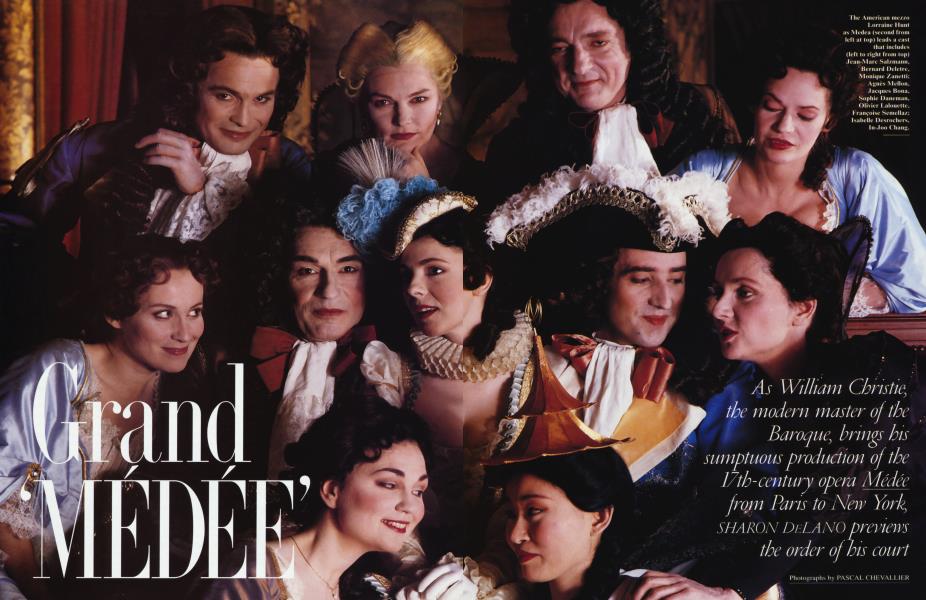
As William Christie, the modern master of the Baroque, brings his sumptuous production of the 17th-century opera Médée from Paris to New York, SHARON DELANO previews the order of his court
SHARON DELANO
"Seductive," "sensuous," "revelatory" are adjectives commonly used to describe Christie's reperioire
The pivotal dramatic scene in William Christie's new production of Medee is a Black Mass that takes place in an ingeniously lit brick antechamber somewhere in the palace of Versailles. "Your eyes will not be able to bear the horror that I shall wreak," Medea proclaims as she is about to prepare the poisoned robe that will kill her rival later, in Act V, just before she murders her own children in a mad gesture of vengeance and retribution. The sentiments are familiar from, say, Maria Callas's interpretation of Cherubini's Medea, but the context here is pure William Christie, master of the French Baroque, member of the French Legion of Honor, illustrious professor of early music at the Paris Conservatory. This Medee was composed in 1693 by Marc Antoine Charpentier for the court of Louis XIV. Before it opened in Caen last spring, Le Monde called it "the most eagerly awaited opera event of the year," and it didn't disappoint. There will be four performances this month at the Brooklyn Academy of Music, and they will undoubtedly be sold out.
"Seductive," "sensuous," "revelatory" are adjectives commonly used by bedazzled critics to describe Christie's work. He is an American, born in New York, who went to France in 1971 to work as a harpsichordist, and eight years later founded Les Arts Florissants (named after a Charpentier opera), a vocal and instrumental ensemble specializing in 17thand 18thcentury music. Les Arts Florissants has by now produced 35 recordings on the Harmonia Mundi label, is laden down with prizes and praise, and has participated in the most stunning stagings of Baroque operas anyone has ever seen (including the BAM production of Jean-Baptiste Lully's Atys). The Medee costumes and sets refer to the court of Louis XIV without being "reproductions," and the dance reconstructions are fully integrated with the vocal and dramatic performances. These are not austere period pieces. Medee is four hours long, with no dull moments.
Subscribers have complete access to the archive.
Sign In Not a Subscriber?Join Now


