

Sign In to Your Account
Subscribers have complete access to the archive.
Sign In Not a Subscriber?Join NowAs the ultimate film festival nears its half-century mark, HELMUT NEWTON turns his camera on the glamour and decadence of Cannes, while DAVID KAMP eyes the tacky, gaudy brew of starlets, art-house talent, and floating brothels
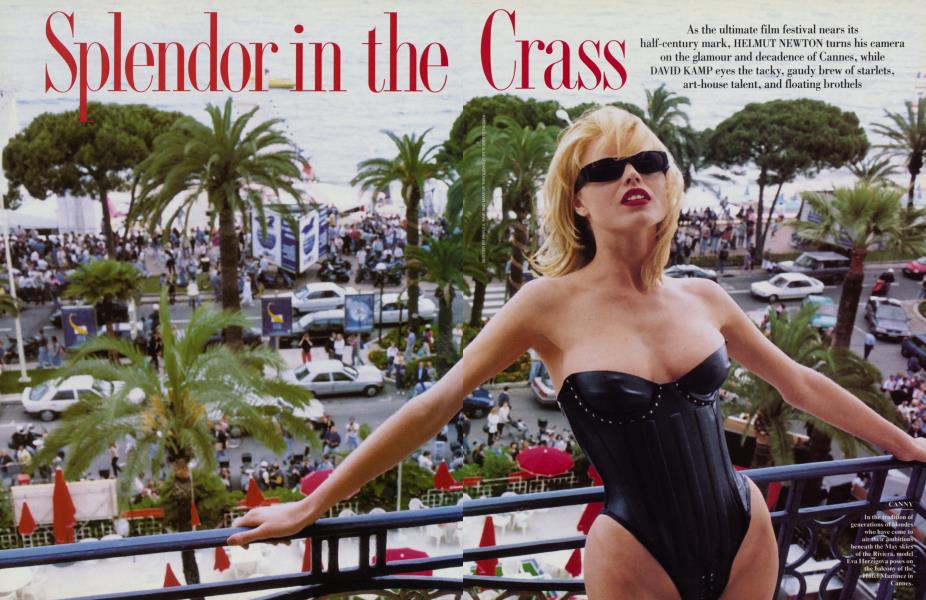
As the ultimate film festival nears its half-century mark, HELMUT NEWTON turns his camera on the glamour and decadence of Cannes, while DAVID KAMP eyes the tacky, gaudy brew of starlets, art-house talent, and floating brothels
Right from the get-go, an air of folly has permeated the International Festival of Film at Cannes. At the event's inaugural, 50 years ago, France's minister of commerce and industry stood before the assembled crowd, his mind clouded with postwar euphoria (or something), and announced with great fanfare the opening of "the first Festival ... of Agriculture!" Ever since, Cannes has had a deserved reputation for ridiculousness, what with the catty stories of jury infighting, the failure of A-list stars to materialize, the indelicate questions posed to filmmakers by the European press (Mr. Lee, why is it that so many American Negroes are criminals?), and the requisite rush of photographers toward some buxom young lovely who has begun a striptease on the Croisette, the honky-tonk spit of Cannes coast that runs along the Mediterranean.
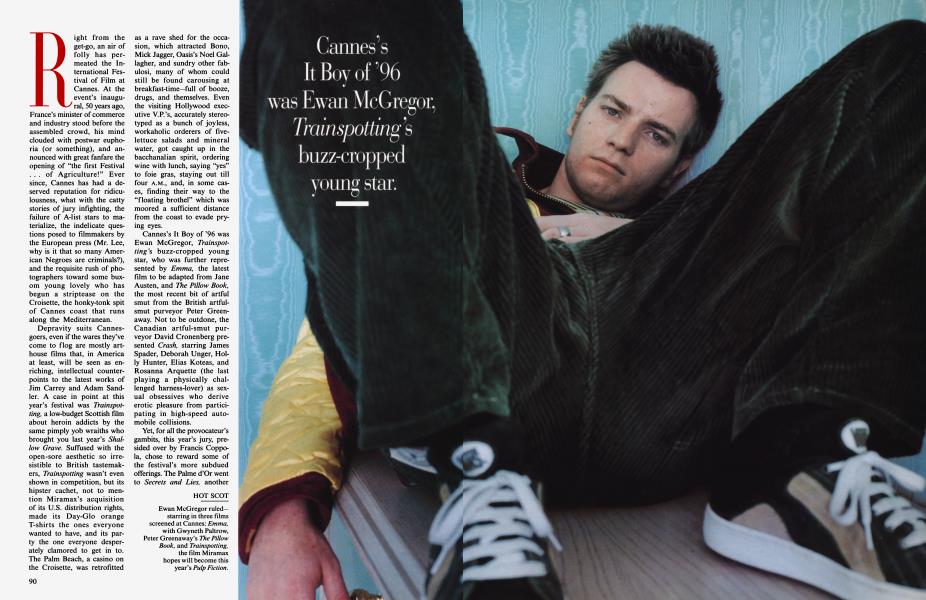
Cannes's It Boy of '96 was Ewan McGregor, Trainspotting's buzz-cropped young star.
Depravity suits Cannes-goers, even if the wares they've come to flog are mostly arthouse films that, in America at least, will be seen as enriching, intellectual counterpoints to the latest works of Jim Carrey and Adam Sandler. A case in point at this year's festival was Trainspotting, a low-budget Scottish film about heroin addicts by the same pimply yob wraiths who brought you last year's Shallow Grave. Suffused with the open-sore aesthetic so irresistible to British tastemakers, Trainspotting wasn't even shown in competition, but its hipster cachet, not to mention Miramax's acquisition of its U.S. distribution rights, made its Day-Glo orange T-shirts the ones everyone wanted to have, and its party the one everyone desperately clamored to get in to. The Palm Beach, a casino on the Croisette, was retrofitted as a rave shed for the occasion, which attracted Bono, Mick Jagger, Oasis's Noel Gallagher, and sundry other fabulosi, many of whom could still be found carousing at breakfast-time—full of booze, drugs, and themselves. Even the visiting Hollywood executive V.P.'s, accurately stereotyped as a bunch of joyless, workaholic orderers of five-lettuce salads and mineral water, got caught up in the bacchanalian spirit, ordering wine with lunch, saying "yes" to foie gras, staying out till four A.M., and, in some cases, finding their way to the "floating brothel" which was moored a sufficient distance from the coast to evade prying eyes.
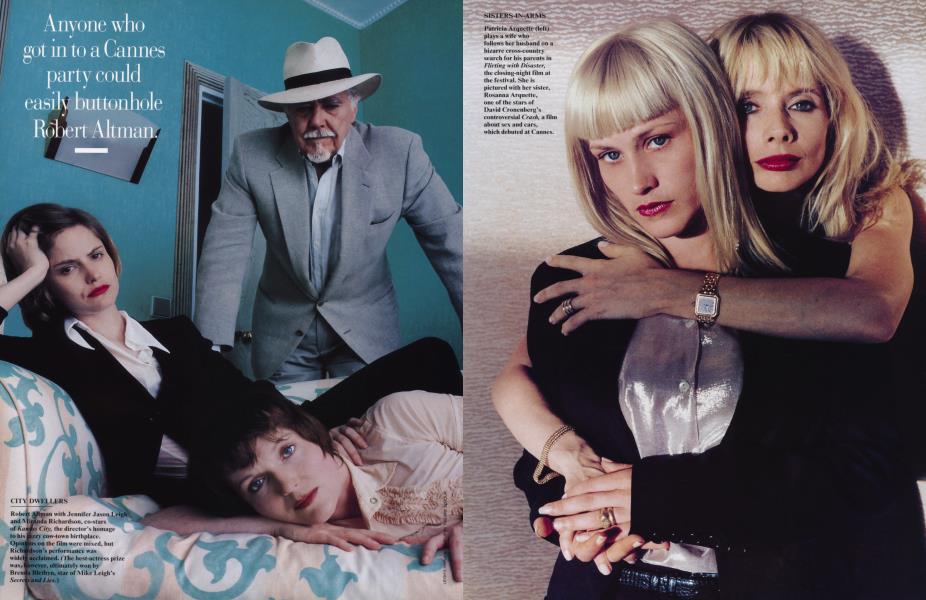
Anyone who got in to a Cannes party could easily buttonhole Robert Altman.
Cannes's It Boy of '96 was Ewan McGregor, Trainspotting's buzz-cropped young star, who was further represented by Emma, the latest film to be adapted from Jane Austen, and The Pillow Book, the most recent bit of artful smut from the British artful-smut purveyor Peter Greenaway. Not to be outdone, the Canadian artful-smut purveyor David Cronenberg presented Crash, starring James Spader, Deborah Unger, Holly Hunter, Elias Koteas, and Rosanna Arquette (the last playing a physically challenged harness-lover) as sexual obsessives who derive erotic pleasure from participating in high-speed automobile collisions.
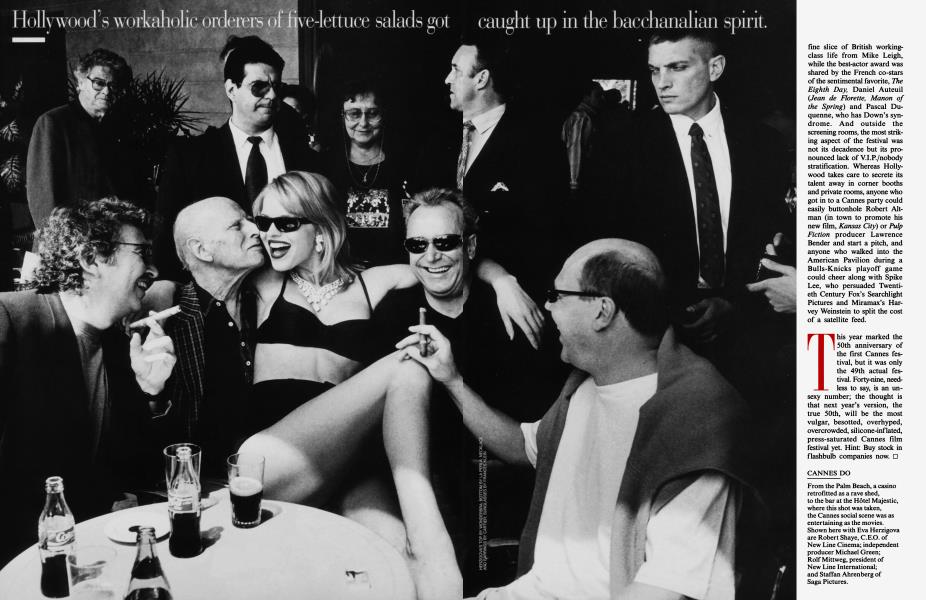
Hollywood's workaholic orderers of five-lettuce salads got caught up in the bacchanalian spirit.
Yet, for all the provocateur's gambits, this year's jury, presided over by Francis Coppola, chose to reward some of the festival's more subdued offerings. The Palme d'Or went to Secrets and Lies, another fine slice of British working-class life from Mike Leigh, while the best-actor award was shared by the French co-stars of the sentimental favorite, The Eighth Day, Daniel Auteuil (Jean de Florette, Manon of the Spring) and Pascal Duquenne, who has Down's syndrome. And outside the screening rooms, the most striking aspect of the festival was not its decadence but its pronounced lack of V.I.P./nobody stratification. Whereas Hollywood takes care to secrete its talent away in comer booths and private rooms, anyone who got in to a Cannes party could easily buttonhole Robert Altman (in town to promote his new film, Kansas City) or Pulp Fiction producer Lawrence Bender and start a pitch, and anyone who walked into the American Pavilion during a Bulls-Knicks playoff game could cheer along with Spike Lee, who persuaded Twentieth Century Fox's Searchlight Pictures and Miramax's Harvey Weinstein to split the cost of a satellite feed.
This year marked the 50th anniversary of the first Cannes festival, but it was only the 49th actual festival. Forty-nine, needless to say, is an unsexy number; the thought is that next year's version, the true 50th, will be the most vulgar, besotted, overhyped, overcrowded, silicone-inflated, press-saturated Cannes film festival yet. Hint: Buy stock in flashbulb companies now.
Subscribers have complete access to the archive.
Sign In Not a Subscriber?Join Now


