Sign In to Your Account
Subscribers have complete access to the archive.
Sign In Not a Subscriber?Join NowBorn to Be Wilde
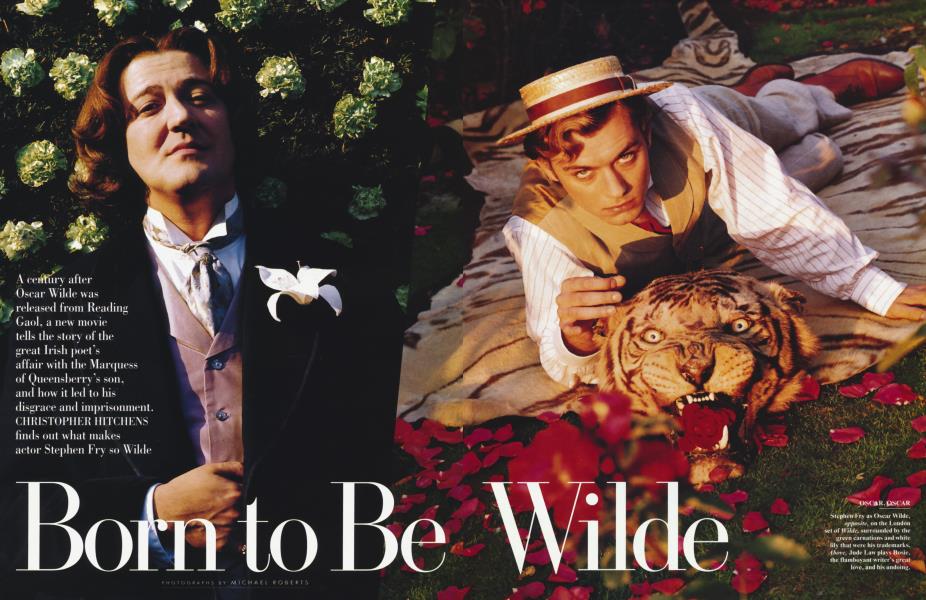
A century after Oscar Wilde was released from Reading Gaol, a new movie tells the story of the great Irish poet's affair with the Marquess of Queensberry's son, and how it led to his disgrace and imprisonment. CHRISTOPHER HITCHENS finds out what makes actor Stephen Fry so Wilde
CHRISTOPHER HITCHENS
What might it take to play Oscar Wilde on the silver screen? One would need a certain talent to amuse, combined with a certain bulk. A familiarity with the worlds of stage and scandal would not be amiss. Nor, for that matter, would a bit of informal knowledge of the gay underworld. British actor Stephen Fry first drew attention to himself as a bright young man at Cambridge, where his wit in revues took him to the Edinburgh Festival. He is not a slim chap. Indeed, a book aboiit him is called Fat Chance, by playwright Simon Gray. It tells the story of Fry's headline-making flight from the cast of one of Gray's plays and his taking refuge on the Continent. A novel under his nan%, demonstrates a deeply felt kinship with the milieu where boys go on sale.
This year is the centenary of Oscar Wilde's release from Reading Gaol. Condemned to two yeai^ of hard labor for the crime of homosexuality, he had been urged to flee for the Continent before he could be arrested, and he did flee there after he was let out. Marc and Peter Samuelson, who brought you Tom & Viv with director Brian Gilbert, have filmed Wilde using Julian Mitchell's adaptation of Richard Ellmann's biography. Vanessa Redgrave plays Oscar's mother, Jude Law plays his lover, Bosie, and Tom Wilkinson plays the young man's outraged father, the Marquess of Queensberry, who devoted himself to hounding and exposing the poet. Fry, by every account, renders the part of Oscar with bulk— and with feeling.
Subscribers have complete access to the archive.
Sign In Not a Subscriber?Join Now


