





Sign In to Your Account
Subscribers have complete access to the archive.
Sign In Not a Subscriber?Join NowCentral Casting
Brazilian director Walter Salles's New New Cinema
FOR DETAILS, SEE CREDITS PAGE
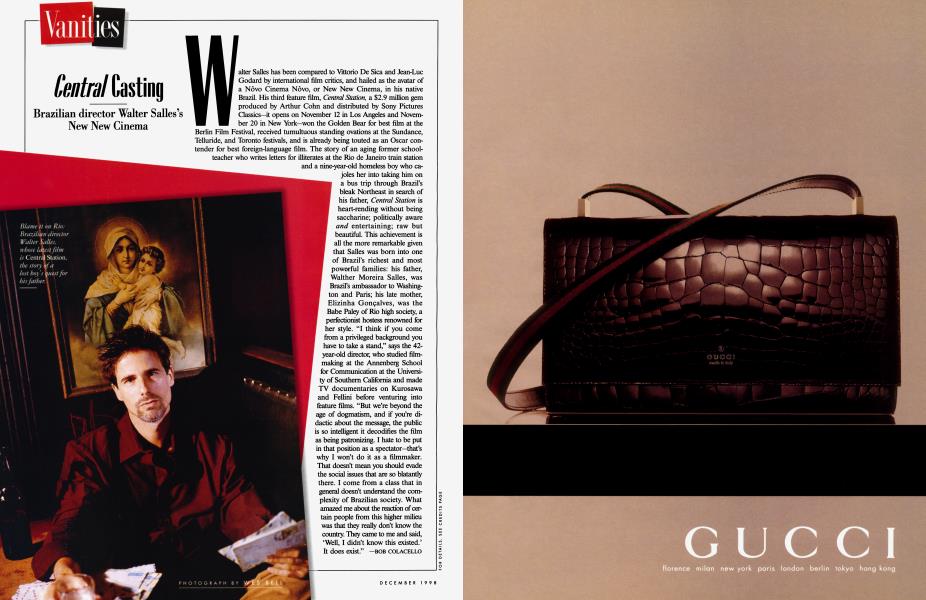
Walter Salles has been compared to Vittorio De Sica and Jean-Luc Godard by international film critics, and hailed as the avatar of a Novo Cinema Novo, or New New Cinema, in his native Brazil. His third feature film, Central Station, a $2.9 million gem produced by Arthur Cohn and distributed by Sony Pictures Classics—it opens on November 12 in Los Angeles and November 20 in New rk—won the Golden Bear for best film at the Berlin Film Festival, received tumultuous standing ovations at the Sundance, Telluride, and Toronto festivals, and is already being touted as an Oscar contender for best foreign-language film. The story of an aging former schoolteacher who writes letters for illiterates at the Rio de Janeiro train station and a nine-year-old homeless boy who cajoles her into taking him on a bus trip through Brazil's bleak Northeast in search of his father, Central Station is heart-rending without being saccharine; politically aware and entertaining; raw but beautiful. This achievement is all the more remarkable given that Salles was bom into one of Brazil's richest and most powerful families: his father, Walther Moreira Salles, was Brazil's ambassador to Washington and Paris; his late mother, Elizinha Gonsalves, was the Babe Paley of Rio high society, a perfectionist hostess renowned for her style. "I think if you come from a privileged background you have to take a stand," says the 42year-old director, who studied filmmaking at the Annenberg School for Communication at the University of Southern California and made TV documentaries on Kurosawa and Fellini before venturing into feature films. "But we're beyond the age of dogmatism, and if you're didactic about the message, the public is so intelligent it decodifies the film as being patronizing. I hate to be put in that position as a spectator—that's why I won't do it as a filmmaker. That doesn't mean you should evade the social issues that are so blatantly there. I come from a class that in general doesn't understand the complexity of Brazilian society. What amazed me about the reaction of certain people from this higher milieu was that they really don't know the country. They came to me and said, 'Well, I didn't know this existed.' It does exist."
BOB COLACELLO
Subscribers have complete access to the archive.
Sign In Not a Subscriber?Join Now